
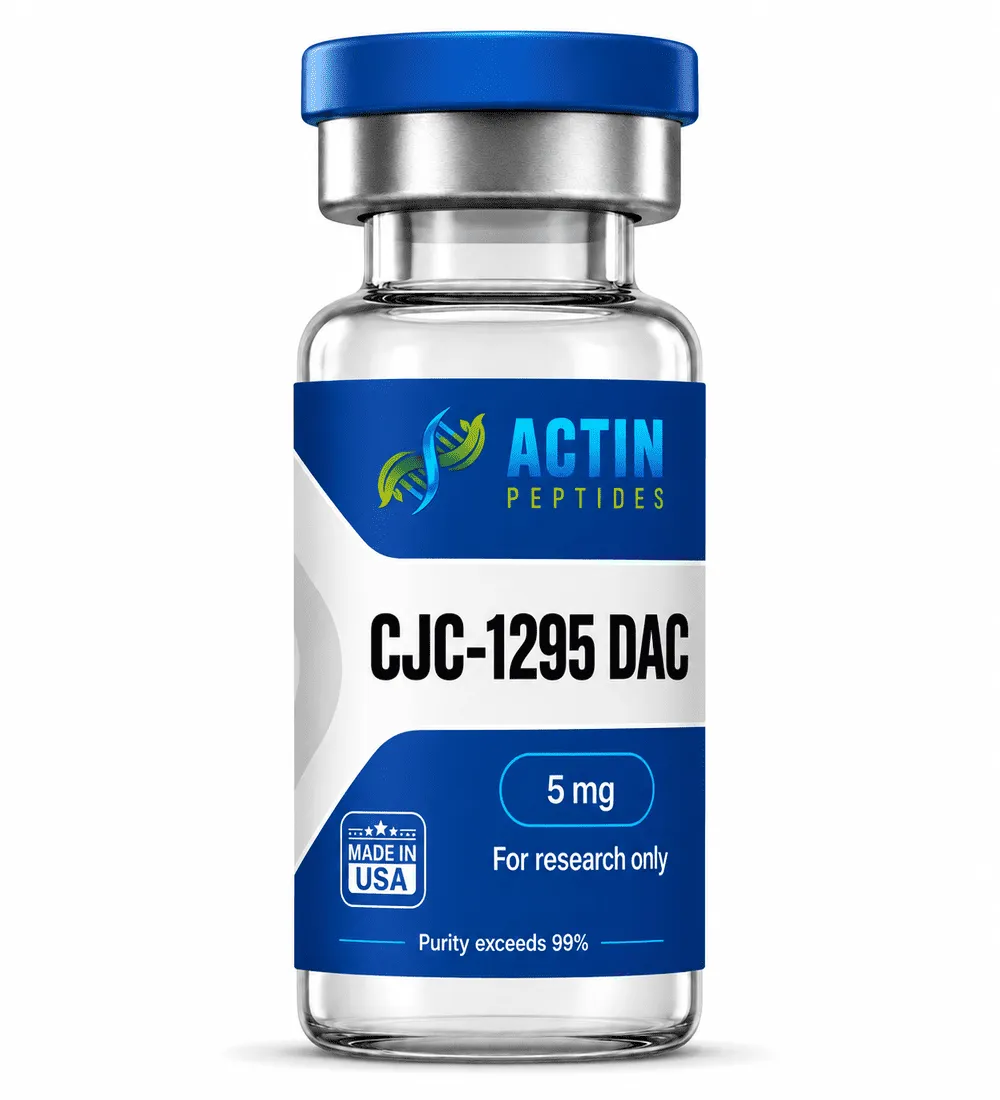
Description
CJC-1295 DAC Peptide: GHRH Analog Research, Mechanism, and Half-Life
Introduction
CJC-1295 DAC peptide is a synthetic 29-amino-acid analog of growth hormone-releasing hormone (GHRH) that scientists have studied for its ability to interact with GHRH receptors and influence growth hormone (GH) signaling. The addition of the Drug Affinity Complex (DAC) distinguishes this version from CJC-1295 without DAC and was designed to substantially extend peptide stability and circulating half-life.
Research on CJC-1295 DAC has primarily examined its relationship with the GHRH receptor, growth hormone secretion, insulin-like growth factor-1 (IGF-1), and related cellular signaling pathways. Studies have also investigated its pharmacokinetic characteristics and its effects in experimental models involving growth hormone deficiency and body composition.
For researchers comparing different growth-hormone-related compounds, CJC-1295 DAC can be considered alongside other GHRH-related research peptides, including Sermorelin peptide, as well as research involving GHRH and growth-factor signaling.
Important: Research findings involving CJC-1295 DAC should not be interpreted as evidence of therapeutic efficacy or human-use safety.
What Is CJC-1295 DAC Peptide?
CJC-1295 DAC is a synthetic, long-acting analog of GHRH consisting of 29 amino acids. Researchers developed structural modifications to the GHRH sequence to improve stability, while the Drug Affinity Complex (DAC) component further extends its pharmacokinetic profile.
Unlike naturally occurring GHRH, which has a very short circulating half-life, CJC-1295 DAC has been investigated for substantially longer activity in experimental settings.
Key characteristics
- Peptide type: Synthetic GHRH analog
- Length: 29 amino acids
- Primary research target: GHRH receptor
- Major signaling relationship: Growth hormone and IGF-1
- Distinguishing feature: Drug Affinity Complex (DAC)
- Research areas: GH signaling, IGF-1 signaling, peptide pharmacokinetics, and growth-related cellular pathways
CJC-1295 DAC Overview
CJC-1295 DAC is also described in scientific literature using names such as:
- CJC-1295 with DAC
- CJC-1295 DAC
- DAC:GRF
- Long-acting GHRH analog
- Synthetic GHRH analog
- Tetrasubstituted GRF 1-29 with DAC
The peptide represents a modified version of the functional 1–29 region of GHRH. Researchers substituted four amino acids within the sequence and incorporated the DAC component to improve stability and prolong the compound’s pharmacokinetic profile.
The resulting molecule retains affinity for the GHRH receptor while exhibiting a substantially longer reported half-life than native GHRH.
How Does CJC-1295 DAC Work?
CJC-1295 DAC mechanism research centers on its interaction with GHRH receptors on pituitary somatotroph cells. Receptor activation can initiate intracellular signaling involving G-proteins, cyclic adenosine monophosphate (cAMP), protein kinases, and transcriptional regulation associated with GH production.
GHRH Receptor Interaction
The GHRH receptor belongs to the G-protein-coupled receptor family. When a GHRH analog interacts with this receptor, researchers propose that it can activate intracellular signaling cascades that influence GH secretion from somatotroph cells in the pituitary.
The process can be summarized as:
CJC-1295 DAC → GHRH receptor → G-protein signaling → cAMP-related signaling → protein kinase activation → GH-related gene expression
This pathway provides the primary mechanistic basis for CJC-1295 DAC research.
Growth Hormone and IGF-1 Signaling
Growth hormone can subsequently interact with GH receptors in target tissues. Researchers associate this interaction with downstream activation of signaling systems that include the Janus kinase/signal transducer and activator of transcription (JAK-STAT) pathway.
One proposed downstream consequence involves stimulation of IGF-1 production, particularly in the liver.
The resulting research model can therefore be represented as:
CJC-1295 DAC → GHRH receptor → GH signaling → GH receptor → JAK-STAT signaling → IGF-1 expression
IGF-1 is an important growth factor involved in cellular growth, proliferation, protein synthesis, and tissue development. However, the presence of a biological pathway does not establish that CJC-1295 DAC produces a specific clinical outcome.
CJC-1295 DAC and Growth Hormone Signaling
Scientists have investigated whether CJC-1295 DAC can alter circulating GH and IGF-1 concentrations in experimental and clinical research settings.
Two studies conducted in 2006 evaluated different administration patterns and concentrations. According to the reported findings, exposure to CJC-1295 DAC was associated with increases in GH and IGF-1 measurements.
Research models showed that:
- GH concentrations increased following peptide exposure.
- IGF-1 concentrations also increased.
- Repeated exposure produced prolonged changes in IGF-1 measurements.
- The response varied according to exposure pattern and concentration.
These findings established CJC-1295 DAC as a compound of interest for researchers studying long-acting GHRH analogs and endocrine signaling.
CJC-1295 DAC and GHRH Receptor Signaling
Researchers propose that the peptide interacts with binding sites on the GHRH receptor, producing conformational changes that initiate intracellular signaling.
Following receptor activation, G-proteins may stimulate secondary messengers such as cyclic adenosine monophosphate (cAMP) and, depending on the cellular context, other signaling molecules.
Protein kinases activated downstream of these messenger systems can phosphorylate transcription-regulating proteins. These transcription factors may then influence gene expression associated with GH production within pituitary somatotroph cells.
This receptor-to-gene signaling cascade represents an important area of CJC-1295 research.
CJC-1295 DAC and IGF-1 Research
IGF-1, or insulin-like growth factor-1, is a peptide growth factor associated with numerous biological processes, including cellular proliferation, protein synthesis, and tissue growth.
Research involving CJC-1295 DAC suggests that increasing GH signaling can subsequently influence IGF-1 concentrations.
Studies have reported increases in IGF-1 following exposure to the peptide, with some experimental observations indicating that elevated IGF-1 measurements persisted beyond the initial GH response.
This relationship makes the compound relevant to researchers investigating the GHRH-GH-IGF-1 axis.
Chemical Makeup of CJC-1295 DAC
| Property | Details |
|---|---|
| Molecular Formula | C152H252N44O42 |
| Molecular Weight | 3367.95 g/mol |
| Peptide Length | 29 amino acids |
| Classification | Synthetic GHRH analog |
| Other Known Title | Tetrasubstituted GRF 1-29 with DAC |
| Key Modification | Drug Affinity Complex (DAC) |
CJC-1295 DAC Half-Life and Pharmacokinetics
One of the defining characteristics of CJC-1295 DAC is its extended pharmacokinetic profile.
Native GHRH has a very short circulating half-life. Researchers developed modified GHRH analogs to increase resistance to enzymatic degradation and improve stability.
Four amino-acid substitutions
CJC-1295 incorporates substitutions at four positions of the original GHRH sequence:
- Position 2: L-alanine → D-alanine
- Position 8: Asparagine → glutamine
- Position 15: Glycine → alanine
- Position 27: Methionine → leucine
These modifications were designed to improve peptide stability and reduce susceptibility to enzymatic degradation.
The role of DAC
The Drug Affinity Complex further distinguishes this compound from CJC-1295 without DAC.
The DAC component incorporates a modified lysine derivative that can interact with plasma proteins. This interaction has been investigated as a mechanism for extending the peptide’s circulation time.
Research has reported a half-life of approximately 6–8 days for CJC-1295 DAC, although pharmacokinetic characteristics can vary according to experimental conditions.
CJC-1295 DAC vs. CJC-1295 Without DAC
The two compounds share a GHRH-related structure but differ substantially in pharmacokinetic behavior.
| Characteristic | CJC-1295 DAC | CJC-1295 Without DAC |
|---|---|---|
| GHRH analog | Yes | Yes |
| 29-amino-acid structure | Yes | Yes |
| DAC component | Yes | No |
| Research focus | Long-acting GHRH signaling | Shorter-acting GHRH signaling |
| Reported half-life | Approximately 6–8 days | Approximately 30 minutes |
| Primary research target | GHRH receptor | GHRH receptor |
Researchers continue to study both forms because their different pharmacokinetic profiles can provide useful models for investigating pulsatile versus prolonged GHRH signaling.
CJC-1295 DAC Research and Clinical Studies
1. Human Research on GH and IGF-1 Response
Study objective:
Researchers investigated whether CJC-1295 DAC could influence GH and IGF-1 concentrations.
Methodology:
Two 2006 studies evaluated different concentrations and repeated exposure patterns.
Findings:
Researchers reported increases in GH and IGF-1 following exposure to the peptide. Some measurements remained elevated for extended periods following exposure.
Scientific significance:
The findings contributed to research into long-acting GHRH analogs and demonstrated the potential for sustained modulation of the GH/IGF-1 axis.
2. Research on GH Pulsatility
Study objective:
Researchers examined whether CJC-1295 DAC influenced GH secretion patterns following exposure.
Methodology:
Experimental measurements compared GH secretion before and after peptide exposure.
Findings:
The study reported an increase in mean GH secretion and IGF-1 measurements following exposure. Researchers also reported increases in peak GH concentrations.
Scientific significance:
These findings provide additional evidence that CJC-1295 DAC can interact with physiological GH signaling mechanisms.
3. Animal Research on Growth and Body Composition
Study objective:
Researchers investigated the effects of CJC-1295 DAC in growth-hormone-deficient animal models.
Methodology:
Models with disrupted GHRH signaling received different exposure schedules of CJC-1295 DAC or placebo.
Findings:
Researchers reported normalization of growth in some experimental groups. They also observed changes in lean tissue and fat-related measurements.
The study additionally reported increased pituitary RNA and GH messenger RNA (mRNA), findings that researchers interpreted as evidence of altered somatotroph-related activity.
Scientific significance:
This research provides a model for studying how long-acting GHRH analogs may influence GH-related signaling in conditions involving impaired GHRH activity.
4. Pharmacokinetic Research
Study objective:
Researchers sought to improve the stability and circulating duration of GHRH analogs.
Methodology:
Scientists modified the original GHRH sequence and incorporated the DAC technology.
Findings:
The resulting compound demonstrated substantially longer reported activity than native GHRH.
Scientific significance:
The DAC modification represents an important pharmacokinetic development in long-acting peptide research.
5. Ancillary Research
Researchers have also investigated CJC-1295 DAC in other experimental contexts, including research involving HIV-associated visceral obesity.
However, one 2005 clinical study was terminated during recruitment, and related results were not published. Therefore, this study does not provide usable efficacy evidence.
A separate 2009 analytical study from Norwegian researchers identified CJC-1295 DAC as a growth-hormone-releasing factor during substance analysis.
What Is CJC-1295 DAC Researched For?
CJC-1295 DAC has primarily been researched in connection with:
- GHRH receptor signaling
- Growth hormone secretion
- IGF-1 signaling
- Pituitary somatotroph activity
- Peptide pharmacokinetics
- Long-acting GHRH analog development
- Growth-related cellular signaling
- Experimental body-composition research
These areas represent research applications rather than established medical uses.
What Makes CJC-1295 DAC Unique?
The defining feature of CJC-1295 DAC is its Drug Affinity Complex, which was designed to extend the compound’s pharmacokinetic profile.
Unlike shorter-acting GHRH analogs, the DAC modification enables the peptide to interact with plasma proteins, contributing to its reported multi-day half-life.
This makes CJC-1295 DAC particularly relevant to researchers studying prolonged GHRH receptor activation and the downstream GH/IGF-1 signaling axis.
Related Peptide Research at Actin Peptides
Researchers exploring the GHRH and growth-factor signaling landscape may also examine related compounds.
For example, Sermorelin peptide represents another GHRH-related research compound. Researchers may also investigate IGF-1 LR3 when studying downstream growth-factor signaling.
For studies involving complementary GHRH and ghrelin-receptor pathways, researchers may also examine CJC-1295 without DAC in combination with Ipamorelin where appropriate for their laboratory model.
CJC-1295 DAC Research Summary
| Research Area | What Studies Investigate |
|---|---|
| GHRH receptor | Receptor activation and intracellular signaling |
| Growth hormone | Changes in GH secretion and pulsatility |
| IGF-1 | Downstream growth-factor signaling |
| Pharmacokinetics | Stability and prolonged circulation |
| Pituitary signaling | Somatotroph-related activity |
| Animal growth models | Growth and body-composition changes |
| Molecular signaling | cAMP, G-protein, kinase, and transcription pathways |
Frequently Asked Questions
What is CJC-1295 DAC peptide?
CJC-1295 DAC is a synthetic 29-amino-acid analog of GHRH that researchers study for its interaction with GHRH receptors and its influence on GH and IGF-1 signaling. The DAC component distinguishes it from shorter-acting CJC-1295 formulations.
How does CJC-1295 DAC work?
Research suggests that CJC-1295 DAC interacts with GHRH receptors on pituitary somatotroph cells, activating intracellular signaling pathways associated with GH secretion. Downstream GH signaling may subsequently influence IGF-1 production.
What is CJC-1295 DAC researched for?
CJC-1295 DAC research primarily examines growth hormone signaling, IGF-1 regulation, GHRH receptor activity, peptide pharmacokinetics, and long-acting GHRH analog development.
What is the difference between CJC-1295 DAC and CJC-1295 without DAC?
The primary distinction is the Drug Affinity Complex. CJC-1295 DAC has been engineered for a substantially longer reported half-life, while CJC-1295 without DAC has a considerably shorter pharmacokinetic profile.
How long is the reported half-life of CJC-1295 DAC?
Research has reported a half-life of approximately 6–8 days for CJC-1295 DAC. Pharmacokinetic measurements can vary according to the experimental model and study conditions.
Is CJC-1295 DAC FDA approved?
This product should not be represented as FDA-approved. Actin Peptides markets its peptide products for research and laboratory purposes rather than as approved medicines.
Conclusion
CJC-1295 DAC remains an important research compound for scientists investigating GHRH receptor biology, growth hormone signaling, IGF-1 pathways, and long-acting peptide pharmacokinetics.
The compound combines a modified 29-amino-acid GHRH analog with a Drug Affinity Complex designed to extend its circulating duration. Research has reported effects on GH and IGF-1 measurements, while animal studies have explored its relationship with growth, lean tissue, and pituitary signaling.
However, these findings should remain within their appropriate scientific context. Experimental and clinical research does not establish CJC-1295 DAC as a treatment, nor does it establish safety or efficacy for human use.
Research Disclaimer
CJC-1295 DAC peptide is available strictly for research and laboratory purposes only. It is not approved for human consumption, therapeutic use, or diagnostic applications. Please review our Terms and Conditions before placing an order.
 English
Reviews
There are no reviews yet.