
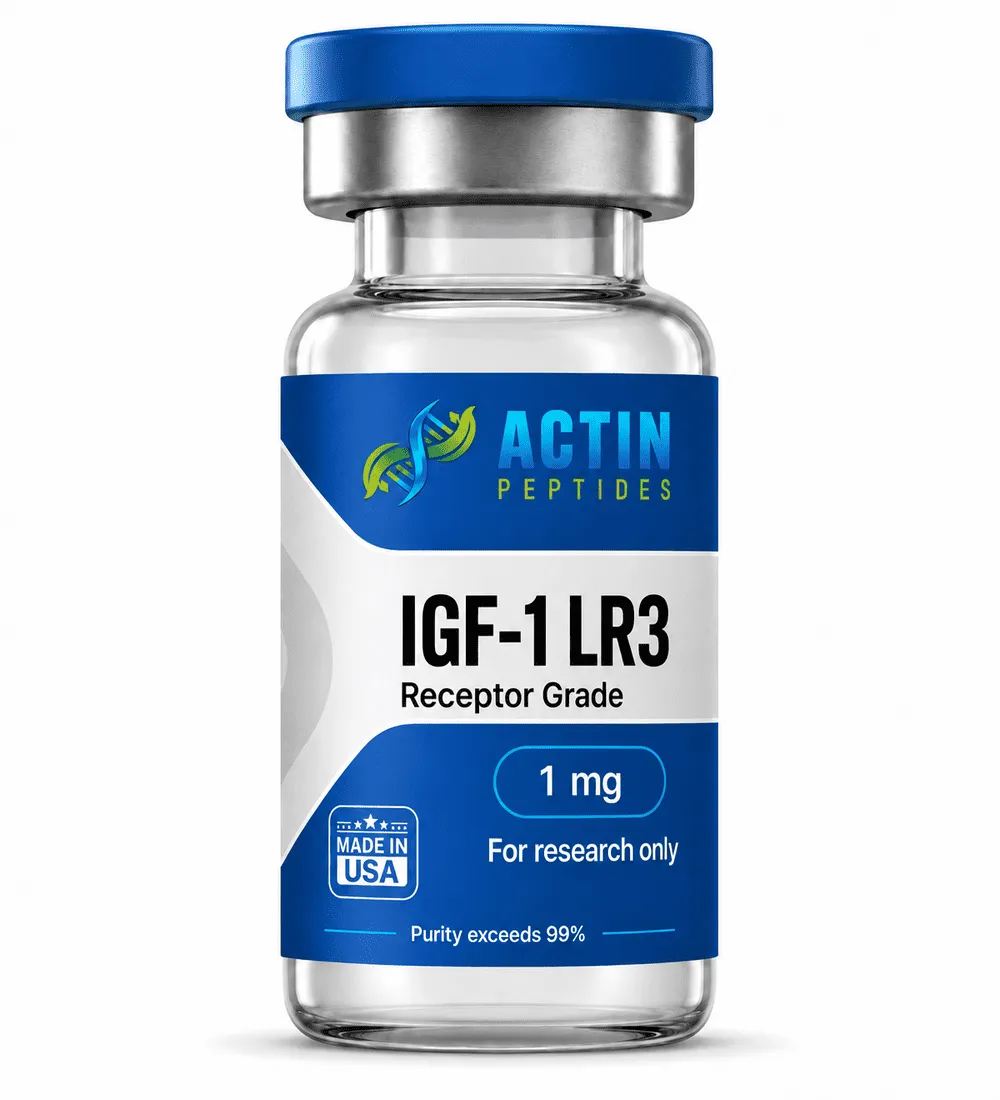
Description
Receptor Grade IGF-1 LR3 Peptide: Research, Mechanism, and Cellular Signaling
Introduction
Receptor Grade IGF-1 LR3 peptide is a synthetic analog of insulin-like growth factor-1 (IGF-1) that researchers have developed for laboratory studies involving cellular growth, metabolism, protein synthesis, and receptor-mediated signaling. Also known as Long R3 IGF-1, IGF-1 LR3, or Long-(Arg3) insulin-like growth factor-I, this modified peptide differs structurally from native IGF-1 through an extended N-terminal sequence and an arginine substitution at position 3.
IGF-1 is a naturally occurring 70-amino-acid peptide associated with growth-factor signaling. By comparison, IGF-1 LR3 contains 83 amino acids. Researchers have investigated this structural modification because it may alter the peptide’s interaction with IGF-binding proteins (IGFBPs) and consequently influence its availability in experimental systems.
At Actin Peptides, Receptor Grade IGF-1 LR3 research is presented strictly within a laboratory and scientific context. It is particularly relevant to research involving growth-factor signaling, cellular metabolism, receptor interactions, and anabolic signaling pathways.
What Is Receptor Grade IGF-1 LR3?
Receptor Grade IGF-1 LR3 is a modified 83-amino-acid analog of IGF-1 designed for receptor-focused laboratory research. Its structural differences from native IGF-1 may reduce its interaction with certain IGF-binding proteins, making it useful for investigating IGF-related signaling in experimental models.
The peptide emerged from research into somatomedins and insulin-like growth factors. Scientists originally identified serum factors associated with growth hormone activity and later characterized them as insulin-like growth factors.
Researchers subsequently developed modified IGF-1 analogs to investigate how structural changes affect receptor interactions, bioavailability, and biological signaling.
Receptor Grade IGF-1 LR3 Overview
Native IGF-1 contains 70 amino acids. IGF-1 LR3 contains an additional N-terminal sequence and an arginine substitution at residue 3, resulting in an 83-amino-acid structure.
These modifications are important because IGF-binding proteins can regulate the availability and distribution of IGF molecules.
Research suggests that IGF-1 LR3 may interact differently with IGFBPs than native IGF-1. Consequently, scientists have investigated whether these structural characteristics alter tissue distribution and receptor-mediated signaling in experimental models.
Key characteristics
- Peptide class: Modified insulin-like growth factor analog
- Native counterpart: IGF-1
- Length: 83 amino acids
- Native IGF-1 length: 70 amino acids
- Structural modification: Extended N-terminal region and Arg3 substitution
- Primary research areas: Growth-factor signaling, cellular metabolism, receptor biology, and anabolic signaling
- Research status: Preclinical and laboratory research
Receptor Grade IGF-1 LR3 Mechanism of Action
IGF-1 Receptor Signaling
The IGF-1 LR3 mechanism centers on research into insulin-like growth factor signaling. IGF-1 normally interacts with the insulin-like growth factor-1 receptor (IGF-1R), a receptor tyrosine kinase located on the surface of many cell types.
Activation of IGF-1R can initiate intracellular signaling cascades associated with:
- Cell growth
- Cellular survival
- Protein synthesis
- Glucose utilization
- Cellular differentiation
- Metabolic regulation
Researchers have investigated whether IGF-1 LR3 can engage similar signaling systems while exhibiting altered interactions with IGF-binding proteins.
IGF-Binding Proteins and Bioavailability
IGF-binding proteins (IGFBPs) regulate the availability and distribution of IGF molecules within biological systems.
Research suggests that the structural modifications incorporated into IGF-1 LR3 reduce its binding to some IGFBPs. This characteristic has attracted scientific interest because altered IGFBP interaction may change the peptide’s distribution and receptor availability in experimental systems.
Animal research has examined the distribution of IGF-1 LR3 following exposure and detected the peptide in organs including the kidneys, ovaries, and adrenal glands.
However, tissue distribution observed in animal models does not establish equivalent behavior in humans.
PI3K-Akt Signaling
One major signaling pathway associated with IGF research is the phosphoinositide 3-kinase (PI3K)-Akt pathway.
When growth-factor receptors activate PI3K, downstream Akt signaling can influence several cellular processes, including:
- Cell survival
- Protein synthesis
- Glucose transport
- Cellular metabolism
- Growth-related signaling
Researchers have therefore investigated IGF-1 analogs in experimental models to understand how modified IGF signaling may influence these intracellular processes.
AMPK and Cellular Metabolism
The AMP-activated protein kinase (AMPK) pathway acts as an important cellular energy sensor.
Research has explored potential relationships between IGF-related signaling, PI3K-Akt activity, and AMPK-associated metabolic regulation. These pathways can influence glucose transport and energy utilization within cells.
Because IGF signaling intersects with metabolic pathways, IGF-1 LR3 has been investigated as a research tool for studying these relationships.
Autocrine and Paracrine Signaling
Growth-factor signaling can occur through both autocrine and paracrine mechanisms.
- Autocrine signaling: A cell produces a signaling molecule that acts on the same cell.
- Paracrine signaling: A signaling molecule influences nearby cells.
Researchers have proposed that altered IGF-1 availability could influence these signaling patterns in experimental tissue models.
Chemical Makeup of Receptor Grade IGF-1 LR3
| Property | Details |
|---|---|
| Molecular Formula | C400H625N111O115S9 |
| Molecular Weight | 9,117.5 g/mol |
| Peptide Length | 83 amino acids |
| Native IGF-1 Length | 70 amino acids |
| Other Known Titles | Long-(Arg3) insulin-like growth factor-I; Insulin-like growth factor long chain R3 |
| Peptide Type | Modified IGF-1 analog |
The extended structure and Arg3 substitution distinguish IGF-1 LR3 from native IGF-1 and form the basis for much of the research surrounding its receptor interactions and IGFBP binding characteristics.
Receptor Grade IGF-1 LR3 Research and Studies
IGF-1 LR3 and Tissue Anabolism
Study Objective
Researchers have investigated IGF-1 LR3 to understand how structural modifications to IGF-1 might influence anabolic signaling and tissue growth in experimental models.
Methodology
One study compared IGF-1 LR3 with native IGF-1 in normal and dexamethasone-induced catabolic animal models. Researchers examined parameters associated with anabolic activity, including body weight, organ weight, feed efficiency, and markers of protein degradation.
Findings
The researchers reported stronger effects from IGF-1 LR3 than native IGF-1 under certain experimental conditions. The study also reported changes in Nτ-methylhistidine excretion, a marker researchers use to investigate muscle protein degradation.
Scientific Significance
These findings have contributed to interest in IGF-1 LR3 as a laboratory model for studying growth-factor signaling and protein metabolism.
Importantly, these findings come from experimental models and should not be interpreted as evidence of equivalent effects in humans.
IGF-1 LR3 and Growth-Factor Research
IGF-1 research has historically focused on the relationship between growth hormone (GH), IGF-1, and cellular growth.
Researchers have developed recombinant and modified IGF-1 compounds to investigate these relationships under controlled experimental conditions.
One example is recombinant human IGF-1 (rhIGF-1), which has been studied in experimental models involving IGF-1 deficiency and growth-related disorders. These studies provide broader context for understanding IGF signaling but should not be interpreted as direct evidence for the activity of IGF-1 LR3.
For researchers investigating growth-factor signaling, related compounds such as MGF provide additional models for examining peptide-mediated cellular signaling.
IGF-1 LR3 and Metabolic Signaling
Study Objective
Scientists have investigated whether IGF-related compounds influence glucose uptake and cellular energy metabolism.
Mechanistic Research
Studies have focused on signaling networks involving:
- IGF-1 receptors
- PI3K
- Akt
- AMPK
- GLUT4
PI3K-Akt signaling can influence the movement of glucose transporters toward the cell membrane, while AMPK functions as an energy-sensing pathway.
Scientific Significance
These observations make IGF-related peptides relevant to laboratory research examining the relationship between growth-factor signaling and cellular metabolism.
However, laboratory findings do not establish that IGF-1 LR3 produces a particular metabolic outcome in humans.
IGF-1 LR3 and Muscle Research
Researchers have also examined IGF-1 analogs in relation to muscle-cell signaling.
One experimental study involving female mice investigated whether IGF-1 analogs, including IGF-1 LR3, could influence myostatin-related signaling.
Myostatin is a growth-regulatory protein involved in skeletal muscle development and differentiation. Scientists study myostatin because changes in its signaling can alter experimental models of muscle-cell growth.
The research suggested that IGF-1 analogs could influence pathways associated with muscle-cell survival and differentiation.
These findings contribute to the broader field of IGF-1 LR3 muscle research, although they remain experimental and do not establish human performance or muscle-growth effects.
For researchers examining related growth-factor systems, Actin Peptides also provides MGF research material and Follistatin-344 as additional research compounds with distinct molecular targets.
What Are the Potential Research Applications of IGF-1 LR3?
Current research interests surrounding IGF-1 LR3 include:
- IGF-1 receptor signaling
- Growth-factor biology
- Cellular proliferation
- Protein metabolism
- Glucose uptake
- PI3K-Akt signaling
- AMPK-related metabolism
- Muscle-cell signaling
- Myostatin research
- Autocrine and paracrine signaling
- IGF-binding protein interactions
These applications describe research areas, rather than established medical uses.
What Makes Receptor Grade IGF-1 LR3 Unique?
IGF-1 LR3 differs from native IGF-1 because researchers modified its molecular structure by extending the N-terminal region and replacing the amino acid at position 3 with arginine.
These changes may alter its interaction with IGF-binding proteins and influence how researchers can study IGF-mediated signaling in laboratory systems.
The Receptor Grade designation refers to the material’s intended research-grade purity classification and should not be interpreted as evidence of regulatory approval or clinical suitability.
Receptor Grade IGF-1 LR3 vs. Native IGF-1
| Characteristic | Native IGF-1 | IGF-1 LR3 |
|---|---|---|
| Amino acids | 70 | 83 |
| N-terminal extension | No | Yes |
| Arg3 modification | No | Yes |
| IGFBP interaction | Stronger | Altered/reduced in research |
| Research focus | Natural growth-factor signaling | Modified IGF signaling |
| Application | Biological and laboratory research | Primarily laboratory research |
Frequently Asked Questions
What is Receptor Grade IGF-1 LR3?
Receptor Grade IGF-1 LR3 is an 83-amino-acid synthetic analog of IGF-1. Researchers study it to investigate IGF receptor signaling, IGF-binding protein interactions, cellular metabolism, protein synthesis, and growth-factor biology.
How does IGF-1 LR3 work?
Research suggests that IGF-1 LR3 may interact with IGF-related signaling systems involving IGF-1 receptors and downstream pathways such as PI3K-Akt. Its structural modifications may also alter interactions with IGF-binding proteins.
What is IGF-1 LR3 researched for?
IGF-1 LR3 research includes growth-factor signaling, cellular metabolism, protein metabolism, muscle-cell signaling, receptor biology, and IGFBP interactions.
What is the difference between IGF-1 and IGF-1 LR3?
Native IGF-1 contains 70 amino acids, whereas IGF-1 LR3 contains 83. IGF-1 LR3 incorporates an extended N-terminal sequence and an arginine substitution at position 3.
Is IGF-1 LR3 approved for human use?
This research-grade product is not presented as an FDA-approved medication or as a product intended for human consumption. Its use on this page is limited to laboratory and research applications.
Where can researchers buy IGF-1 LR3?
Researchers seeking IGF-1 LR3 peptide for sale should evaluate product identity, purity documentation, analytical testing, storage information, and supplier transparency before purchasing research materials. Actin Peptides provides Receptor Grade IGF-1 LR3 as a research and laboratory product.
Related Peptide Research
Researchers exploring IGF-1 LR3 may also investigate other compounds associated with growth-factor, cellular signaling, and metabolic research.
Relevant Actin Peptides research products include:
- MGF Peptide — research involving growth-factor and muscle-cell signaling
- Follistatin-344 — research involving myostatin-related pathways
- ACE-031 — research involving activin receptor signaling
- AOD-9604 — research involving growth-hormone-derived peptide signaling
- MOTS-C — research involving cellular metabolism and mitochondrial signaling
These compounds have different structures and biological targets, so they should not be considered interchangeable with IGF-1 LR3.
Conclusion
Receptor Grade IGF-1 LR3 peptide is a modified IGF-1 analog that researchers study because its extended N-terminal structure and Arg3 substitution may alter IGF-binding protein interactions and growth-factor signaling.
Research has explored its potential role in IGF-1 receptor signaling, PI3K-Akt pathways, glucose metabolism, protein metabolism, muscle-cell biology, and myostatin-related research. Experimental models have generated findings of scientific interest, but the available evidence remains primarily preclinical.
For this reason, IGF-1 LR3 should be discussed in terms of research applications and molecular mechanisms rather than established therapeutic effects.
Research Disclaimer
Receptor Grade IGF-1 LR3 peptide is available strictly for research and laboratory purposes only. It is not approved for human consumption, therapeutic use, or diagnostic applications. Please review our Terms and Conditions before placing an order.
 English
Reviews
There are no reviews yet.