
Description
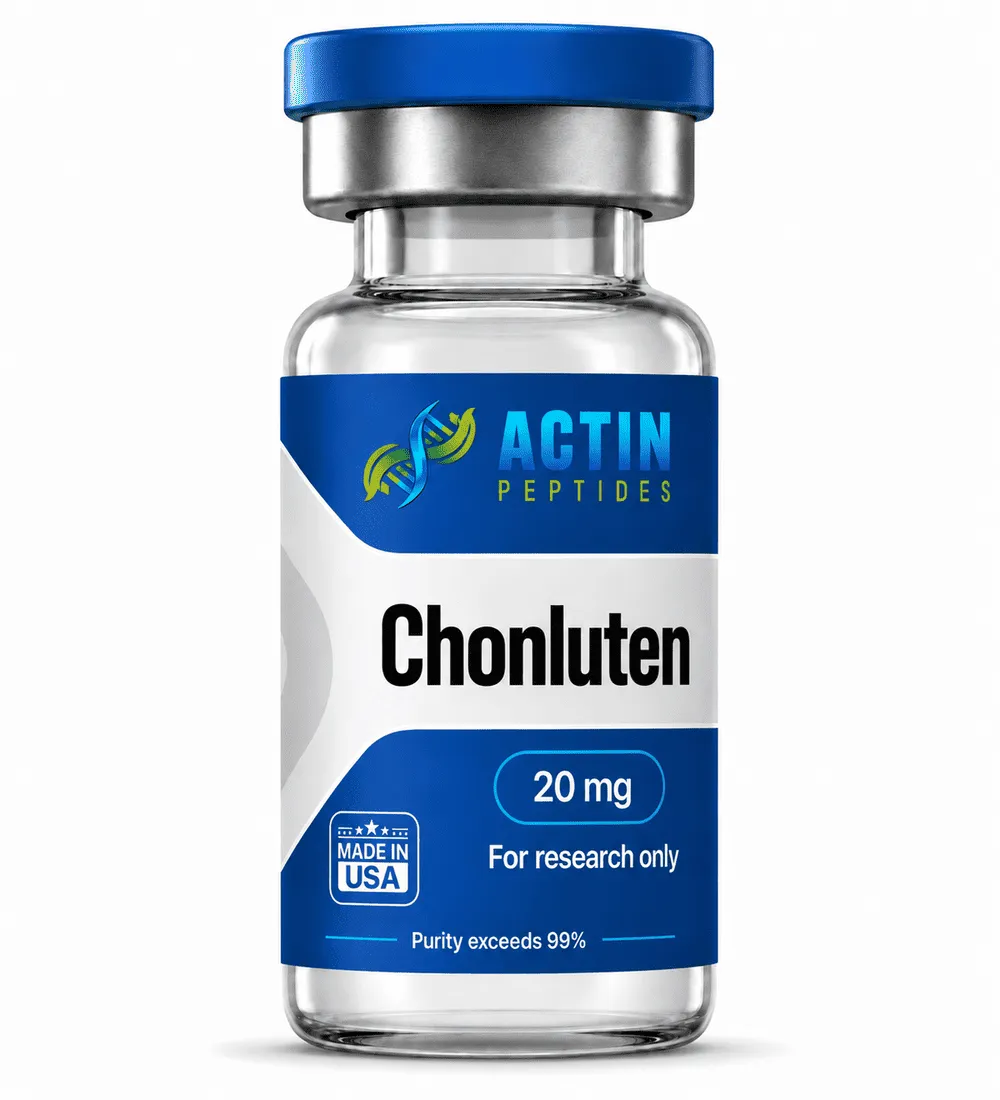
Chonluten Peptide – Research on Respiratory Signaling, Cellular Regulation & Immune Modulation
Introduction
Peptide de chonlutène, also known in research literature as the EDG tripeptide or T-34, is a short-chain peptide studied for its potential role in respiratory tissue biology, cellular signaling, inflammation-related pathways, and tissue maintenance. Research has primarily focused on its interaction with bronchial and pulmonary tissues, although scientists have also investigated its potential relevance to gastrointestinal tissues and cellular aging.
Chonluten consists of three amino acids and has been investigated as a potential bioregulatory compound. Preclinical studies suggest that its biological activity may involve inflammatory signaling, oxidative-stress responses, epithelial-cell regulation, fibroblast activity, and gene-expression pathways.
Because Chonluten research remains predominantly preclinical, findings should be interpreted as exploratory rather than as evidence of therapeutic efficacy.
What Is Chonluten Peptide?
Chonluten is a synthetic tripeptide composed of glutamic acid, aspartic acid, and glycine. Researchers have investigated the compound primarily for its potential interactions with respiratory tissues, immune signaling, cellular proliferation, and mechanisms associated with tissue maintenance.
Key Research Areas
Studies have investigated Chonluten in relation to:
- Respiratory and bronchial tissue biology
- Signalisation inflammatoire
- Immune-cell activity
- Oxidative-stress regulation
- Epithelial-cell proliferation
- Activité des fibroblastes
- Gene-expression mechanisms
- Gastrointestinal tissue models
- Cellular responses to hypoxic stress
Chonluten Peptide Overview
Chonluten has attracted research interest because short peptides can participate in highly specific biological signaling processes. Researchers have proposed that this tripeptide may influence several pathways involved in cellular homeostasis.
In respiratory research models, scientists have examined whether Chonluten may help regulate the balance between cellular proliferation and cell death within bronchial tissues. Researchers have also explored its possible influence on immune-cell signaling and inflammatory mediators.
Importantly, the available research does not establish Chonluten as an approved treatment for respiratory, gastrointestinal, inflammatory, or other medical conditions.
Chonluten Peptide Mechanism of Action
Le Chonluten peptide mechanism remains under investigation. Available research suggests that its potential biological activity may involve several interconnected signaling systems rather than a single receptor or pathway.
STAT Signaling and Immune Regulation
One area of interest involves the Signal Transducer and Activator of Transcription (STAT) family of proteins.
Researchers have investigated potential changes in STAT1 and STAT3 signaling following Chonluten exposure. These proteins transmit signals from cellular receptors toward the nucleus, where they can influence gene transcription.
Studies suggest that Chonluten may:
- Influence STAT1 phosphorylation
- Modulate STAT3 activity
- Alter downstream inflammatory signaling
- Affect expression of inflammatory mediators such as IL-6
- Influence immune-cell responses to inflammatory stimuli
These observations have made STAT signaling an important area of Chonluten research.
Inflammatory Cytokine Signaling
Researchers have also examined the peptide in models involving inflammatory stimuli such as bacterial lipopolysaccharide (LPS).
Experimental findings suggest that Chonluten may influence the production of inflammatory mediators including:
- Tumor necrosis factor-alpha (TNF-α)
- Interleukine-6 (IL-6)
- Interleukin-17 (IL-17)
The findings suggest possible immunomodulatory activity rather than simple suppression of immune function.
Oxidative-Stress Pathways
Oxidative stress represents another area of interest. Researchers have investigated whether Chonluten may influence genes associated with antioxidant defense, including those related to superoxide dismutase (SOD).
SOD is an important antioxidant enzyme that helps cells manage reactive oxygen species. Consequently, research into Chonluten and SOD may help scientists understand how the peptide interacts with cellular responses to oxidative stress.
HSP70 and Cellular Stress
Research has also examined heat shock protein 70 (HSP70) in connection with Chonluten.
HSP70 belongs to a family of stress-response proteins that can help maintain cellular protein stability under challenging conditions. Changes in HSP70 expression may therefore provide useful information about how cells respond to environmental and metabolic stress.
c-Fos and Cellular Signaling
Le c-Fos protein represents another signaling component investigated in Chonluten research.
c-Fos participates in cellular differentiation, proliferation, and responses to environmental stress. Researchers have therefore examined whether Chonluten may influence c-Fos-associated pathways in respiratory and other tissue models.
Chemical Makeup of Chonluten
| Property | Research Information |
|---|---|
| Peptide Name | Chonluten |
| Autres noms | EDG tripeptide, T-34 |
| Molecular Formula | C11H17N3O8 |
| Molecular Weight | 319.27 g/mol |
| Structure | 4S)-4-amino-5-[[(2S)-3-carboxy-1-(carboxymethyl amino)-1-oxopropan-2-yl]amino]-5-oxopentanoic acid |
| Type de peptide | Synthetic tripeptide |
The source material also identifies related naming conventions including Glu-Asp-Gly, glutamyl-aspartyl-glycine, et H-Glu-Asp-Gly-OH.
Chonluten Peptide Research and Experimental Studies
Chonluten Peptide and Inflammatory Signaling
Objectif de l'étude
Researchers have investigated whether Chonluten may influence inflammatory responses in respiratory and immune-cell models.
Méthodologie
Experimental studies examined cellular responses to inflammatory stimuli and evaluated changes in signaling proteins and inflammatory mediators.
Researchers paid particular attention to STAT1 and STAT3 signaling, cytokine production, and interactions between immune cells and endothelial cells.
Résultats
Research findings suggest that Chonluten may:
- Influence STAT1 phosphorylation
- Modulate STAT3-related signaling
- Reduce TNF production under certain experimental conditions
- Alter IL-6 and IL-17 signaling
- Affect interactions between immune and endothelial cells
Importance scientifique
These observations have led researchers to investigate Chonluten as a potential immunomodulatory research compound. However, the findings remain experimental and do not establish clinical effectiveness.
Chonluten Peptide and Respiratory Tissue Research
Chonluten has been studied particularly in relation to bronchial and respiratory tissue biology.
Objectif de l'étude
Researchers have investigated whether the peptide may influence cellular proliferation, survival, and inflammatory signaling within bronchial tissue models.
Résultats
Experimental research suggests that Chonluten may influence:
- Bronchial epithelial-cell activity
- Prolifération cellulaire
- Cell-death pathways
- Régulation de la matrice extracellulaire
- Signalisation inflammatoire
- Oxidative-stress responses
The bronchial epithelium forms an important protective interface between inhaled environmental factors and underlying tissues. Consequently, researchers have investigated whether modulation of epithelial-cell behavior could provide insight into respiratory tissue homeostasis.
Importance scientifique
These findings make respiratory tissue one of the primary areas of Chonluten peptide studies, although further research is necessary to determine the precise mechanisms involved.
Chonluten Peptide and Gastrointestinal Research
Researchers have also investigated Chonluten in gastrointestinal tissue models.
Objectif de l'étude
The objective was to explore whether the peptide could influence oxidative stress, inflammatory signaling, epithelial-cell activity, and tissue remodeling.
Research Findings
Studies suggest that Chonluten may interact with pathways associated with:
- Superoxide dismutase (SOD)
- TNF-α
- Cyclooxygenase-2 (COX-2)
- HSP70
- Prolifération des fibroblastes
- Epithelial-cell proliferation
- Apoptosis
Researchers have proposed that these interactions could influence cellular responses within stomach and intestinal tissue models.
Importance scientifique
The findings provide a basis for continued investigation into how short peptides may regulate gastrointestinal tissue biology. They do not, however, establish Chonluten as a treatment for gastrointestinal disease.
Chonluten Peptide and Gene Expression
Objectif de l'étude
Scientists have investigated whether short peptides can interact with nuclear components and influence gene-expression processes.
Short peptides may interact with nucleosomes, histones, and DNA under certain experimental conditions. Researchers have consequently examined whether peptide-mediated signaling could influence epigenetic mechanisms such as DNA methylation.
Potential Biological Significance
DNA methylation represents an important epigenetic mechanism that can influence whether particular genes become more or less active.
Research into Chonluten therefore explores whether the peptide may participate in broader regulatory processes involving:
- Gene transcription
- DNA-associated signaling
- Différenciation cellulaire
- Cellular aging
- Tissue-specific regulation
These mechanisms remain areas of scientific investigation.
Chonluten Peptide and Immune-System Research
Chonluten has also been investigated for potential immunomodulatory activity.
Rather than functioning exclusively as an immune stimulant or suppressor, researchers have proposed that the peptide may influence cellular signaling according to the experimental environment.
Research has examined potential interactions involving:
- HSP70
- SOD
- c-Fos
- TNF-α
- Oxidative-stress pathways
- Immune-cell signaling
This makes Chonluten relevant to research investigating how short peptides may influence immune homeostasis.
Chonluten Peptide and Hypoxia Research
Another area of interest involves cellular responses to reduced oxygen availability, known as hypoxia.
Researchers have investigated whether Chonluten may influence cellular responses to hypoxic stress by interacting with genes associated with:
- c-Fos
- HSP70
- SOD
- COX-2
- TNF-α
These pathways participate in cellular stress responses, antioxidant defense, inflammation, and tissue adaptation.
Consequently, Chonluten research may provide insight into how peptide signaling interacts with cellular responses when oxygen availability changes.
Chonluten Peptide and Aerobic Research
Researchers have also explored bioactive peptides in the context of physical activity, muscle metabolism, and recovery-related cellular processes.
Within this broader research area, Chonluten has been investigated for its potential relationship with stress responses and oxygen availability.
Experimental findings suggest that the peptide may influence certain molecular pathways involved in cellular adaptation to hypoxic conditions. However, these findings should not be interpreted as evidence that Chonluten improves athletic performance or physical recovery in humans.
What Is Chonluten Researched For?
Chonluten is primarily researched for its potential interactions with respiratory tissue biology, inflammatory signaling, immune-cell regulation, oxidative-stress pathways, and cellular gene expression.
Its research profile also includes experimental investigation of gastrointestinal tissues and cellular responses to hypoxia.
What Makes Chonluten Peptide Unique?
Chonluten is notable for its small three-amino-acid structure and its proposed activity across several cellular signaling systems. Research has examined its potential relationship with STAT signaling, inflammatory cytokines, antioxidant enzymes, HSP70, and c-Fos.
Chonluten and Related Peptide Research
Researchers studying Chonluten may also examine other peptides with overlapping research themes.
Par exemple, Thymosin Alpha-1 has been investigated in immune-system research, while Thymalin is another bioregulatory peptide of interest in immune and cellular research.
For broader research into tissue signaling and inflammatory pathways, BPC-157 et Peptide KPV provide additional examples of compounds investigated in preclinical peptide research.
Researchers examining cellular regeneration and connective-tissue biology may also find GHK-Cu relevant because of its research associations with cellular signaling, extracellular matrix biology, and fibroblast activity.
Foire aux questions
Is Chonluten a peptide?
Yes. Chonluten is a short synthetic tripeptide consisting of three amino-acid residues and is also identified in research literature as EDG tripeptide or T-34.
What is Chonluten peptide researched for?
Chonluten is primarily researched for respiratory tissue biology, immune signaling, inflammatory pathways, oxidative-stress responses, and cellular regulation.
How does Chonluten work?
The precise mechanism remains under investigation. Research suggests that its activity may involve STAT1/STAT3 signaling, cytokine regulation, HSP70, SOD, c-Fos, and other cellular stress-response pathways.
Is Chonluten FDA approved?
The supplied research material does not establish Chonluten as an FDA-approved drug. Actin Peptides presents it as a research compound rather than an approved therapeutic product.
What is the molecular weight of Chonluten?
The molecular weight listed for Chonluten is 319.27 g/mol, with the molecular formula C11H17N3O8.
Where can researchers buy Chonluten peptide?
Researchers evaluating Chonluten peptide for sale should assess product identity, analytical documentation, purity data, and research-use labeling before purchasing. Actin Peptides provides research-grade peptide products for laboratory applications.
Conclusion
Chonluten peptide is a short-chain research compound that has attracted scientific interest because of its potential interactions with respiratory tissues, immune signaling, oxidative-stress pathways, and cellular gene regulation.
Research suggests that its biological activity may involve multiple interconnected mechanisms, including STAT signaling, inflammatory cytokines, HSP70, SOD, c-Fos, and cellular stress responses. Researchers have also explored its potential relevance to gastrointestinal tissues and hypoxia-related cellular adaptation.
Although these findings provide several areas for further investigation, the available evidence remains predominantly experimental. Additional research is necessary to establish the precise molecular mechanisms, reproducibility, and biological significance of the reported observations.
Avertissement relatif à la recherche
Chonluten peptide is available strictly for research and laboratory purposes only. It is not approved for human consumption, therapeutic use, or diagnostic applications. Please review our Termes et conditions avant de passer commande.
 English
  French
Avis
Il n’y a pas encore d’avis.