
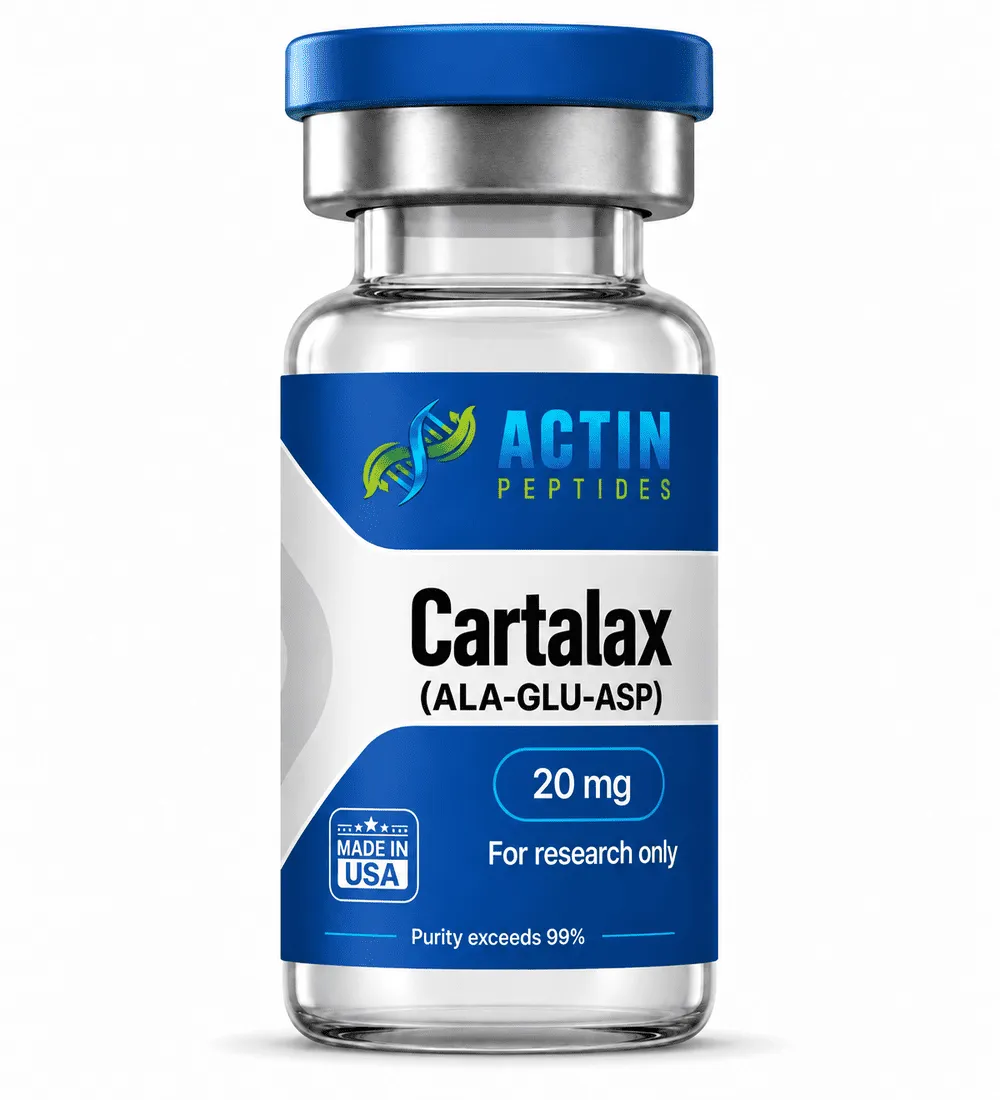
Description
Cartalax Peptide – Research on Cellular Aging, Fibroblast Signaling and Tissue Biology
Introduction
Cartalax peptide, également connu sous le nom de AED ou T-31, is a synthetic tripeptide composed of the amino acid sequence alanine-glutamate-aspartate (Ala-Glu-Asp). The sequence is associated with the alpha-1 chain of type XI collagen, and Cartalax belongs to a group of peptides commonly described as Khavinson peptides or peptide bioregulators.
Cartalax peptide research has primarily examined cellular aging, fibroblast activity, apoptosis, extracellular matrix regulation, and gene-expression patterns in experimental cell and tissue models. Researchers have also investigated its potential effects on kidney cells and bone-marrow-derived mesenchymal stem cells.
Because fibroblasts contribute to connective-tissue structure and extracellular matrix organization, scientists have studied Cartalax in models designed to better understand cellular proliferation, senescence, and tissue-maintenance mechanisms.
What Is Cartalax Peptide?
Cartalax is a synthetic three-amino-acid peptide studied for its potential influence on cellular aging, fibroblast activity, apoptosis-related signaling, and extracellular matrix regulation.
Its short Ala-Glu-Asp sequence distinguishes it from larger peptides while allowing researchers to investigate how small regulatory peptides may influence cellular processes.
Quick Facts
- Primary research areas: cellular aging, fibroblasts, kidney-cell biology, mesenchymal stem cells
- Peptide sequence: Ala-Glu-Asp
- Peptide class: synthetic tripeptide
- Also known as: AED, T-31
- Research focus: cellular proliferation, apoptosis, senescence-associated markers, extracellular matrix biology
Cartalax Peptide Overview
Research on Cartalax has focused on biological markers associated with cellular aging and tissue maintenance.
In fibroblast models, studies have examined markers including Ki-67, CD98hc, caspase-3, and MMP-9. These proteins and enzymes provide researchers with useful indicators of cellular proliferation, survival, apoptosis, and extracellular matrix remodeling.
Researchers have also examined Cartalax in kidney-cell cultures, where experimental findings have focused on proliferation and markers associated with cellular senescence, including p16, p21, p53, and SIRT-6.
Furthermore, research involving bone-marrow mesenchymal stem cells has explored possible changes in genes associated with cellular growth, stress responses, and longevity.
These findings make Cartalax an area of interest within broader peptide research, particularly research examining how short peptide sequences may interact with cellular signaling and age-associated molecular processes.
How Does Cartalax Peptide Work?
Cartalax peptide mechanism research centers on changes in cellular markers associated with proliferation, apoptosis, extracellular matrix remodeling, and cellular senescence.
The available experimental findings suggest that its biological activity may involve several interconnected pathways rather than a single established mechanism.
Fibroblast Signaling
Fibroblasts produce and organize components of the extracellular matrix, including structural proteins involved in tissue architecture. Research suggests Cartalax may influence fibroblast proliferation and survival.
One proposed indicator involves Ki-67, a protein commonly used as a marker of actively proliferating cells. Experimental fibroblast cultures exposed to Cartalax demonstrated changes in Ki-67 expression.
CD98hc and Cellular Function
Studies have also examined CD98hc, a membrane-associated protein involved in amino-acid transport and cellular signaling.
Changes in CD98hc expression observed in Cartalax-exposed fibroblast models may indicate an interaction with cellular processes associated with regeneration and maintenance.
Caspase-3 and Apoptosis
Caspase-3 participates in programmed cell death, or apoptosis.
Research models have reported reduced caspase-3 activity following Cartalax exposure. Scientists have therefore investigated whether the peptide may influence apoptosis-related processes in aging fibroblast cultures.
Importantly, these observations represent experimental findings rather than evidence of a therapeutic effect.
MMP-9 and Extracellular Matrix Remodeling
Matrix metalloproteinase-9 (MMP-9) is an enzyme involved in extracellular matrix remodeling.
Studies have reported reduced MMP-9 synthesis in Cartalax-treated fibroblast cultures. Researchers have consequently examined whether this activity could influence extracellular matrix stability during cellular aging.
Chemical Makeup of Cartalax Peptide
| Property | Détails |
|---|---|
| Molecular Formula | C12H19N3O8 |
| Molecular Weight | 333.29 g/mol |
| Amino Acid Sequence | Ala-Glu-Asp |
| Structure | H-Ala-Glu-Asp-OH |
| Autres noms | AED, T-31 |
| Classification | Synthetic tripeptide |
Recherche et études cliniques
Cartalax Peptide and Fibroblast Research
Objectif de l'étude
Researchers investigated whether Cartalax could influence molecular markers associated with aging and proliferation in cultured skin fibroblasts.
Méthodologie
Experimental fibroblast cultures representing different stages of cellular aging were exposed to Cartalax. Researchers then examined molecular markers associated with proliferation, apoptosis, extracellular matrix remodeling, and cellular maintenance.
Résultats
The research reported changes involving:
- Ki-67, a proliferation-associated marker
- CD98hc, a protein associated with cellular transport and signaling
- Caspase-3, an apoptosis-related enzyme
- MMP-9, an extracellular matrix-remodeling enzyme
Cartalax exposure was associated with increased Ki-67 and CD98hc expression while researchers observed lower caspase-3 activity and reduced MMP-9 synthesis in the experimental models.
Importance scientifique
These findings suggest that Cartalax may influence several interconnected processes involved in fibroblast biology. Because fibroblasts contribute to extracellular matrix organization, these models provide a useful framework for studying peptide-mediated regulation of cellular aging.
Cartalax Peptide and Kidney Cell Research
Objectif de l'étude
Researchers investigated whether Cartalax could affect proliferation and apoptosis-related signaling in kidney tissue cultures obtained from younger and older experimental models.
Méthodologie
Organotypic kidney cultures were maintained under controlled laboratory conditions and exposed to Cartalax. Researchers evaluated proliferation markers and proteins associated with cellular survival and aging.
Résultats
The experimental findings associated Cartalax exposure with:
- Increased Ki-67 expression
- Changes in cellular proliferation
- Reduced expression of p53
- Potential modulation of apoptosis-related processes
Additional research examined aging renal cell cultures and markers including p16, p21, and p53.
Researchers also reported increased SIRT-6 expression in experimental models.
Importance scientifique
SIRT-6 participates in DNA repair and genomic stability, while p16, p21, and p53 are frequently studied in relation to cellular senescence. Consequently, Cartalax has attracted interest as a research compound for investigating molecular pathways associated with cellular aging.
Cartalax Peptide and DNA Interaction Research
Objectif de l'étude
Researchers have explored whether Cartalax could interact directly with specific DNA sequences and whether such interactions might contribute to changes in gene expression.
Méthodologie
Experimental models examined the potential interaction between Cartalax and selected DNA sequences, including repetitive adenine-thymine regions.
Résultats
The research proposed that Cartalax could form energetically favorable interactions with specific DNA sequences, particularly within the minor groove.
Importance scientifique
This work provides a possible molecular explanation for some of the gene-expression changes observed in cellular models. However, the precise biological consequences of these interactions require further investigation.
Cartalax Peptide and Mesenchymal Stem Cell Research
Objectif de l'étude
Researchers have investigated Cartalax in bone-marrow-derived mesenchymal stem cells undergoing experimental models of cellular aging.
Méthodologie
Scientists compared gene-expression patterns in cells maintained under proliferative and stationary culture conditions.
Résultats
The research reported changes in several genes associated with cellular growth and aging.
Notably, Cartalax was associated with increased expression of IGF1 in the experimental models. The reported increase varied between approximately 3.5- and 5.6-fold depending on the culture condition.
Researchers also observed changes involving NF-κB et TNKS2.
Importance scientifique
These findings suggest that Cartalax may influence several molecular pathways associated with cellular growth, stress responses, and aging. Nevertheless, the results remain experimental and do not establish a clinical application.
Cartalax Peptide and Cellular Aging Research
Cartalax peptide studies have investigated cellular senescence through markers involved in proliferation, apoptosis, DNA maintenance, and extracellular matrix remodeling.
Cellular senescence describes a state in which cells stop proliferating while remaining metabolically active. Researchers commonly evaluate senescence using combinations of molecular markers rather than a single biomarker.
Cartalax research has therefore examined:
- Ki-67 — cellular proliferation
- p16 — senescence-associated signaling
- p21 — cell-cycle regulation
- p53 — DNA-damage and apoptosis signaling
- SIRT-6 — DNA repair and genomic stability
- MMP-9 — extracellular matrix remodeling
- Caspase-3 — apoptosis
- IGF1 — growth and cellular signaling
- NF-κB — inflammatory and stress-response signaling
- TNKS2 — cellular signaling and telomere-related biology
This multi-marker approach makes Cartalax research particularly relevant to investigators studying the molecular biology of cellular aging.
What Makes Cartalax Peptide Unique?
Cartalax differs from many commonly researched peptides because of its exceptionally short three-amino-acid structure.
Rather than functioning as a conventional growth-factor-like molecule, researchers have investigated whether this small peptide can influence cellular signaling and gene-expression patterns associated with proliferation, apoptosis, extracellular matrix remodeling, and senescence.
Its connection to the Ala-Glu-Asp sequence of type XI collagen has also contributed to interest in its potential relationship with connective-tissue and fibroblast biology.
Cartalax Peptide Research and Related Peptides
Researchers studying cellular aging and tissue biology may also investigate other peptide classes with different mechanisms.
Par exemple, Peptides GHK-Cu research focuses on copper-bound peptide signaling, extracellular matrix biology, and cellular processes involving fibroblasts.
For broader tissue-repair research, Peptide BPC-157 et TB-500 (Thymosine Bêta-4) provide additional research models involving cellular migration and tissue biology.
Researchers interested in longevity-associated signaling can also examine compounds such as Peptide épithalon et Peptide humain, which are investigated through different molecular pathways.
These compounds should not be considered interchangeable. Each peptide has a distinct sequence, mechanism, research history, and experimental profile.
Cartalax Peptide Benefits Research: What Does the Evidence Show?
The available research suggests that Cartalax may influence several cellular processes, including:
- Prolifération des fibroblastes
- Apoptosis-associated signaling
- remodelage de la matrice extracellulaire
- Cellular senescence markers
- Kidney-cell proliferation
- Mesenchymal stem-cell gene expression
- DNA-associated signaling
- Cellular growth pathways
However, these observations primarily come from cell-culture and animal research models. They should therefore be interpreted as areas for scientific investigation rather than established human benefits.
Foire aux questions
What is Cartalax peptide?
Cartalax is a synthetic tripeptide composed of alanine, glutamate, and aspartate (Ala-Glu-Asp). Researchers have studied it in connection with fibroblast biology, cellular aging, apoptosis, extracellular matrix remodeling, and gene-expression regulation.
What is Cartalax researched for?
Cartalax research focuses primarily on cellular aging, fibroblast activity, kidney-cell biology, mesenchymal stem cells, apoptosis-related signaling, and extracellular matrix regulation.
How does Cartalax work?
The precise Cartalax mechanism remains under investigation. Experimental studies suggest possible effects on markers and pathways involving Ki-67, CD98hc, caspase-3, MMP-9, p53, SIRT-6, IGF1, NF-κB, and TNKS2.
What is the molecular formula of Cartalax?
The reported molecular formula is C12H19N3O8, with a molecular weight of approximately 333.29 g/mol.
Is Cartalax the same as AED?
Yes. AED is another designation used for Cartalax and refers to its three-amino-acid sequence: alanine-glutamate-aspartate.
Is Cartalax FDA approved?
This research content does not establish FDA approval or therapeutic authorization for Cartalax. The compound is presented by Actin Peptides as a research-use material.
Can I buy Cartalax peptide?
Cartalax may be offered by research-chemical suppliers for laboratory applications. Any purchase should be evaluated according to applicable laws, supplier documentation, product specifications, and research-use requirements.
Conclusion
Cartalax peptide represents a small synthetic peptide that researchers have investigated across several areas of cellular biology. Current experimental studies have focused particularly on fibroblast proliferation, apoptosis, extracellular matrix remodeling, kidney-cell biology, mesenchymal stem cells, and molecular markers associated with cellular aging.
Research involving Ki-67, CD98hc, caspase-3, MMP-9, p53, SIRT-6, IGF1, NF-κB, and TNKS2 provides several potential directions for further investigation. At the same time, the available evidence remains predominantly preclinical, and additional research is necessary to establish the biological significance of these observations.
For researchers evaluating Cartalax peptide research, the most important distinction is between experimental molecular findings and demonstrated human outcomes. Current evidence supports continued laboratory investigation rather than conclusions about therapeutic efficacy.
Avertissement relatif à la recherche
Cartalax peptide is available strictly for research and laboratory purposes only. It is not approved for human consumption, therapeutic use, or diagnostic applications. Please review our Termes et conditions avant de passer commande.



 English
  French
Avis
Il n’y a pas encore d’avis.