
Description
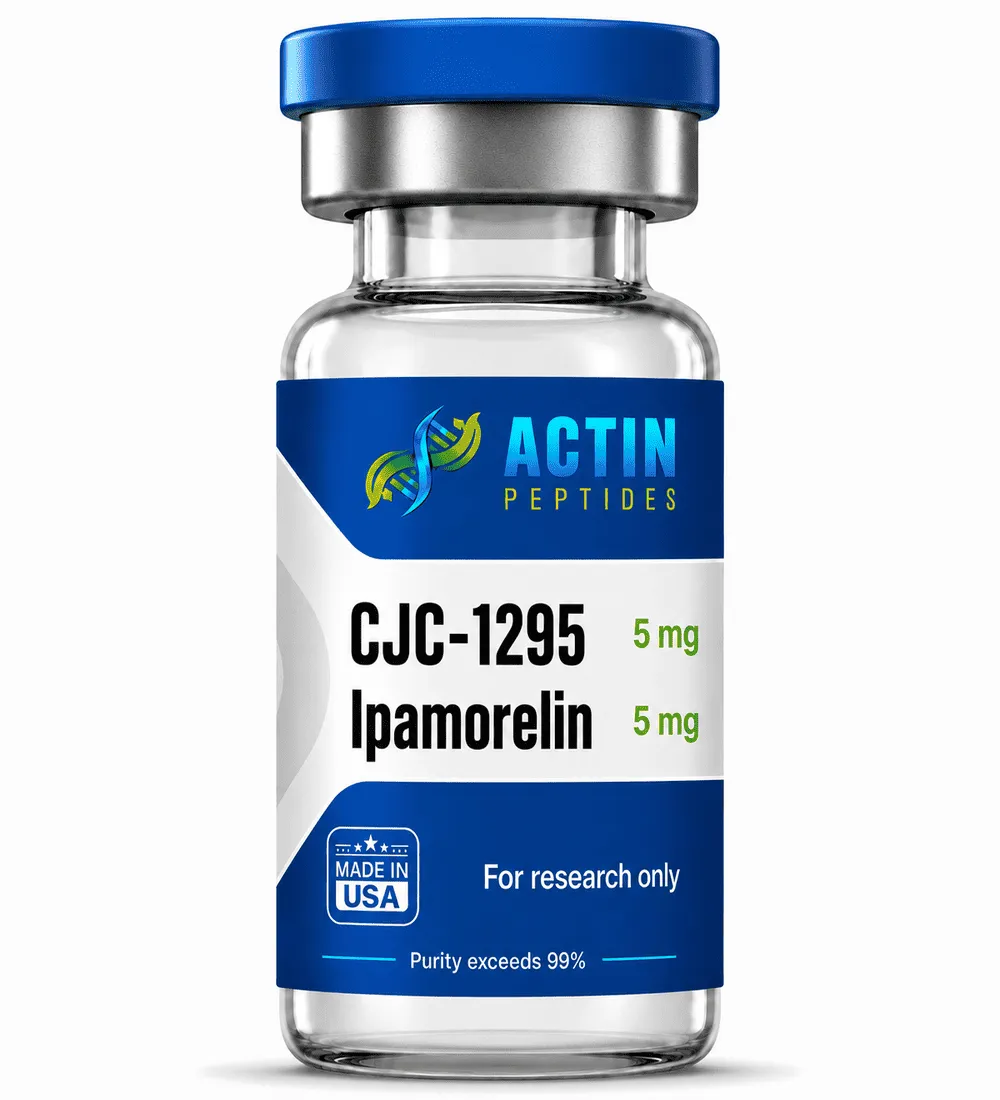
CJC-1295 & Ipamorelin Peptide Blend: Growth Hormone Secretagogue Research
Introduction
CJC-1295 & Ipamorelin peptide blend combines two synthetic peptides that researchers have investigated for their potential influence on growth hormone (GH) signaling. CJC-1295 is a modified peptide related to growth hormone-releasing hormone (GHRH), while Ipamorelin is a pentapeptide classified as a growth hormone secretagogue.
Research into this combination focuses primarily on pituitary signaling, growth hormone release, pharmacokinetics, somatotroph activity, and metabolic regulation. The two compounds interact with different receptor systems, which makes their combined research profile particularly relevant to studies of GH-axis signaling.
For researchers comparing related compounds, Actin Peptides also offers standalone CJC-1295 DAC Peptide et Ipamorelin Peptide products.
Research note: Available studies have generally evaluated CJC-1295 and Ipamorelin individually or investigated their pharmacological characteristics separately. The supplied research material does not establish clinical efficacy for the combined blend.
What Is CJC-1295 & Ipamorelin Peptide Blend?
CJC-1295 & Ipamorelin peptide blend is a research combination of two growth hormone secretagogues with different molecular targets.
CJC-1295 is a modified 29-amino-acid peptide related to GHRH and has been studied for its interaction with GHRH receptors on pituitary somatotroph cells.
Ipamorelin is a synthetic pentapeptide that has been studied for its interaction with the growth hormone secretagogue receptor 1a (GHS-R1a), also known as the ghrelin receptor.
Because these peptides act through distinct receptor systems, researchers have investigated whether their signaling profiles may complement one another within experimental models of GH-axis regulation.
Aperçu
Both compounds belong to the broader research category of growth hormone secretagogues (GHSs). Rather than supplying growth hormone directly, these compounds have been investigated for their potential to influence endogenous GH release through pituitary signaling.
CJC-1295 is structurally related to the first 29 amino acids of native GHRH. The supplied research material describes four amino-acid substitutions designed to improve stability and pharmacokinetic characteristics. The modified structure may interact with plasma proteins, contributing to a substantially longer apparent half-life than shorter-acting GHRH-related peptides.
Ipamorelin, meanwhile, has been investigated as a selective GHS-R1a ligand. Researchers have examined whether its receptor activity can stimulate GH release from pituitary somatotrophs while producing a different hormonal signaling profile from less selective secretagogues.
The resulting research interest centers on the complementary receptor biology and different pharmacokinetic characteristics of the two compounds.
CJC-1295 & Ipamorelin Mechanism of Action
CJC-1295 and the GHRH Receptor
CJC-1295 has been studied primarily in relation to the growth hormone-releasing hormone receptor (GHRHR) located on pituitary somatotroph cells.
When a GHRH-related ligand interacts with this receptor, it may initiate intracellular signaling involving G-proteins and cyclic adenosine monophosphate (cAMP).
The resulting signaling cascade may influence protein kinases and transcription-regulating proteins involved in GH synthesis and secretion.
Research therefore focuses on CJC-1295 as a compound capable of interacting with the existing GHRH signaling system rather than acting as growth hormone itself.
Ipamorelin and GHS-R1a
Ipamorelin has been investigated for its interaction with GHS-R1a, a receptor associated with ghrelin signaling.
Research models suggest that receptor activation can involve the Gαq/11 protein, followed by activation of phospholipase C (PLC). PLC can then influence phosphatidylinositol 4,5-bisphosphate (PIP2), producing the secondary messengers inositol trisphosphate (IP3) et diacylglycerol (DAG).
IP3 can promote calcium release from intracellular stores, while DAG can activate protein kinase C (PKC). Together, these signaling events may contribute to GH secretion from pituitary somatotrophs.
Why Researchers Study the Combination
The CJC-1295 and Ipamorelin combination is scientifically interesting because the compounds interact with different receptor systems within the GH regulatory network.
In simplified terms:
- CJC-1295 → GHRH receptor signaling
- Ipamorelin → GHS-R1a signaling
- Both pathways → pituitary somatotroph activity
- Somatotroph activity → growth hormone secretion research
The supplied research material suggests that Ipamorelin may display a comparatively shorter pharmacokinetic profile, whereas CJC-1295 has been investigated for substantially longer persistence in circulation.
Composition chimique
| Compound | Molecular Formula | Molecular Weight | Other Known Titles |
|---|---|---|---|
| CJC-1295 | C152H252N44O42 | 3367.9 g/mol | CJC-1295 NO DAC; Mod GRF 1-29 |
| Ipamorelin | C38H49N9O5 | 711.8 g/mol | NNC 26-0161 |
CJC-1295
CJC-1295 is a modified peptide related to GHRH 1-29. The supplied research material describes substitutions at positions 2, 8, 15, and 27 and discusses the potential contribution of these modifications to peptide stability and pharmacokinetic behavior.
Ipamorelin
Ipamorelin is a synthetic pentapeptide studied as a GHS-R1a ligand. Its comparatively small molecular structure distinguishes it from longer GHRH-related peptides.
CJC-1295 & Ipamorelin Research and Clinical Studies
CJC-1295 & Ipamorelin Half-Life Research
Objectif de l'étude
Researchers have investigated the pharmacokinetic profiles of CJC-1295 and Ipamorelin to better understand how long each compound may remain active within experimental systems.
Méthodologie
The supplied research describes a late-1990s clinical study involving eight male participants and escalating concentrations of Ipamorelin. Researchers monitored GH responses following peptide exposure.
Résultats
The study reported a distinct GH response with a peak occurring relatively early after Ipamorelin exposure, followed by declining concentrations. The supplied material describes an apparent half-life of approximately 2 hours.
CJC-1295 demonstrated a substantially longer pharmacokinetic profile in separate research. One study reported prolonged GH-related activity following administration, while another publication estimated a half-life ranging from approximately 5.8 to 8.1 days.
Importance scientifique
These observations provide an important distinction between the two compounds. Ipamorelin has been studied as a comparatively shorter-acting secretagogue, whereas CJC-1295 has been investigated for longer-lasting pharmacokinetic behavior.
CJC-1295 and Growth Hormone Pulsatility
Objectif de l'étude
Researchers investigated whether CJC-1295 could influence the natural pulsatile pattern of GH secretion.
Méthodologie
Researchers divided adult male participants into peptide and placebo groups. Then, they collected blood samples before and after exposure to monitor GH concentrations and pulsatility.
Résultats
The supplied research material reports that CJC-1295 was associated with an approximately 7.5-fold increase in GH pulsatility compared with placebo in the referenced experimental setting.
Other research described prolonged increases in GH and IGF-1 concentrations following CJC-1295 exposure.
Importance scientifique
These findings have contributed to continuing research into how modified GHRH analogs can influence pituitary GH signaling and downstream endocrine pathways.
CJC-1295 and Somatotroph Research
Objectif de l'étude
Scientists have also investigated whether CJC-1295 may influence the cells responsible for producing GH.
Méthodologie
In an experimental murine model, researchers examined pituitary tissue and measured RNA associated with GH production.
Résultats
The supplied research reports increases in total pituitary RNA and GH messenger RNA (mRNA), with immunohistochemical observations interpreted as being consistent with changes in somatotroph cell activity.
Importance scientifique
This research expands the CJC-1295 mechanism beyond acute GH secretion and raises questions about how GHRH-related signaling may influence pituitary cellular biology.
These observations remain experimental and should not be interpreted as evidence of therapeutic efficacy.
Ipamorelin Metabolic Research
Nitrogen Balance and Metabolic Signaling
Objectif de l'étude
Researchers investigated Ipamorelin in an experimental model of catabolic metabolism, focusing on nitrogen processing and hepatic urea-cycle activity.
Méthodologie
Investigators examined markers associated with hepatic nitrogen metabolism, including urea nitrogen production and messenger RNA associated with urea-cycle enzymes.
Résultats
The supplied research describes an apparent 20% reduction in CUNS, alongside changes in urea-cycle enzyme expression and nitrogen distribution across experimental tissues.
Importance scientifique
These findings have contributed to research examining how GH secretagogue signaling may interact with broader metabolic pathways.
However, laboratory observations concerning nitrogen balance should not be interpreted as evidence that the peptide blend increases muscle mass or produces a specific body-composition outcome in humans.
CJC-1295 & Ipamorelin Pharmacokinetic Research
One of the distinguishing characteristics of this combination is the difference between the reported pharmacokinetic profiles of its individual components.
Ipamorelin
Research has characterized Ipamorelin as a comparatively short-acting compound, with the supplied material describing an approximate 2-hour half-life in the referenced study.
CJC-1295
CJC-1295 has been investigated for substantially longer persistence. The supplied research describes detectable peptide-related activity extending for prolonged periods and cites estimated half-life values of approximately 5.8–8.1 days in the referenced research.
Why This Matters in Research
The difference illustrates why researchers study these compounds separately as well as together. Their receptor targets and pharmacokinetic characteristics are not identical.
CJC-1295 & Ipamorelin Research: Key Scientific Concepts
Research involving this peptide combination intersects with several important areas of molecular biology:
- Growth hormone signaling
- GHRH receptor biology
- GHS-R1a receptor activity
- Pituitary somatotroph function
- cAMP signaling
- PLC/IP3/DAG signaling
- Calcium-dependent signaling
- Growth hormone pulsatility
- IGF-1 signaling
- Nitrogen metabolism
- Peptide pharmacokinetics
Researchers studying related growth-factor pathways may also examine IGF-1 LR3 de qualité récepteur as a separate research compound.
Recherche sur les peptides connexes
Actin Peptides provides several products that can be useful when comparing peptide classes and molecular signaling systems.
Growth Hormone Secretagogue Research
Researchers exploring related GH-axis compounds can compare:
Growth-Factor Research
For downstream growth-factor research, IGF-1 LR3 de qualité récepteur provides a separate research model involving the IGF signaling system.
What Is CJC-1295 & Ipamorelin Researched For?
CJC-1295 and Ipamorelin are primarily researched for their potential effects on growth hormone signaling, pituitary somatotroph activity, pharmacokinetics, GH pulsatility, and metabolic pathways.
How Does CJC-1295 & Ipamorelin Work?
The two compounds have different primary molecular targets. CJC-1295 is studied in relation to GHRH receptor signaling, while Ipamorelin interacts with GHS-R1a. Both pathways can influence intracellular signaling within GH-producing pituitary cells.
What Makes the CJC-1295 & Ipamorelin Blend Unique?
The blend combines two compounds that have been studied through distinct receptor pathways and that exhibit different pharmacokinetic profiles. This makes the combination relevant to research examining coordinated GH-axis signaling.
CJC-1295 & Ipamorelin Peptide Blend FAQ
Is CJC-1295 the same as Ipamorelin?
No. CJC-1295 and Ipamorelin are structurally different peptides that interact with different receptor systems. CJC-1295 is related to GHRH signaling, whereas Ipamorelin is studied primarily as a GHS-R1a ligand.
What is CJC-1295 researched for?
CJC-1295 research focuses on GHRH receptor signaling, GH pulsatility, pituitary somatotroph activity, pharmacokinetics, and related IGF-1 signaling.
What is Ipamorelin researched for?
Ipamorelin has been studied primarily for its interaction with GHS-R1a and its potential influence on growth hormone secretion and related metabolic pathways.
How long does CJC-1295 remain active in research models?
The supplied research describes substantially longer pharmacokinetic persistence for CJC-1295 than for Ipamorelin, with one cited estimate placing its half-life at approximately 5.8–8.1 days.
How long is the reported Ipamorelin half-life?
The supplied research describes an approximate half-life of 2 hours in the referenced study.
Are CJC-1295 and Ipamorelin proven to increase muscle growth?
The supplied research does not establish therapeutic muscle-growth efficacy in humans. Although GH and nitrogen metabolism have been investigated, these findings should remain within their experimental research context.
Has the CJC-1295 and Ipamorelin blend been extensively studied together?
The supplied material primarily describes research on the individual compounds and their respective mechanisms. It does not establish a substantial body of controlled research specifically evaluating the combined blend.
Conclusion
CJC-1295 & Ipamorelin peptide blend represents a research combination involving two distinct classes of growth hormone secretagogues. CJC-1295 has been studied for its relationship with GHRH receptor signaling and prolonged pharmacokinetic behavior, while Ipamorelin has been investigated for selective interaction with GHS-R1a and comparatively shorter-duration activity.
Together, these compounds provide a useful research model for examining pituitary signaling, GH pulsatility, receptor pharmacology, intracellular second-messenger systems, pharmacokinetics, and metabolic regulation.
Importantly, the available research does not establish therapeutic efficacy for the combined blend, and findings from experimental models should not be extrapolated to human treatment outcomes.
Avertissement relatif à la recherche
CJC-1295 & Ipamorelin peptide blend is available strictly for research and laboratory purposes only. It is not approved for human consumption, therapeutic use, or diagnostic applications. Please review our Termes et conditions avant de passer commande.
 English
  French
Avis
Il n’y a pas encore d’avis.