
Description
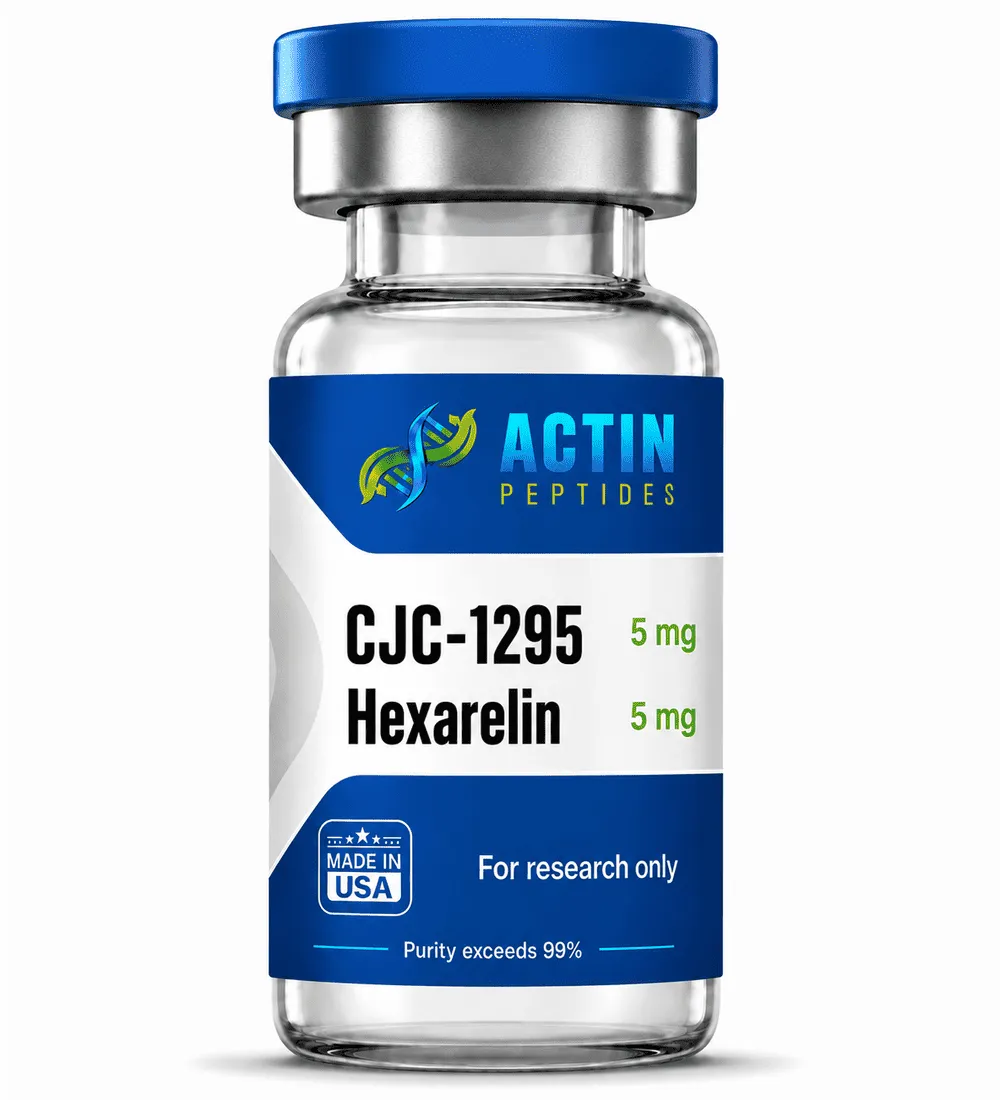
CJC-1295 (No DAC) & Hexarelin Peptide Blend – Growth Hormone Research
Introduction
CJC-1295 (no DAC) & Hexarelin is a research peptide combination investigated for its potential effects on growth hormone (GH) signaling in pituitary-cell models. The two compounds belong to different peptide classes and interact with distinct receptor systems involved in growth hormone secretion.
CJC-1295 (no DAC), also known as Modified GRF 1-29, is a synthetic derivative of growth hormone-releasing hormone (GHRH). Hexarelin, also known as examorelin, is a synthetic growth hormone secretagogue studied for its interaction with the growth hormone secretagogue receptor.
Because the compounds engage different receptor pathways, scientists have investigated whether simultaneous activation of GHRH and growth hormone secretagogue signaling could produce complementary or synergistic effects in experimental models.
For researchers comparing related compounds, Actin Peptides also offers Hexarelin Peptide, GHRP-2 Peptide, GHRP-6 Peptide, et Ipamorelin Peptide for laboratory research.
Aperçu
CJC-1295 (no DAC) & Hexarelin are studied together because they engage different components of the growth hormone signaling network. CJC-1295 (no DAC) functions as a modified GHRH analog, while Hexarelin belongs to the growth hormone secretagogue class.
Rather than relying on identical receptors, the two compounds have been studied for their respective interactions with:
- GHRH receptors (GHRHR) on pituitary somatotroph cells
- Growth hormone secretagogue receptor 1a (GHS-R1a)
- Intracellular cyclic AMP (cAMP) signaling
- Calcium-dependent signaling
- Protein kinase pathways involved in hormone secretion
- Downstream growth hormone and IGF-1 signaling
The distinction between the two compounds is important when evaluating CJC-1295 (no DAC) & Hexarelin research, because their proposed mechanisms are complementary rather than identical.
What Is CJC-1295 (No DAC)?
CJC-1295 (no DAC) is a synthetic derivative of GHRH commonly identified as Modified GRF 1-29 ou CJC-1295-no DAC.
The no-DAC form contains the 29-residue modified GRF backbone and differs chemically from the albumin-binding DAC version. Current chemical references list the no-DAC molecular formula as C152H252N44O42 and molecular weight at approximately 3,367.9 g/mol.
Researchers have investigated this peptide because modifications to the GHRH(1-29) sequence can influence peptide stability while retaining interaction with the GHRH receptor.
What Is Hexarelin?
Hexarelin, also known as examorelin, is a synthetic hexapeptide classified as a growth hormone secretagogue.
Chemical references identify its molecular formula as C47H58N12O6 and molecular weight at approximately 887.0 g/mol.
Unlike a GHRH analog, Hexarelin has been studied primarily for its interaction with GHS-R1a, a receptor associated with growth hormone secretagogue signaling.
CJC-1295 (No DAC) & Hexarelin Mechanism of Action
CJC-1295 (No DAC) and GHRH Receptor Signaling
CJC-1295 (no DAC) has been studied as an analog of GHRH, the endogenous hormone that regulates growth hormone secretion from pituitary somatotroph cells.
The proposed mechanism begins with interaction between the modified peptide and the GHRH receptor (GHRHR).
Researchers have described a signaling sequence involving:
- GHRH receptor activation
- Stimulation of adenylyl cyclase
- Increased intracellular cyclic AMP (cAMP)
- Activation of protein kinase A (PKA)
- Changes in voltage-dependent calcium-channel activity
- Increased intracellular calcium
- Growth hormone secretion from somatotroph cells
This signaling cascade provides the primary biological rationale for studying CJC-1295 (no DAC) in experimental growth hormone research.
Structural Modifications of CJC-1295 (No DAC)
The modified GRF 1-29 structure incorporates several amino-acid substitutions designed to alter peptide stability and receptor activity.
Research descriptions commonly identify modifications at positions 2, 8, 15, and 27, including substitutions involving D-alanine, lysine, D-phenylalanine, and sarcosine.
These structural changes distinguish Modified GRF 1-29 from native GHRH while retaining the core framework associated with GHRH receptor interaction.
Hexarelin and GHS-R1a Signaling
Hexarelin operates through a different receptor system.
Research has associated Hexarelin with the growth hormone secretagogue receptor 1a (GHS-R1a). This receptor is also associated with ghrelin signaling and is expressed in tissues involved in endocrine regulation.
The proposed intracellular pathway includes:
- GHS-R1a activation
- Phospholipase C signaling
- Generation of inositol trisphosphate (IP3)
- Generation of diacylglycerol (DAG)
- Intracellular calcium mobilization
- Protein kinase C activation
- Growth hormone secretion
Consequently, CJC-1295 (no DAC) and Hexarelin have different proposed mechanisms, providing a scientific basis for investigating their combined receptor activity.
Recherche et études cliniques
CJC-1295 (No DAC) and Growth Hormone Signaling
Objectif de l'étude
Researchers have investigated modified GHRH analogs to better understand how structural modifications influence growth hormone synthesis and secretion.
Méthodologie
Experimental studies have examined pituitary-cell and animal models exposed to modified GHRH analogs, measuring markers associated with GH secretion and pituitary activity.
Résultats
Research has reported increases in growth hormone secretion following exposure to modified GHRH analogs. Some experimental observations have also suggested changes in pituitary RNA and GH messenger RNA (GH mRNA).
Importance scientifique
These observations provide a basis for continued investigation into the relationship between GHRH receptor activation, pituitary somatotroph activity, and growth hormone synthesis.
Hexarelin and Growth Hormone Secretion
Objectif de l'étude
Researchers have studied Hexarelin to characterize the growth hormone response produced through GHS-R1a activation.
Méthodologie
Experimental investigations have measured circulating growth hormone following exposure to Hexarelin and compared the response with baseline or placebo conditions.
Résultats
Research has reported a pronounced growth hormone response following Hexarelin exposure, with the observed response developing relatively rapidly and subsequently declining toward baseline.
Some studies have also examined whether Hexarelin alters other pituitary hormones, including luteinizing hormone, follicle-stimulating hormone, and thyroid-stimulating hormone.
Importance scientifique
These findings have helped researchers distinguish GHS-R1a-mediated signaling from the mechanisms associated with GHRH analogs.
CJC-1295 (No DAC) & Hexarelin Synergistic Potential
Objectif de l'étude
Scientists have investigated whether simultaneous stimulation of GHRH and growth hormone secretagogue receptors can produce a stronger GH response than stimulation of either receptor system alone.
Méthodologie
Although direct research evaluating the CJC-1295 (no DAC) and Hexarelin combination remains limited, related experiments have examined full-length GHRH together with Hexarelin.
Researchers compared the effects of each compound individually with their combined exposure in experimental models.
Résultats
Studies involving GHRH and Hexarelin have reported greater growth hormone responses when both signaling systems were activated simultaneously than when either compound was studied alone.
For example, one research model reported an integrated GH response of approximately:
- GHRH alone: ~792 µg/L·h
- Hexarelin alone: ~2,201 µg/L·h
- Combined exposure: ~4,259 µg/L·h
The combined response exceeded the simple sum of the individual responses, which researchers interpreted as evidence of synergistic receptor interaction.
Importance scientifique
These findings provide a mechanistic rationale for studying combinations that activate both GHRH receptor et GHS-R1a pathways. Importantly, however, evidence involving GHRH and Hexarelin should not be presented as direct evidence for the specific CJC-1295 (no DAC) and Hexarelin blend.
No direct experiment using this exact combination is established in the supplied research material.
Composition chimique
| Compound | Other Known Titles | Molecular Formula | Approx. Molecular Weight |
|---|---|---|---|
| CJC-1295 (No DAC) | Modified GRF 1-29; CJC-1295-no DAC | C152H252N44O42 | 3,367.9 g/mol |
| Hexarelin | Examorelin; EP-23905 | C47H58N12O6 | 887.0 g/mol |
The original source supplied incorrect molecular-weight values for both compounds. Current chemical references identify CJC-1295 (no DAC) at approximately 3,367.9 g/mol and Hexarelin at approximately 887.0 g/mol.
CJC-1295 (No DAC) & Hexarelin Research Applications
Researchers studying this combination may be interested in several related areas of peptide biology, including:
- Growth hormone secretion
- Pituitary somatotroph signaling
- GHRH receptor activity
- GHS-R1a receptor activity
- cAMP-dependent signaling
- Calcium-dependent signaling
- Protein kinase pathways
- GH and IGF-1 signaling relationships
- Peptide-receptor interactions
- Hormonal signaling models
For comparison with other growth-hormone-related research compounds, see Actin Peptides’ Sermorelin Peptide, GHRP-6 Peptide, et IGF-1 LR3 de qualité récepteur research products.
What Is CJC-1295 (No DAC) & Hexarelin?
CJC-1295 (no DAC) & Hexarelin is a research peptide combination involving a modified GHRH analog and a growth hormone secretagogue. The compounds have different receptor targets and have therefore attracted research interest in studies of pituitary growth hormone signaling.
How Does CJC-1295 (No DAC) & Hexarelin Work?
CJC-1295 (no DAC) has been studied for interaction with the GHRH receptor, while Hexarelin has been studied for interaction with GHS-R1a. Their proposed downstream signaling pathways include cAMP/PKA and calcium/PKC mechanisms, respectively.
What Is CJC-1295 (No DAC) & Hexarelin Researched For?
Research focuses primarily on growth hormone secretion, pituitary somatotroph signaling, receptor pharmacology, intracellular signaling, and the interaction between GHRH-type and growth hormone secretagogue pathways.
What Makes This Peptide Combination Unique?
The combination is notable because its two components belong to different functional classes. Rather than targeting the same receptor, they have been investigated for activating complementary receptor systems involved in growth hormone signaling.
Recherche sur les peptides connexes
Researchers exploring growth hormone-related peptide signaling may also compare this combination with:
- Hexarelin Peptide
- GHRP-2 Peptide
- GHRP-6 Peptide
- Ipamorelin Peptide
- Sermorelin Peptide
- IGF-1 LR3 de qualité récepteur
These related research compounds can help researchers compare different approaches to studying growth hormone secretagogues, GHRH signaling, and downstream growth-factor pathways.
Foire aux questions
Is CJC-1295 (No DAC) the same as CJC-1295 with DAC?
No. CJC-1295 (no DAC), commonly identified as Modified GRF 1-29, is chemically distinct from the DAC-containing form. The DAC version contains an additional albumin-binding modification, resulting in a different molecular structure and mass.
Is Hexarelin a GHRH analog?
No. Hexarelin is classified as a growth hormone secretagogue rather than a GHRH analog. Research has associated it primarily with GHS-R1a signaling.
Does research show that CJC-1295 (No DAC) and Hexarelin work synergistically?
Related studies involving GHRH and Hexarelin have reported synergistic growth hormone responses. However, the supplied research does not establish a direct experimental study of the specific CJC-1295 (no DAC) and Hexarelin combination.
What receptor does CJC-1295 (No DAC) target?
CJC-1295 (no DAC) has been studied primarily for its interaction with the growth hormone-releasing hormone receptor (GHRHR).
What receptor does Hexarelin target?
Hexarelin has been studied primarily for its interaction with the growth hormone secretagogue receptor 1a (GHS-R1a).
What is the molecular weight of CJC-1295 (No DAC)?
The molecular weight of the CJC-1295 (no DAC) peptide is approximately 3,367.9 g/mol.
What is the molecular weight of Hexarelin?
Hexarelin has a molecular weight of approximately 887.0 g/mol.
Conclusion
CJC-1295 (no DAC) and Hexarelin provide researchers with two distinct approaches for investigating growth hormone signaling. The former has been studied as a modified GHRH analog that interacts with the GHRH receptor, while the latter belongs to the growth hormone secretagogue class and has been investigated primarily through GHS-R1a signaling.
The scientific interest in combining these compounds stems from research showing that simultaneous activation of GHRH and secretagogue pathways can produce amplified GH signaling in certain experimental models. Nevertheless, researchers should distinguish evidence involving related GHRH/Hexarelin combinations from direct evidence involving this specific blend.
As research continues, this peptide combination may remain relevant to studies examining receptor pharmacology, pituitary signaling, intracellular second-messenger systems, and growth hormone biology.
Avertissement relatif à la recherche
CJC-1295 (no DAC) & Hexarelin blend is available strictly for research and laboratory purposes only. It is not approved for human consumption, therapeutic use, or diagnostic applications. Please review our Termes et conditions avant de passer commande.
 English
  French
Avis
Il n’y a pas encore d’avis.