

Description
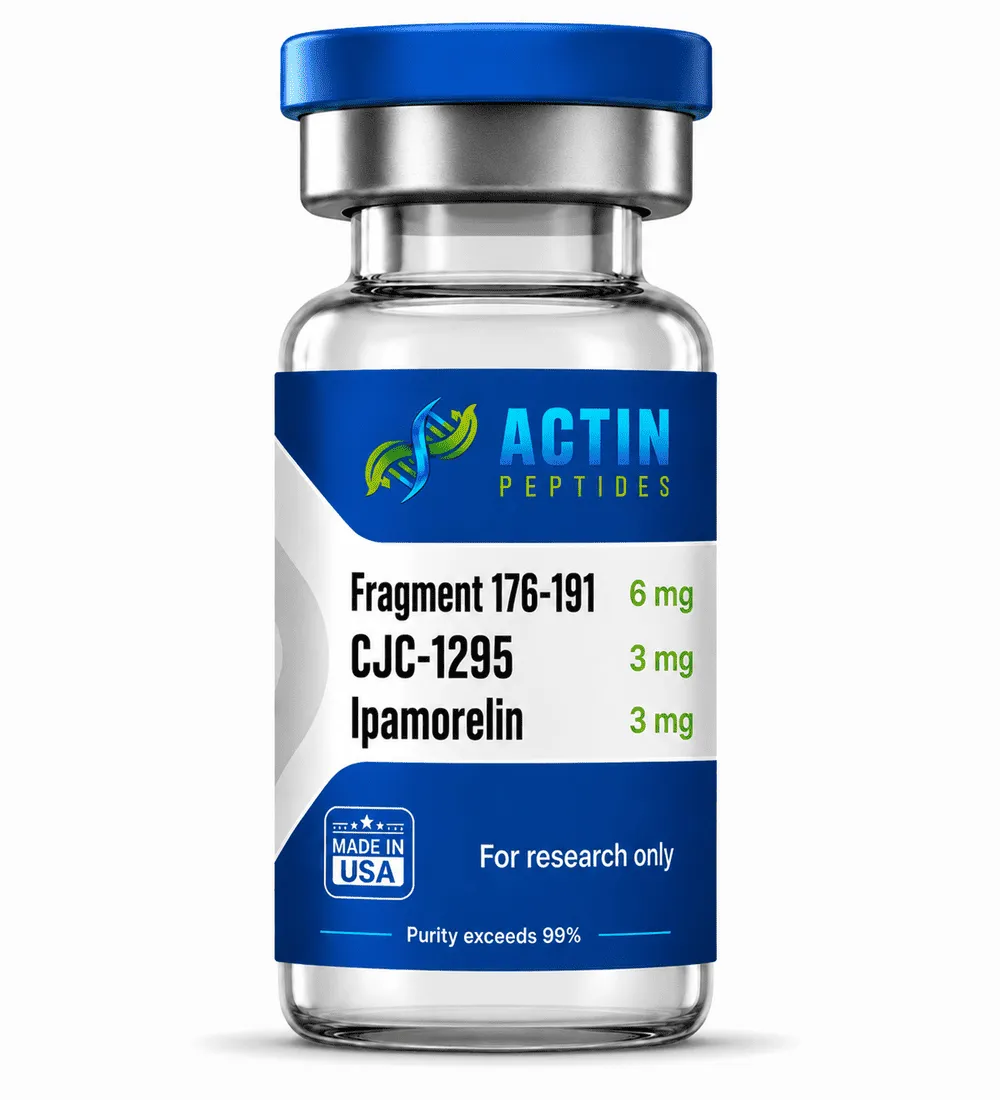
Fragment 176-191 & Mod GRF 1-29 & Ipamorelin Peptide Blend
Introduction
Fragment 176-191 & Mod GRF 1-29 & Ipamorelin Peptide Blend is a three-component research formulation combining peptides that scientists have investigated through different branches of growth hormone and metabolic biology.
The blend contains Fragment 176-191, an hGH-derived peptide studied primarily in adipose and metabolic research; Modified GRF 1-29, a stabilized growth hormone-releasing hormone (GHRH) analog studied for its interaction with pituitary GHRH receptors; and Ipamorelin, a synthetic pentapeptide studied for its interaction with the growth hormone secretagogue receptor (GHS-R1a).
In simple terms, the three components approach related biological systems from different directions. Fragment 176-191 is primarily investigated for peripheral metabolic and lipolytic signaling, while Mod GRF 1-29 and Ipamorelin have been studied for their interactions with separate receptor systems involved in pituitary growth hormone signaling.
For researchers exploring the Fragment 176-191 & Mod GRF 1-29 & Ipamorelin peptide blend, this multi-pathway design makes the formulation relevant to studies of endocrine signaling, growth hormone pulsatility, adipose biology, metabolism, energy expenditure, body-composition models, and cellular signaling.
Importantly, studies on the individual components should not be interpreted as proof that the same effects occur when all three peptides are combined. At present, direct studies examining this exact three-peptide combination remain limited.
What Is Fragment 176-191 & Mod GRF 1-29 & Ipamorelin Peptide Blend?
Fragment 176-191 & Mod GRF 1-29 & Ipamorelin Peptide Blend is a research formulation containing three synthetic peptides with distinct but potentially complementary mechanisms of scientific interest.
The blend combines:
- Fragment 176-191 — an hGH-derived peptide studied in adipose-tissue and metabolic signaling research.
- Modified GRF 1-29 — a stabilized GHRH analog studied for its interaction with the GHRH receptor.
- Ipamorelin — a synthetic growth hormone secretagogue studied for its interaction with GHS-R1a.
Together, these components provide researchers with a model for examining several parts of the growth hormone and metabolic signaling network within the same experimental framework.
Overview
Each peptide contributes a different area of scientific interest.
Fragment 176-191 and Metabolic Signaling
Fragment 176-191 is a synthetic peptide derived from the C-terminal region of human growth hormone. It contains 16 amino acids and is also commonly described as an hGH fragment or AOD-9604-related peptide in research literature.
Unlike full-length growth hormone, researchers have studied this fragment independently to examine its relationship with:
- Adipose-tissue signaling
- Lipolysis
- Lipid oxidation
- Energy expenditure
- β3-adrenergic receptor expression
- Cartilage and extracellular matrix research
Researchers interested specifically in hGH-derived metabolic peptides may also compare this component with other compounds in the Actin Peptides research catalog, including AOD-9604, MOTS-C, and Adipotide (FTPP).
Modified GRF 1-29 and GHRH Signaling
Modified GRF 1-29 is a shortened and modified analog of growth hormone-releasing hormone. It contains the biologically active N-terminal region of GHRH, while specific amino acid substitutions are designed to improve resistance to enzymatic degradation.
Researchers often describe Mod GRF 1-29 as:
- CJC-1295 without DAC
- CJC-1295 No DAC
- Modified GRF 1-29
- Tetrasubstituted GRF 1-29
The peptide has been studied primarily for its interaction with the GHRH receptor on anterior pituitary somatotroph cells.
Ipamorelin and Ghrelin-Receptor Signaling
Ipamorelin is a synthetic pentapeptide classified as a growth hormone secretagogue. Research indicates that it interacts with the growth hormone secretagogue receptor type 1a (GHS-R1a), also known as the ghrelin receptor.
This receptor is expressed in regions involved in endocrine signaling, including the pituitary and hypothalamus.
Researchers have studied Ipamorelin in connection with:
- Growth hormone secretagogue signaling
- Pituitary activity
- Pulsatile endocrine responses
- Ghrelin-receptor biology
- Bone and body-composition models
- Appetite and energy-balance research
How Does Fragment 176-191 & Mod GRF 1-29 & Ipamorelin Work?
The blend is designed around three distinct research pathways: peripheral metabolic signaling, GHRH receptor signaling, and GHS-R1a signaling.
Rather than acting as a single molecule, the blend contains components that have been investigated through separate biological mechanisms.
1. Fragment 176-191: Adipose and Lipolytic Signaling
Research suggests that Fragment 176-191 may influence metabolic pathways associated with adipose tissue. Studies have investigated changes in:
- Lipolytic activity
- Fat oxidation
- Energy expenditure
- β3-adrenergic receptor expression
- Adipocyte signaling
Experimental findings suggest that its biological activity may not depend entirely on a single β-adrenergic receptor pathway. This has led researchers to investigate broader metabolic mechanisms involving lipid utilization and energy regulation.
2. Mod GRF 1-29: GHRH Receptor and cAMP Signaling
Modified GRF 1-29 is studied for its interaction with GHRH receptors on somatotroph cells in the anterior pituitary.
Following receptor activation, researchers have investigated signaling involving:
- G-protein activation
- Adenylyl cyclase
- Cyclic adenosine monophosphate (cAMP)
- Protein kinase A (PKA)
- Calcium-channel activity
- Growth hormone secretion
The proposed sequence begins with GHRH receptor activation and may lead to increased intracellular cAMP. Researchers have further investigated whether downstream signaling affects calcium-dependent secretory activity in somatotroph cells.
3. Ipamorelin: GHS-R1a and Calcium Signaling
Ipamorelin is studied through a different receptor system.
Research suggests that activation of GHS-R1a may involve signaling through:
- G-proteins
- Phospholipase C
- Inositol trisphosphate
- Intracellular calcium
- Secretory vesicle activity
Because Mod GRF 1-29 and Ipamorelin interact with different receptor systems, researchers have explored whether simultaneous investigation of GHRH and growth hormone secretagogue pathways may provide a useful model for studying coordinated pituitary signaling.
Potential Relationship Between Mod GRF 1-29 and Ipamorelin
A major point of interest is that the two peptides are not believed to target the same primary receptor.
- Mod GRF 1-29 is studied at the GHRH receptor.
- Ipamorelin is studied at GHS-R1a.
This difference allows researchers to investigate two complementary upstream pathways involved in growth hormone regulation. However, the presence of both pathways in a blend should not be interpreted as proof of clinical synergy or established human efficacy.
What Makes This Three-Peptide Blend Unique?
The primary research distinction is its three-part approach to related but different biological systems.
Fragment 176-191 is investigated mainly for peripheral metabolic signaling. In contrast, Mod GRF 1-29 and Ipamorelin are studied for their interactions with two separate receptor systems involved in pituitary endocrine signaling.
This gives researchers an opportunity to examine:
- Adipose and lipid metabolism signaling
- GHRH receptor activity
- Growth hormone secretagogue receptor activity
within one research formulation.
Chemical Makeup
| Peptide | Molecular Formula | Molecular Weight | Alternative Names |
|---|---|---|---|
| Fragment 176-191 | C78H125N23O23S2 | 1817.12 g/mol | AOD 9604, hGH Fragment 176-191, lipolytic hGH fragment |
| Modified GRF 1-29 | C152H252N44O42 | 3367.9 g/mol | Mod GRF 1-29, CJC-1295 without DAC, CJC-1295 No DAC |
| Ipamorelin | C38H49N9O5 | 711.8 g/mol | Ipamorelin Acetate, IPA |
Research and Clinical Studies
Fragment 176-191 and Lipolytic Research
Study Objective
Researchers investigated whether the hGH-derived fragment could influence adipose metabolism and lipolytic signaling in experimental obesity models.
Methodology
Higher weight murine models were exposed to Fragment 176-191 over approximately two weeks. Investigators monitored changes in body weight, adipose tissue, receptor expression, and metabolic activity.
Findings
Studies reported reductions in body weight and adipose tissue alongside changes in β3-adrenergic receptor expression.
Additional research using models with altered lipolytic receptor signaling suggested that the observed metabolic activity may not depend exclusively on β3-adrenergic receptor activation.
Scientific Significance
These findings support continued research into the possibility that Fragment 176-191 may influence lipid metabolism through several pathways rather than a single receptor mechanism.
Mod GRF 1-29 and Ipamorelin: Pituitary Signaling Research
Study Objective
Researchers have investigated GHRH analogs and growth hormone secretagogues to understand how different pituitary receptors may coordinate endocrine signaling.
Methodology
Experimental research has examined receptor activation, intracellular signaling, calcium activity, and hormone secretion following exposure to peptides acting through GHRH and GHS-R pathways.
Findings
Mod GRF 1-29 has been studied for activation of GHRH receptor signaling and downstream cAMP-related pathways.
Ipamorelin has been investigated for GHS-R1a activation and calcium-dependent intracellular signaling.
Scientific Significance
The two components represent distinct research tools for studying upstream endocrine pathways. Their combination is therefore relevant to experiments examining coordinated or multi-receptor growth hormone signaling.
Fragment 176-191 and Metabolic Research
Study Objective
Clinical research involving Fragment 176-191-related compounds has explored changes in body-composition and metabolic markers.
Methodology
A larger clinical investigation examined several peptide concentrations over approximately 12 weeks, comparing peptide-exposed groups with a placebo group.
Findings
Researchers reported differences in body-weight measurements and metabolic markers, including observations related to glucose tolerance and lipid profiles.
Scientific Significance
These findings helped expand interest in the hGH-derived fragment as a tool for studying adipose biology and energy metabolism. However, experimental findings should not be interpreted as evidence that the complete three-peptide blend produces the same outcomes.
Fragment 176-191 and Cartilage Research
Study Objective
Researchers investigated whether an hGH-derived fragment could influence cartilage changes in an experimental joint model.
Methodology
Experimental rabbits were divided into groups receiving a control, the peptide, hyaluronic acid, or a combination of peptide and hyaluronic acid. Investigators later assessed cartilage degeneration.
Findings
The combination group showed less cartilage degeneration than comparison groups in the experimental model.
Scientific Significance
The study broadened interest in Fragment 176-191 beyond adipose research and into extracellular matrix and cartilage biology.
For researchers studying peptides involved in tissue structure and extracellular matrix biology, related research compounds may include BPC-157, TB-500, and GHK-Cu.
Ipamorelin and Bone Mineral Research
Study Objective
Scientists investigated whether Ipamorelin could influence skeletal parameters in experimental catabolic models.
Methodology
Researchers monitored bone mineral content and structural measurements using imaging methods including DEXA and peripheral quantitative computed tomography.
Findings
Experimental studies reported changes in bone mineral content and cortical bone measurements compared with controls.
Scientific Significance
These findings support continued investigation of Ipamorelin in growth hormone secretagogue research involving skeletal biology and bone metabolism.
Ipamorelin and Appetite Signaling Research
Study Objective
Researchers examined whether activation of ghrelin-related signaling by Ipamorelin could influence food intake and energy balance.
Methodology
Experimental murine models were monitored for changes in body weight, fat distribution, and appetite-related metabolic markers.
Findings
Some experimental studies reported increased body weight and changes in fat-pad mass. Researchers also investigated alterations in leptin and appetite-related signaling.
Scientific Significance
These findings highlight the complexity of GHS-R1a research. Ghrelin-related signaling extends beyond growth hormone biology and may also interact with energy balance and feeding behavior.
Important Research Limitation: No Established Direct Combination Studies
There are currently no widely established studies demonstrating the biological effects of Fragment 176-191, Mod GRF 1-29, and Ipamorelin together in the same experimental model.
This distinction is important.
Research involving one component cannot automatically establish the behavior of the complete blend. The peptides have different molecular structures, receptor targets, and signaling mechanisms.
Therefore, researchers should interpret the blend as a combination of three individually studied research compounds rather than as a clinically validated combination.
What Is Fragment 176-191 & Mod GRF 1-29 & Ipamorelin Researched For?
Scientists have also investigated the individual components of the blend in relation to:
- Growth hormone signaling
- GHRH receptor activity
- GHS-R1a receptor signaling
- Pituitary somatotroph biology
- Lipid metabolism
- Lipolysis
- Adipose tissue
- Energy expenditure
- Bone mineralization
- Cartilage biology
- Cellular signaling
- Appetite and energy-balance pathways
The exact three-peptide combination remains an area requiring further direct research.</p>
Fragment 176-191 & Mod GRF 1-29 & Ipamorelin Benefits Research
The phrase “Fragment 176-191 & Mod GRF 1-29 & Ipamorelin benefits research” refers to biological observations investigated in laboratory and experimental settings.
Research has explored whether the individual components may support the study of:</p>
- Multi-pathway endocrine signaling
- Growth hormone pulsatility
- Metabolic regulation
- Lipid mobilization
- Adipocyte biology
- Cellular energy metabolism
- Bone and extracellular matrix biology
These research areas do not establish therapeutic benefits or clinical efficacy.
Fragment 176-191 & Mod GRF 1-29 & Ipamorelin Peptide for Sale
Researchers looking to buy Fragment 176-191 & Mod GRF 1-29 & Ipamorelin peptide blend should evaluate product-specific analytical documentation, purity testing, peptide identity, handling requirements, and applicable laboratory procedures.
For broader comparative research, Actin Peptides also provides individual compounds and related formulations for studies involving metabolic and growth hormone signaling pathways.</p>
Frequently Asked Questions
What is Fragment 176-191 & Mod GRF 1-29 & Ipamorelin peptide blend?
It is a three-component research blend containing an hGH-derived metabolic peptide, a stabilized GHRH analog, and a GHS-R1a agonist studied for different aspects of metabolic and endocrine signaling.
How does the blend work?
Fragment 176-191 is studied mainly for metabolic and adipose signaling, while Mod GRF 1-29 and Ipamorelin interact with separate receptor pathways involved in pituitary growth hormone regulation.
Is Fragment 176-191 the same as growth hormone?
No. Fragment 176-191 is a small synthetic fragment derived from the human growth hormone sequence and does not represent full-length hGH.
Is Mod GRF 1-29 the same as CJC-1295?
Mod GRF 1-29 is commonly referred to as CJC-1295 without DAC or CJC-1295 No DAC. It differs from DAC-containing formulations in structure and pharmacokinetic design.
What receptor does Ipamorelin target?
Ipamorelin has been studied primarily for its interaction with the growth hormone secretagogue receptor type 1a, also called GHS-R1a or the ghrelin receptor.</p>
Is there evidence that all three peptides work together?
Direct research on the exact three-component combination remains limited. Researchers should not automatically attribute findings from studies of the individual peptides to the complete blend
What makes the blend unique?
Its primary research interest comes from combining three distinct signaling approaches: hGH-fragment metabolic research, GHRH receptor signaling, and GHS-R1a signaling.
Conclusion
Fragment 176-191 & Mod GRF 1-29 & Ipamorelin Peptide Blend brings together three research compounds with distinct mechanisms and overlapping relevance to endocrine and metabolic biology.
Fragment 176-191 has been studied primarily for adipose signaling, lipolysis, and energy metabolism. Modified GRF 1-29 is investigated through GHRH receptor signaling, while Ipamorelin provides a separate model for examining GHS-R1a and ghrelin-related pathways.</p>
This structure makes the blend relevant to researchers investigating the relationship between peripheral metabolic signaling and upstream endocrine communication. At the same time, an important scientific limitation remains: individual peptide findings do not establish the effects of the complete three-peptide combination.</p>
Further direct research is needed to determine how the three components interact within the same experimental system.</p>
Research Disclaimer
Fragment 176-191 & Mod GRF 1-29 & Ipamorelin Peptide Blend is available strictly for research and laboratory purposes only. It is not approved for human consumption, therapeutic use, or diagnostic applications. Please review our Terms and Conditions before placing an order.</p>

 English
 French
Reviews
There are no reviews yet.