
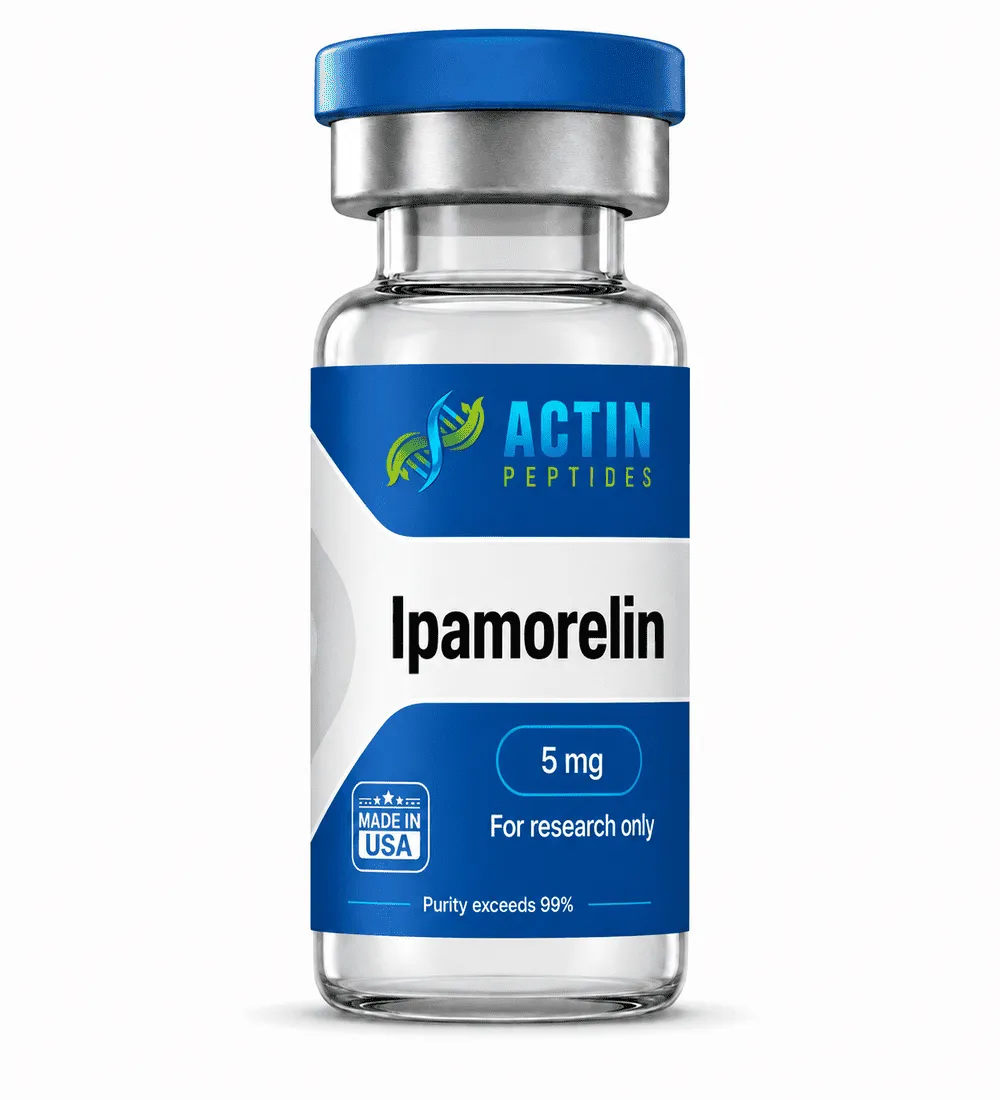
Description
Ipamorelin Peptide: Research, Mechanism of Action, Benefits, and Scientific Studies
What Is Ipamorelin?
Ipamorelin is a synthetic pentapeptide and selective Growth Hormone Secretagogue (GHS) that has been extensively studied for its potential ability to stimulate growth hormone (GH) release. Unlike many earlier growth hormone-releasing compounds, researchers suggest that Ipamorelin may promote growth hormone secretion while exhibiting minimal effects on other pituitary hormones.
Ipamorelin Peptide for Sale
Ipamorelin Peptide for sale (5mg) online. Explore quality-formulated Ipamorelin (5mg) with fast shipping, competitive pricing, and secure ordering. Shop now. Ipamorelin is a synthetic peptide that is composed of five amino acids, otherwise known as a pentadecapeptide (Aib-His-D-2-Nal-D-Phe-Lys-NH2), formally classified as a Growth Hormone Secretagogue (GHS). Its name is derived from the intention of its development.
Overview
Originally developed as a highly selective ghrelin receptor agonist, Ipamorelin interacts with Growth Hormone Secretagogue Receptors (GHS-R1a) located primarily within the pituitary gland. These receptors are the same targets activated by the naturally occurring hormone ghrelin, which plays a role in appetite regulation, metabolism, and growth hormone release.
Because of its receptor selectivity, Ipamorelin has become one of the most widely studied peptides in research involving growth hormone signaling, muscle biology, metabolism, tissue regeneration, and healthy aging.
How Ipamorelin Works
Research suggests that Ipamorelin exerts its effects by binding to growth hormone secretagogue receptors located on somatotroph cells within the anterior pituitary gland.
Upon receptor activation, scientists believe Ipamorelin may initiate a signaling cascade involving:
- Phospholipase C (PLC)
- Inositol Triphosphate (IP3)
- Diacylglycerol (DAG)
- Protein Kinase C (PKC)
- Intracellular Calcium Release
This sequence of cellular events may promote the release of stored growth hormone from pituitary cells.
Unlike certain other growth hormone secretagogues, Ipamorelin has demonstrated remarkable selectivity, potentially stimulating growth hormone secretion without significantly increasing prolactin or adrenocorticotropic hormone (ACTH) levels.
Ipamorelin Chemical Information
| Property | Value |
|---|---|
| Peptide Name | Ipamorelin |
| Molecular Formula | C38H49N9O5 |
| Molecular Weight | 711.86 g/mol |
| Classification | Growth Hormone Secretagogue (GHS) |
| Receptor Target | GHS-R1a (Ghrelin Receptor) |
| Alternate Name | NNC 26-0161 |
Ipamorelin Research Applications
Ipamorelin for Growth Hormone Release
The primary focus of Ipamorelin research is its potential ability to stimulate endogenous growth hormone secretion.
Early studies demonstrated that Ipamorelin may act as a selective agonist of growth hormone secretagogue receptors, promoting GH release from pituitary cells. Researchers noted that its specificity for growth hormone secretion appeared similar to that of naturally occurring Growth Hormone Releasing Hormone (GHRH).
Furthermore, several investigations have suggested that Ipamorelin may increase circulating growth hormone concentrations while maintaining minimal influence on other endocrine pathways.
This unique selectivity remains one of the defining characteristics of the peptide.
Ipamorelin and IGF-1 Signaling
Growth hormone release often leads to increased production of Insulin-Like Growth Factor-1 (IGF-1), a hormone involved in cellular growth, tissue repair, and anabolic signaling.
Researchers have proposed that Ipamorelin-induced growth hormone secretion may indirectly support:
- IGF-1 production
- Cellular regeneration pathways
- Protein synthesis
- Tissue maintenance
- Recovery processes
These mechanisms continue to be investigated in both laboratory and preclinical settings.
Ipamorelin for Muscle Growth
Because growth hormone and IGF-1 play important roles in muscle physiology, researchers have explored Ipamorelin’s potential impact on muscle-related biological processes.
Areas of ongoing interest include:
- Muscle protein synthesis
- Cellular growth signaling
- Recovery mechanisms
- Nitrogen retention
- Lean tissue maintenance
Although research remains ongoing, these pathways have contributed to growing scientific interest in Ipamorelin’s anabolic signaling potential.
Ipamorelin for Bone Health
Studies suggest that growth hormone signaling may influence bone remodeling and skeletal development.
Experimental investigations involving animal models have evaluated whether Ipamorelin may affect:
- Bone mineral content (BMC)
- Bone formation pathways
- Osteoblast activity
- Skeletal growth
Researchers observed increases in bone mineral content and overall bone size measurements in specific skeletal regions, while bone density remained relatively unchanged. These findings indicate that Ipamorelin may influence bone growth and structural development through growth hormone-mediated mechanisms.
Ipamorelin and Digestive Function
One of the more unique areas of Ipamorelin research involves gastrointestinal physiology.
Because the peptide targets ghrelin receptors, scientists have explored its potential role in regulating digestive processes, including:
- Gastric emptying
- Digestive motility
- Gastrointestinal transit
- Smooth muscle contractility
Preclinical studies reported that Ipamorelin appeared to accelerate delayed gastric emptying and improve digestive motility under experimental conditions.
Researchers continue to investigate how ghrelin receptor activation may contribute to these observations.
Ipamorelin for Appetite Regulation
Ghrelin is often referred to as the “hunger hormone” because it plays a key role in appetite signaling.
Since Ipamorelin activates ghrelin receptors, researchers have examined whether the peptide may influence:
- Hunger signaling
- Food intake
- Energy balance
- Body composition
Several studies have reported increases in body weight and fat mass in research models following prolonged exposure, suggesting that appetite stimulation may contribute to some of the peptide’s observed effects.
These findings continue to be explored within metabolic and endocrine research.
Ipamorelin Peptide for Metabolism
Researchers have investigated the relationship between Ipamorelin, growth hormone secretion, and metabolic regulation.
Areas of interest include:
- Fat metabolism
- Lipolysis
- Energy utilization
- Hormonal regulation
- Nutrient partitioning
Because growth hormone influences multiple metabolic pathways, scientists continue to study how selective growth hormone secretagogues may affect overall metabolic function.
Ipamorelin and Nitrogen Balance
Nitrogen balance is often used as an indicator of anabolic and catabolic activity within the body.
Research evaluating Ipamorelin’s effects during experimentally induced catabolic states suggested the peptide may:
- Improve nitrogen retention
- Reduce urea synthesis
- Support protein conservation
- Influence amino acid metabolism
These findings have prompted further investigation into Ipamorelin’s potential role in preserving lean tissue and supporting anabolic processes.
Why Researchers Study Ipamorelin
Ipamorelin has become one of the most extensively researched growth hormone secretagogues because of its unique receptor selectivity and ability to stimulate growth hormone release without significantly affecting other pituitary hormones.
Key areas of scientific interest include:
- Growth hormone secretion
- IGF-1 signaling
- Muscle physiology
- Bone health
- Digestive function
- Metabolic regulation
- Nitrogen balance
- Healthy aging research
Its targeted mechanism of action continues to make Ipamorelin a valuable tool in peptide and endocrine research.
Frequently Asked Questions About Ipamorelin
What is Ipamorelin?
Ipamorelin is a synthetic growth hormone secretagogue that selectively activates ghrelin receptors to stimulate growth hormone release.
How does Ipamorelin work?
Ipamorelin binds to Growth Hormone Secretagogue Receptors (GHS-R1a), triggering cellular pathways that promote growth hormone secretion from the pituitary gland.
Why is Ipamorelin unique?
Unlike many growth hormone secretagogues, Ipamorelin appears highly selective for growth hormone release and may have minimal impact on prolactin and ACTH secretion.
What Does Ipamorelin Do?
Ipamorelin is a synthetic peptide studied for its ability to stimulate the body’s natural release of growth hormone by activating ghrelin receptors in the pituitary gland. Research suggests it may increase growth hormone levels with minimal effects on other pituitary hormones.
What is Ipamorelin researched for?
Researchers investigate Ipamorelin for its potential effects on growth hormone signaling, IGF-1 production, muscle biology, bone metabolism, digestive function, and metabolic health.
Sermorelin vs Tesamorelin vs Ipamorelin?
Sermorelin, tesamorelin, and ipamorelin are all synthetic peptides that stimulate your pituitary gland to naturally produce more growth hormone (GH). However, they differ significantly in their potency, primary health applications, and how they interact with your body
Research Use Disclaimer
Ipamorelin peptide is intended strictly for laboratory and scientific research purposes only. This product is not approved for human consumption, medical use, diagnosis, treatment, or prevention of any disease. Researchers should review all applicable regulations and guidelines before purchasing or conducting studies involving Ipamorelin. Please review and adhere to our Terms and Conditions before ordering.
 English
  French
Reviews
There are no reviews yet.