
Description
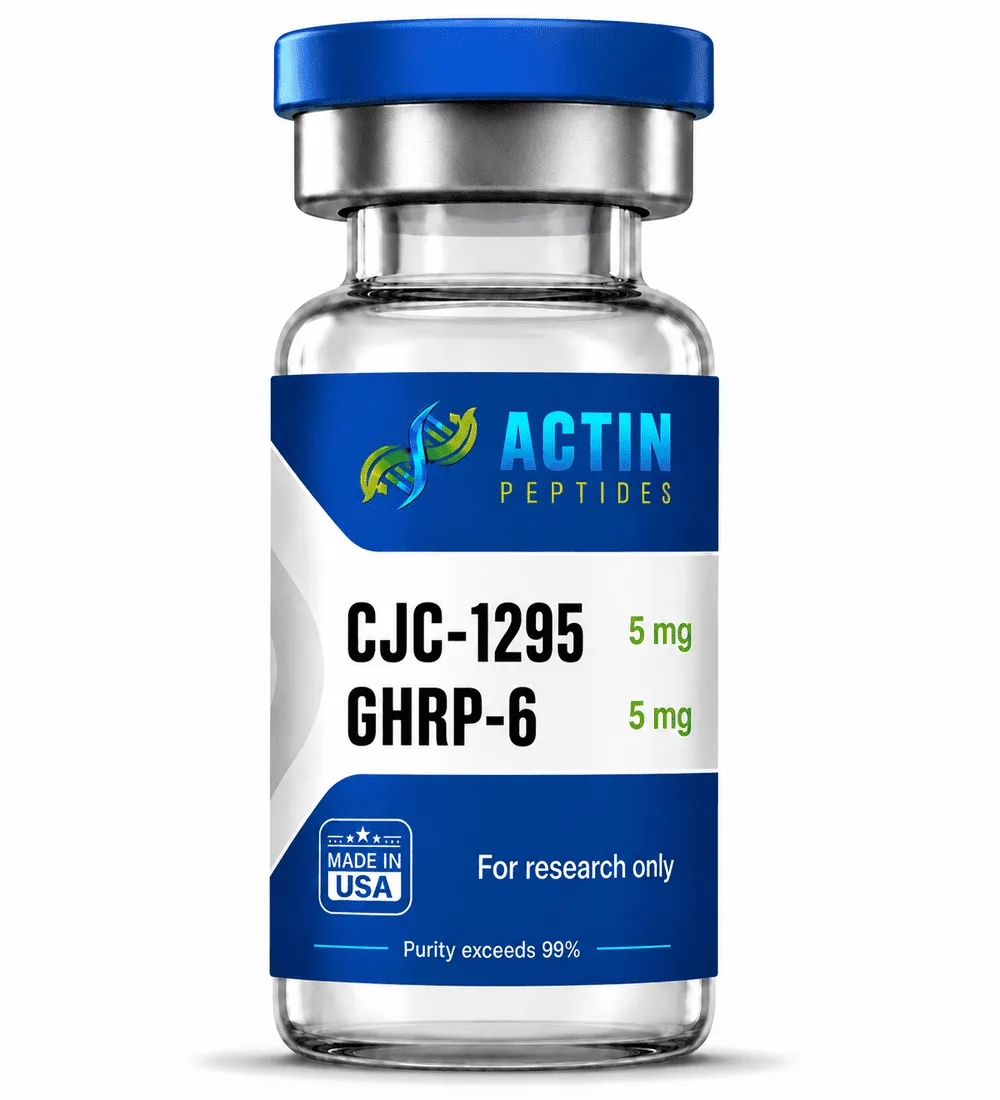
CJC-1295 & GHRP-6 Peptide Blend
Introduction
CJC-1295 & GHRP-6 peptide blend combines two synthetic peptides that researchers have studied for their effects on growth hormone signaling. CJC-1295 is a synthetic analog of growth hormone-releasing hormone (GHRH), while GHRP-6 is a synthetic growth hormone secretagogue associated with the growth hormone secretagogue receptor (GHS-R1a).
Research on the individual peptides has examined growth hormone release, insulin-like growth factor-1 (IGF-1) signaling, cellular responses, gastrointestinal activity, and other physiological pathways. However, the available research does not establish that the specific CJC-1295 and GHRP-6 combination produces a clinically meaningful synergistic effect. Therefore, the blend is best understood as a research formulation based on two separately studied growth hormone-related peptides.
For researchers comparing related compounds, Actin Peptides also offers GHRP-6 peptide, IGF-1 LR3 de qualité récepteur, and other peptides investigated in growth-factor and cellular-signaling research.
Aperçu
What is CJC-1295 & GHRP-6?
CJC-1295 and GHRP-6 are synthetic peptides investigated for their ability to influence growth hormone-related signaling through different biological pathways.
CJC-1295
CJC-1295, also described as a modified GRF (1-29) analog, is derived from the first 29 amino acids of growth hormone-releasing hormone. Researchers designed structural modifications within the sequence to alter its stability and pharmacokinetic characteristics.
Research has investigated CJC-1295 for its effects on growth hormone secretion and downstream IGF-1 signaling.
GHRP-6
GHRP-6 is a synthetic hexapeptide classified as a growth hormone secretagogue. Researchers have studied its interaction with GHS-R1a, a receptor associated with growth hormone secretion.
Unlike ghrelin, GHRP-6 does not share the same amino-acid sequence. Nevertheless, researchers have investigated its ability to interact with the growth hormone secretagogue receptor system.
Why combine CJC-1295 and GHRP-6?
The rationale for studying the two peptides together comes from their different mechanisms within growth hormone signaling.
CJC-1295 is associated with the GHRH pathway, whereas GHRP-6 is associated with the growth hormone secretagogue pathway. Researchers have therefore investigated whether activating these pathways together produces a different growth hormone response from either peptide alone.
Importantly, studies specifically evaluating this commercial blend formulation remain limited.
CJC-1295 & GHRP-6 Mechanism of Action
CJC-1295 and GHRH receptor signaling
CJC-1295 is structurally related to the active region of GHRH. Researchers propose that it interacts with GHRH receptors on pituitary cells, initiating intracellular signaling associated with growth hormone secretion.
The resulting signaling may influence downstream production of IGF-1, an important mediator of several biological effects associated with growth hormone.
GHRP-6 and GHS-R1a
GHRP-6 has been studied as an agonist of the growth hormone secretagogue receptor, commonly designated GHS-R1a.
Activation of this receptor can participate in signaling that promotes growth hormone release. Researchers have also investigated GHRP-6 in relation to other cellular pathways, including systems involving IGF-1, Akt, and apoptosis-related proteins.
Potential interaction between the pathways
The research rationale for combining the two peptides is based on their different signaling routes:
CJC-1295 → GHRH receptor → growth hormone signaling
GHRP-6 → GHS-R1a → growth hormone secretagogue signaling
Because these pathways can interact physiologically, researchers have investigated whether simultaneous stimulation produces a greater growth hormone response.
However, evidence from studies of individual peptides should not automatically be interpreted as evidence that a particular CJC-1295/GHRP-6 blend has the same effect.
CJC-1295 With DAC vs. Without DAC
CJC-1295 is commonly discussed in two forms: with DAC et without DAC.
DAC refers to the Drug Affinity Complex, a structural modification designed to alter the peptide’s interaction with plasma proteins and its pharmacokinetic profile.
CJC-1295 with DAC
Research has investigated the DAC-modified form for prolonged activity and altered plasma persistence. The modification involves attaching a lysine-derived component to the peptide.
CJC-1295 without DAC
The non-DAC form is generally described as a shorter-acting GRF analog because it lacks the additional protein-binding modification.
Consequently, researchers distinguish the two forms primarily according to their pharmacokinetic characteristics rather than treating them as completely different signaling molecules.
Composition chimique
| Property | CJC-1295 | GHRP-6 |
|---|---|---|
| Type de peptide | Analogue modifié de la GHRH | sécrétagogue de l'hormone de croissance |
| Molecular Formula | C152H252N44O42 | C46H56N12O6 |
| Molecular Weight | 3367.9 g/mol | 873.0 g/mol |
| Related Names | Modified GRF (1-29), CJC-1295 DAC | Growth Hormone-Releasing Hexapeptide |
| Primary Research System | GHRH receptor signaling | GHS-R1a signaling |
The molecular characteristics above describe the individual research compounds rather than a newly occurring biological molecule created by combining the two peptides.
Recherche et études cliniques
CJC-1295 & GHRP-6 Research and Growth Hormone Signaling
CJC-1295 and growth hormone levels
Study objective:
Researchers investigated whether CJC-1295 could influence circulating growth hormone concentrations.
Methodology:
Clinical research examined adult male participants who received CJC-1295 or placebo. Researchers collected blood samples before and after peptide exposure.
Findings:
The reported research observed substantial increases in growth hormone concentrations following CJC-1295 exposure, with changes persisting beyond the immediate observation period.
Scientific significance:
These findings provide research support for continued investigation of long-acting GHRH analogs and their effects on growth hormone signaling.
CJC-1295 and Concentration-Dependent Growth Hormone Research
Study objective:
Researchers evaluated whether different concentrations of CJC-1295 produced different growth hormone responses.
Methodology:
Participants received different peptide concentrations, while a comparison group received placebo. Researchers subsequently analyzed blood samples.
Findings:
The reported results indicated a concentration-dependent increase in growth hormone levels, with some experimental conditions producing substantially higher concentrations than placebo.
Scientific significance:
The research provides evidence for investigating the relationship between GHRH receptor stimulation and circulating growth hormone concentrations.
It also highlights the connection between growth hormone and IGF-1, which researchers commonly evaluate as a downstream growth-factor signal.
GHRP-6 and Growth Hormone Research
Study objective:
Researchers examined the growth hormone response associated with GHRP-6 exposure.
Methodology:
Experimental subjects received GHRP-6 either alone or alongside arginine, which researchers commonly study as a modulator of growth hormone secretion.
Findings:
The research reported increases in growth hormone concentrations following GHRP-6 exposure, with comparable responses observed across the experimental conditions.
Scientific significance:
These findings support continued investigation of GHRP-6 as a growth hormone secretagogue and provide context for studying its interaction with other growth hormone signaling pathways.
CJC-1295 and GHRP-6 Research in Thyroid-Related Models
Researchers have also investigated interactions between GHRH/GHRP signaling and thyroid status.
Study objective
The research examined growth hormone responses to GHRH, GHRP-6, and combinations of these signaling agents in subjects with altered thyroid function.
Méthodologie
Experimental groups received individual peptides or combinations, after which researchers assessed growth hormone responses.
Résultats
The reported results indicated that combining GHRH-related signaling with GHRP-6 produced a stronger growth hormone response than some individual treatments.
Scientific significance
These observations are relevant to research into the relationship between thyroid hormones, somatostatin, GHRH, and GHRP signaling.
However, these findings should not be interpreted as evidence that the CJC-1295 & GHRP-6 blend is an established treatment for thyroid disorders.
CJC-1295 & GHRP-6 Research and Cellular Signaling
GHRP-6 and Gastrointestinal Cellular Research
Researchers have investigated GHRP-6 in experimental models involving gastrointestinal cellular function.
Some laboratory studies reported changes in intestinal epithelial activity and cellular migration following exposure to growth hormone secretagogues.
Researchers have also explored the potential involvement of CD36, a membrane-associated receptor expressed by several cell types, including certain muscle, immune, and adipose cells.
Because CD36 participates in lipid metabolism, inflammatory signaling, and vascular biology, its relationship with GHRP-6 remains an area of scientific interest.
Scientific significance
These findings provide a basis for investigating how growth hormone secretagogues may interact with cellular signaling systems beyond the pituitary.
They do not establish a therapeutic gastrointestinal application for GHRP-6.
GHRP-6 and Gastrointestinal Transit Research
Experimental research has investigated whether GHRP-6 influences gastrointestinal motility in animal models with altered metabolic conditions.
Researchers reported changes in gastric emptying and intestinal transit following peptide exposure, while some aspects of colonic transit did not demonstrate the same response.
Scientific significance
These observations indicate that growth hormone secretagogue signaling may interact with gastrointestinal regulatory pathways. Additional research is necessary to clarify the underlying mechanisms and their relevance outside experimental models.
CJC-1295 and Cardiac Research
Researchers have also studied GHRH analogs, including compounds related to CJC-1295, in experimental cardiac models.
These investigations have examined processes such as:
- Cardiac tissue remodeling
- Growth-factor signaling
- Angiogenèse
- Cardiac cell survival
- Myocardial structural changes
Some experimental studies reported changes in cardiac function and tissue characteristics following GHRH-related peptide exposure.
Scientific significance
This research contributes to broader investigations into the role of GHRH signaling in cardiovascular biology.
Importantly, these experimental findings do not establish CJC-1295 as a cardiovascular therapy.
GHRP-6 and Neuroendocrine Research
Researchers have examined GHRP-6 in relation to the IGF-1 system within different regions of the brain.
Study objective
The objective was to investigate whether GHRP-6 could influence IGF-1-related signaling in specific brain regions.
Méthodologie
Experimental animal models received GHRP-6 exposure over a defined period. Researchers subsequently examined IGF-1 messenger RNA (mRNA), IGF-related proteins, and intracellular signaling markers.
Résultats
The reported findings included increased IGF-1 mRNA in selected regions, including the:
- Hypothalamus
- Cerebellum
- Hippocampus
Researchers also observed changes involving Akt and Bad, proteins associated with cellular survival and apoptosis signaling.
Scientific significance
These observations suggest that growth hormone secretagogue signaling may interact with neuroendocrine growth-factor pathways.
The findings remain experimental and should not be interpreted as evidence of a neurological therapeutic effect.
What Is CJC-1295 & GHRP-6?
CJC-1295 & GHRP-6 is a research peptide blend combining a modified GHRH analog with a growth hormone secretagogue. Researchers study the individual compounds for their effects on growth hormone-related signaling and downstream pathways.
How Does CJC-1295 & GHRP-6 Work?
CJC-1295 is associated with GHRH receptor signaling, while GHRP-6 interacts with the growth hormone secretagogue receptor GHS-R1a. Their distinct pathways provide a research basis for studying combined growth hormone signaling.
What Is CJC-1295 & GHRP-6 Researched For?
Research has examined the individual peptides in relation to growth hormone secretion, IGF-1 signaling, gastrointestinal activity, cellular signaling, neuroendocrine pathways, and experimental tissue models.
What Makes CJC-1295 & GHRP-6 Unique?
The blend combines two peptides that influence different components of the growth hormone regulatory network. CJC-1295 represents GHRH-related signaling, while GHRP-6 represents growth hormone secretagogue signaling.
Recherche sur les peptides connexes
Researchers interested in growth hormone and growth-factor signaling may also explore related compounds available through Actin Peptides.
Par exemple, GHRP-6 peptide provides a single-compound research option for investigating GHS-R1a signaling.
IGF-1 LR3 de qualité récepteur can provide a separate research model for investigating IGF-related signaling.
Other growth-hormone-related research compounds include Sermorelin, which is studied as a GHRH-related peptide, and Tesamoréline, another GHRH analog investigated in growth-factor research.
For researchers studying cellular repair and signaling alongside growth-factor pathways, BPC-157 et TB-500 provide additional research compounds with distinct mechanisms.
CJC-1295 & GHRP-6 Peptide Benefits Research: What Does the Evidence Show?
The available evidence primarily concerns the individual peptides, rather than this specific commercial blend. Research suggests that:
- CJC-1295 can influence GHRH-related growth hormone signaling.
- GHRP-6 can stimulate growth hormone secretagogue signaling.
- Both compounds have been investigated in relation to IGF-1 and downstream cellular pathways.
- Experimental research has examined GHRP-6 in gastrointestinal and neuroendocrine models.
- GHRH-related compounds have also been investigated in experimental cardiovascular models.
- Direct research establishing additional benefits from combining CJC-1295 and GHRP-6 remains limited.
This distinction is important for interpreting CJC-1295 & GHRP-6 studies accurately.
Foire aux questions
Is CJC-1295 & GHRP-6 a growth hormone peptide blend?
Yes. The blend combines CJC-1295, a GHRH-related peptide, with GHRP-6, a growth hormone secretagogue. Researchers investigate both compounds for their effects on growth hormone signaling.
What is CJC-1295 researched for?
CJC-1295 has been studied primarily in relation to GHRH receptor signaling, growth hormone secretion, and downstream IGF-1 activity.
What is GHRP-6 researched for?
GHRP-6 has been investigated for growth hormone secretagogue activity and for its potential interactions with IGF-1, gastrointestinal, neuroendocrine, and cellular signaling pathways.
Is CJC-1295 the same as CJC-1295 DAC?
No. CJC-1295 with DAC contains an additional drug-affinity modification intended to alter its pharmacokinetic characteristics. CJC-1295 without DAC lacks this modification.
Does research prove that combining CJC-1295 and GHRP-6 is synergistic?
No. Although the peptides influence different growth hormone signaling pathways, the available research does not establish that every CJC-1295 and GHRP-6 formulation produces a clinically meaningful synergistic effect.
Is this peptide blend FDA approved?
No approval should be implied. This product is marketed by Actin Peptides as a research compound and should not be represented as an FDA-approved drug or treatment.
Conclusion
CJC-1295 & GHRP-6 peptide research centers on two complementary components of growth hormone regulation. CJC-1295 is associated with GHRH receptor signaling, while GHRP-6 interacts with the growth hormone secretagogue system.
Studies of the individual peptides have investigated growth hormone release, IGF-1 signaling, gastrointestinal physiology, neuroendocrine pathways, and experimental cellular responses. Nevertheless, researchers have not established the clinical efficacy or therapeutic benefits of the specific blend.
For accurate scientific interpretation, findings from individual CJC-1295 and GHRP-6 studies should remain distinguished from evidence directly examining their combined formulation.
Avertissement relatif à la recherche
CJC-1295 & GHRP-6 peptide blend is available strictly for research and laboratory purposes only. It is not approved for human consumption, therapeutic use, or diagnostic applications. Please review our Termes et conditions avant de passer commande.
 English
  French
Avis
Il n’y a pas encore d’avis.