
Description
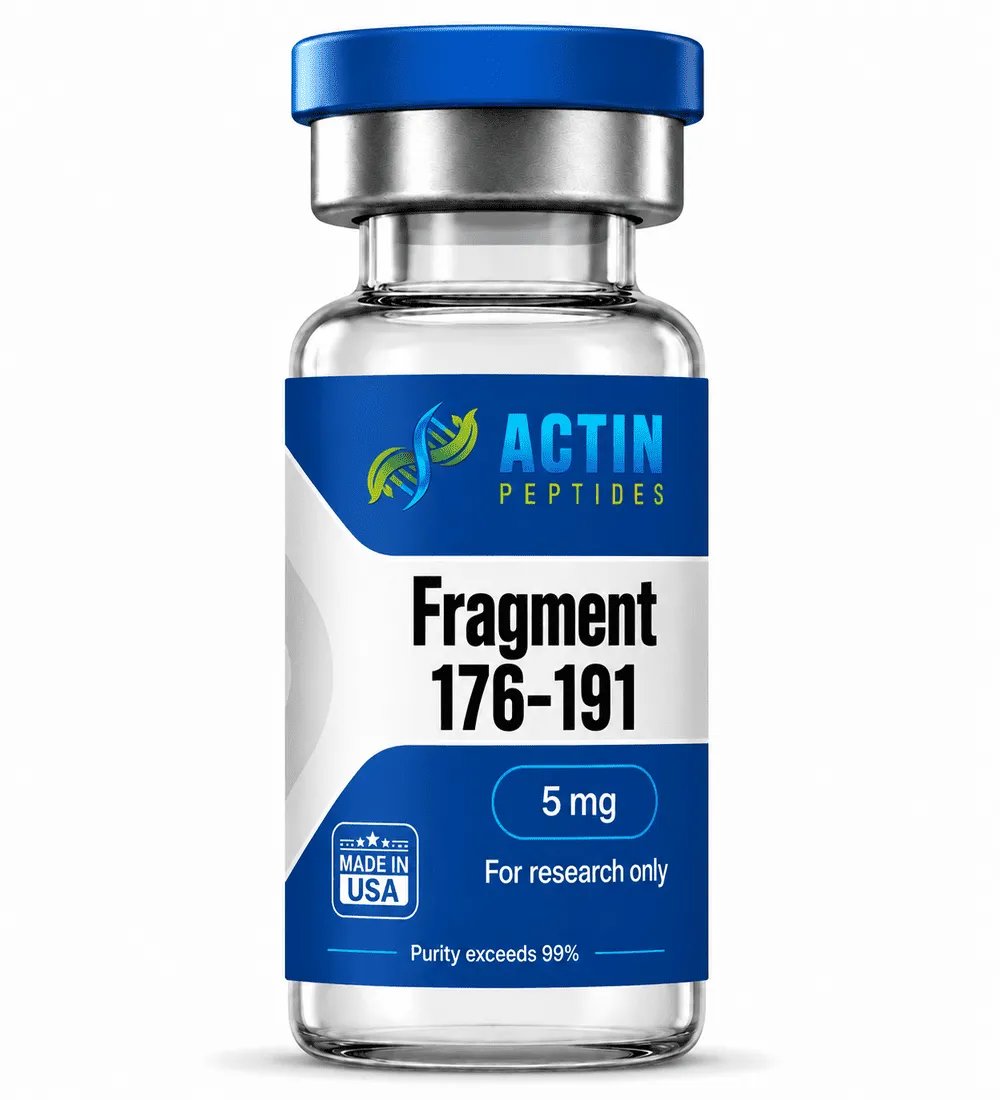
Fragment 176-191 Peptide – Research on Lipolytic Signaling, Metabolism, and hGH Fragment Studies
Introduction
Fragment 176-191 peptide, also known as hGH Fragment 176-191, tyr-hGH 177-191, or lipolytic fragment, is a synthetic peptide derived from the C-terminal region of human growth hormone (hGH). Researchers have studied this 16-amino-acid fragment primarily in relation to adipose-tissue signaling, lipid metabolism, energy expenditure, and other biological processes associated with the growth hormone molecule.
Unlike full-length human growth hormone, Fragment 176-191 represents a specific portion of the hGH sequence that researchers have investigated independently. Studies have explored whether this region may influence lipolytic signaling without reproducing all of the biological activities associated with intact growth hormone.
The compound is therefore of interest within peptide research, particularly studies involving adipocytes, beta-3 adrenergic receptor signaling, lipid metabolism, cartilage models, and glucose-related pathways.
What Is Fragment 176-191 Peptide?
Fragment 176-191 is a synthetic 16-amino-acid peptide corresponding to a C-terminal region of human growth hormone. Researchers have investigated this sequence as a potential lipolytic fragment of hGH, particularly because experimental models have associated it with changes in adipose-tissue metabolism.
The peptide is also referred to as tyr-hGH 177-191 because the N-terminal residue has been modified with tyrosine. Researchers have proposed that this modification may improve peptide stability.
Key Research Characteristics
- Origin: C-terminal region of human growth hormone
- Length: 16 amino acids
- Primary research area: Lipid metabolism and adipose-tissue signaling
- Other names: hGH Fragment 176-191, tyr-hGH 177-191, lipolytic fragment
- Research status: Investigational
Fragment 176-191 Peptide Mechanism of Action
Research into the Fragment 176-191 mechanism has focused primarily on how the peptide may influence lipid metabolism and signaling within adipose tissue.
Beta-3 Adrenergic Receptor Signaling
One proposed mechanism involves beta-3 adrenergic receptors (β3-ARs), which participate in signaling associated with adipocyte lipolysis and energy metabolism.
Experimental research has suggested that Fragment 176-191 may increase expression of β3-AR messenger RNA in higher weight animal models. This observation has led researchers to investigate whether the peptide could influence the sensitivity of adipocytes to endogenous lipolytic signals.
Importantly, the available experimental findings do not establish β3-AR signaling as the sole mechanism. Studies involving models with impaired lipolytic receptor activity have suggested that additional pathways may contribute to the observed metabolic effects.
Lipolysis and Fat Oxidation
Lipolysis describes the breakdown of stored triglycerides within adipocytes into fatty acids and glycerol.
Researchers have investigated whether Fragment 176-191 may influence this process through:
- Changes in β3-adrenergic receptor expression
- Alterations in adipocyte signaling
- Potential changes in lipid oxidation
- Possible effects on energy expenditure
- Regulation of enzymes associated with lipid metabolism
Consequently, Fragment 176-191 research remains focused on understanding whether these pathways operate independently or interact as part of a broader metabolic response.
Peptide Stability and Molecular Structure
Fragment 176-191 incorporates a tyrosine residue at its N-terminal region. Researchers have proposed that this modification may contribute to greater structural stability compared with the corresponding native sequence.
The parent hGH molecule also contains cysteine residues involved in disulfide bonding. These structural characteristics have been investigated in relation to the stability of hGH-derived peptide sequences.
Because peptide stability can influence experimental reproducibility, researchers consider molecular structure, sequence composition, and environmental degradation when evaluating hGH-derived research compounds.
Chemical Makeup
| Property | Fragment 176-191 |
|---|---|
| Molecular Formula | C78H125N23O23S2 |
| Molecular Weight | 1817.12 g/mol |
| Peptide Length | 16 amino acids |
| Other Names | hGH Fragment 176-191; tyr-hGH 177-191; Lipolytic Fragment |
| Research Classification | Synthetic hGH-derived peptide |
Fragment 176-191 Peptide Research and Clinical Studies
Fragment 176-191 and Adipose-Tissue Research
Study Objective
Researchers have investigated whether Fragment 176-191 may influence adipose-tissue metabolism and pathways associated with lipolysis.
Methodology
In one animal study, researchers administered the peptide to higher weight murine models for approximately two weeks. Investigators then evaluated changes in body weight, adipose tissue, and beta-3 adrenergic receptor expression.
Findings
The research reported:
- Reduced body weight in treated animal models
- Changes in adipose-tissue characteristics
- Increased β3-AR RNA expression
- Evidence suggesting altered lipolytic signaling
However, research involving models with impaired lipolytic receptors produced additional observations, suggesting that β3-AR signaling may not fully explain the peptide’s activity.
Scientific Significance
These findings have encouraged further investigation into alternative mechanisms involving energy expenditure, lipid oxidation, and other metabolic signaling pathways.
Fragment 176-191 and Human Metabolic Research
One notable investigation, identified as METAOD005, evaluated the peptide in a human research setting involving approximately 300 participants over 12 weeks.
Study Objective
The study investigated whether Fragment 176-191 could influence body-weight and metabolic parameters.
Methodology
Participants were divided into multiple groups, including a control group and several groups receiving different experimental peptide conditions.
Findings
One experimental group demonstrated an apparent reduction in body weight of approximately 5.7 pounds. The study also reported observations involving cholesterol and glucose tolerance.
Scientific Significance
These findings provided additional data for researchers studying hGH-derived peptide fragments and metabolic signaling. However, a single study does not establish clinical efficacy, and additional controlled research is necessary to determine the consistency and significance of these observations.
Fragment 176-191 and Cartilage Research
Researchers have also investigated whether hGH-derived peptide fragments may influence cartilage-related processes.
Study Objective
An experimental study evaluated Fragment 176-191 in an animal model of cartilage injury associated with collagenase-induced osteoarthritis-like changes.
Methodology
The experimental models were divided into groups receiving:
- Saline
- Hyaluronic acid
- Fragment 176-191
- Fragment 176-191 combined with hyaluronic acid
Researchers subsequently assessed cartilage morphology, histopathology, and observed lameness.
Findings
The study reported differences between treatment groups in gross morphological and histopathological scores. The combination of Fragment 176-191 and hyaluronic acid produced the most favorable experimental observations among the tested groups.
Scientific Significance
These findings have led researchers to investigate whether Fragment 176-191 may interact with pathways involved in cartilage maintenance and tissue remodeling. Because the study used experimental animal models, these findings should not be interpreted as evidence of human therapeutic effectiveness.
Fragment 176-191 and Glycogen Metabolism
Study Objective
Researchers have also examined the effects of synthetic hGH-derived peptides on carbohydrate and glycogen metabolism.
Methodology
Fragment 176-191 was administered to experimental animal models, after which investigators measured blood glucose, lactate, and glycogen-related enzyme activity in skeletal muscle, adipose tissue, and liver.
Findings
The study reported:
- A modest increase in blood glucose
- A modest increase in lactate
- Reduced activity of glycogen synthase
- Relatively stable total glycogen synthase concentrations
Researchers proposed that the observed changes may reflect alterations in enzyme activation rather than changes in total enzyme abundance.
Scientific Significance
These findings demonstrate why metabolic studies involving Fragment 176-191 extend beyond adipose tissue. Researchers continue to investigate how hGH-derived peptides may interact with glucose, glycogen, and lipid metabolism.
What Are the Potential Research Benefits of Fragment 176-191?
The phrase “Fragment 176-191 benefits research” generally refers to biological effects observed in experimental models rather than established human benefits.
Current research has investigated the peptide in relation to:
- Adipocyte signaling
- Lipolysis
- β3-adrenergic receptor expression
- Lipid oxidation
- Energy metabolism
- Glucose and glycogen metabolism
- Cartilage-related experimental models
- hGH-derived signaling mechanisms
These areas remain subjects of scientific investigation.
Fragment 176-191 vs. Full-Length Growth Hormone
Fragment 176-191 represents only a small portion of the much larger human growth hormone molecule.
Researchers have therefore investigated whether this specific sequence can produce selected biological effects associated with hGH without reproducing the complete range of activities associated with full-length growth hormone.
This distinction is important when interpreting Fragment 176-191 studies. Findings involving the isolated peptide should not automatically be attributed to full-length hGH, and observations from hGH research should not automatically be assumed to apply to Fragment 176-191.
Fragment 176-191 and Metabolic Peptide Research
Fragment 176-191 belongs to a broader category of research compounds investigated for their potential interaction with metabolic pathways.
For researchers exploring related compounds, Actin Peptides also provides research-focused products involving different metabolic mechanisms, including AOD-9604, another hGH-derived peptide studied in connection with lipid metabolism.
Other related research compounds include MOTS-C and Adipotide (FTPP), which have been investigated through different experimental approaches to metabolism and energy regulation.
Researchers studying growth-factor-related pathways may also examine IGF-1 LR3 as a separate research compound. Its biological target and mechanism differ substantially from those investigated for Fragment 176-191.
Frequently Asked Questions
What is Fragment 176-191 peptide?
Fragment 176-191 is a synthetic 16-amino-acid peptide derived from the C-terminal region of human growth hormone. Researchers have primarily investigated it in relation to adipose-tissue signaling, lipolysis, lipid metabolism, and related metabolic pathways.
How does Fragment 176-191 work?
The proposed Fragment 176-191 mechanism involves several possible pathways. Research has particularly examined changes in β3-adrenergic receptor expression, adipocyte signaling, lipid oxidation, and energy expenditure. However, the complete mechanism remains under investigation.
What is Fragment 176-191 researched for?
Scientists have studied Fragment 176-191 in experimental models involving lipid metabolism, adipose tissue, glucose and glycogen metabolism, and cartilage-related processes.
Is Fragment 176-191 the same as human growth hormone?
No. Fragment 176-191 is a small synthetic peptide derived from a specific region of the human growth hormone sequence. It is not equivalent to full-length human growth hormone.
What makes Fragment 176-191 unique?
Its primary research interest comes from its origin within the C-terminal region of hGH and its proposed relationship with lipolytic signaling. Researchers have investigated whether this isolated fragment can influence selected metabolic pathways without reproducing the complete biological profile of full-length hGH.
Where can I buy Fragment 176-191 peptide?
For laboratory research, researchers can review Actin Peptides’ Fragment 176-191 research product for product-specific information, availability, and ordering terms.
Conclusion
Fragment 176-191 remains an important subject within research involving hGH-derived peptides, adipose-tissue biology, and metabolic signaling. Experimental studies have examined its potential relationship with β3-adrenergic receptor expression, lipolytic pathways, lipid oxidation, energy metabolism, glycogen regulation, and cartilage-related models.
Human and animal findings provide useful directions for further investigation, but they do not establish therapeutic efficacy or confirm that experimental observations translate directly to humans. Researchers should therefore evaluate Fragment 176-191 within the context of the specific study model, dosage conditions, methodology, and limitations.
For researchers investigating related metabolic compounds, Actin Peptides offers additional research products spanning hGH-derived peptides, metabolic signaling compounds, and growth-factor research.
Research Disclaimer
Fragment 176-191 peptide is available strictly for research and laboratory purposes only. It is not approved for human consumption, therapeutic use, or diagnostic applications. Please review our Terms and Conditions before placing an order.
 English
Reviews
There are no reviews yet.