
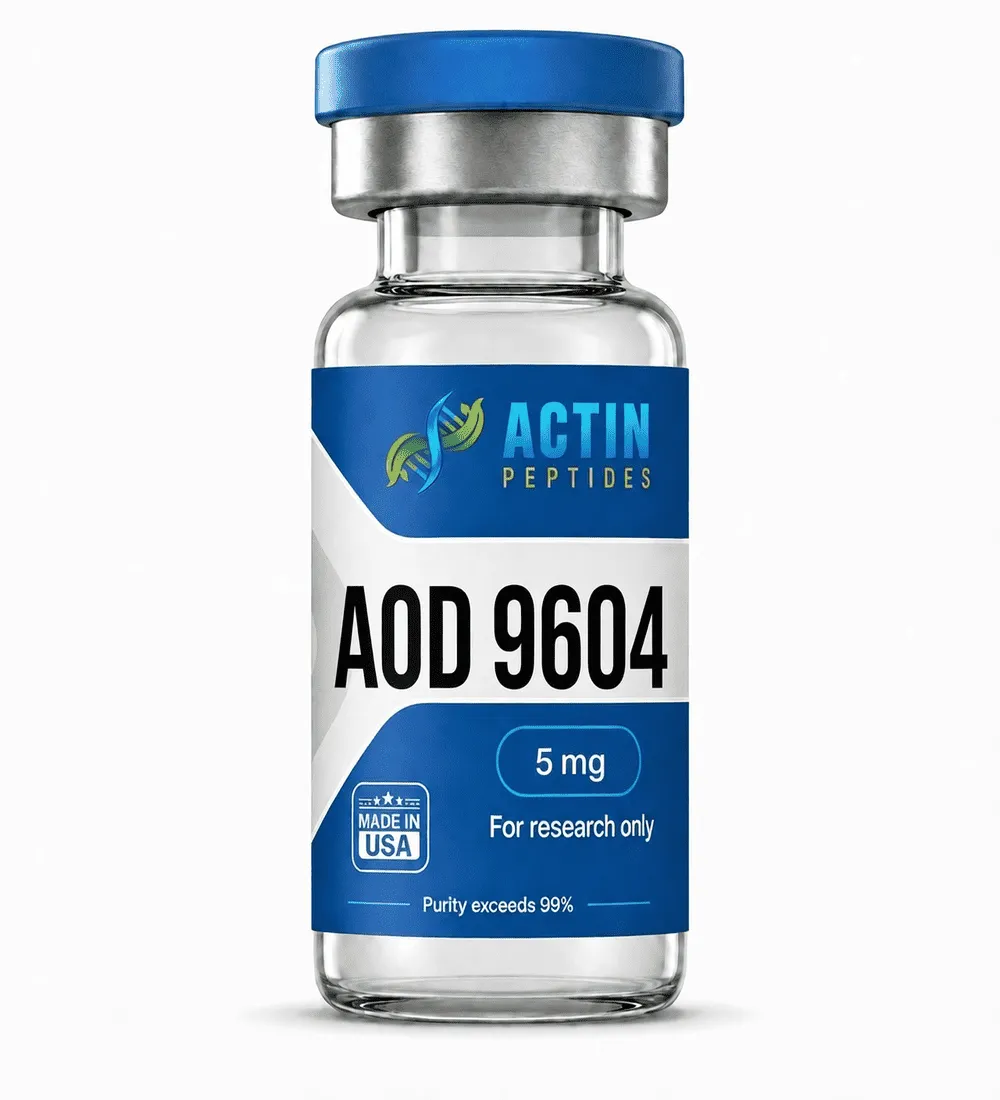
Description
AOD 9604 Peptide Research: Mechanism, Metabolism, and Lipolysis Studies
What Is AOD 9604?
AOD 9604 is a synthetic peptide derived from the lipolytic region of human growth hormone (hGH). Scientists developed this peptide from amino acids 176-191 of growth hormone and modified its structure to improve stability during research applications.
Researchers have extensively investigated AOD 9604 for its potential role in fat metabolism, energy expenditure, cellular signaling, and tissue regeneration. Unlike full-length growth hormone, AOD 9604 is being researched for its ability to influence metabolic pathways without directly mimicking all biological activities associated with growth hormone.
As a result, AOD 9604 research has become increasingly relevant in studies involving lipolysis, adipose tissue metabolism, cellular differentiation, and extracellular matrix remodeling.
Overview of AOD 9604 Peptide Research
AOD 9604 was originally developed as part of efforts to identify growth hormone fragments that may influence fat metabolism.
Research suggests that this peptide may interact with metabolic signaling pathways involved in:
- Lipolysis
- Fat oxidation
- Energy expenditure
- Adipocyte regulation
- Cellular differentiation
- Cartilage regeneration
- Extracellular matrix production
Scientists have investigated AOD 9604 alongside other metabolism-focused compounds such as AOD-9604, Fragment 176-191, MOTS-C, and Adipotide FTPP due to their potential involvement in energy metabolism and cellular energy regulation.
How Does AOD 9604 Work?
Research suggests AOD 9604 may influence fat metabolism by increasing lipolytic activity, enhancing fat oxidation, and interacting with metabolic signaling pathways involved in energy expenditure.
What Is AOD 9604 Researched For?
Scientists have investigated AOD 9604 for:
- Fat metabolism research
- Lipolysis studies
- Energy expenditure
- Cellular differentiation
- Cartilage regeneration
- Tissue remodeling
- Metabolic signaling
What Makes AOD 9604 Unique?
Unlike full-length growth hormone, AOD 9604 focuses on a specific lipolytic region of the hormone and is being researched for metabolic activity without directly replicating all growth hormone functions.
Mechanism of Action
How AOD 9604 Influences Metabolic Pathways
Research suggests AOD 9604 may activate biological pathways involved in fat utilization and energy production.
Scientists have proposed that the peptide may:
- Increase fat oxidation
- Enhance energy expenditure
- Influence adipocyte signaling
- Support metabolic regulation
- Affect lipolytic receptor expression
Furthermore, studies indicate that AOD 9604 may influence beta-adrenergic signaling pathways that regulate lipid metabolism inside adipose tissue.
Interaction with Beta-Adrenergic Receptors
Beta-3 adrenergic receptors (β3-AR) are important regulators of fat metabolism.
Research suggests that AOD 9604 may increase expression of these receptors in adipose tissue. Consequently, cells may become more responsive to natural lipolytic signals that regulate fat breakdown.
However, studies indicate that receptor activation alone does not fully explain the peptide’s biological activity. Researchers believe additional mechanisms involving energy expenditure and fatty acid oxidation may contribute to observed outcomes.
Cellular Signaling and Energy Regulation
Scientists have investigated how AOD 9604 influences cellular energy pathways.
Research suggests the peptide may affect:
- Fatty acid oxidation
- Mitochondrial function
- Cellular metabolism
- Stem cell differentiation
- Extracellular matrix production
These biological activities have made AOD 9604 a subject of interest in broader peptide research fields involving tissue remodeling and regenerative biology.
Chemical Makeup
| Property | Details |
|---|---|
| Molecular Formula | C78H123N23O23S2 |
| Molecular Weight | 1815.12 g/mol |
| Alternative Name | Tyr-hGH Fragment 177-191 |
| Peptide Class | Growth Hormone Fragment |
| Research Category | Metabolism and Lipolysis Research |
Research and Clinical Studies
AOD 9604 Peptide and Lipolytic Activity
Study Objective
Scientists investigated whether AOD 9604 could influence fat metabolism and lipolytic activity.
Methodology
Researchers administered the peptide to experimental animal models and monitored body composition, receptor expression, and metabolic markers.
Findings
Studies indicated:
- Increased fat oxidation
- Enhanced energy expenditure
- Elevated β3-adrenergic receptor expression
- Reduced adipose tissue accumulation
Additional investigations demonstrated that lipolytic activity persisted even when certain lipolytic receptors were absent, suggesting multiple mechanisms may contribute to the peptide’s biological effects.
Scientific Significance
These findings suggest that AOD 9604 may influence several metabolic pathways involved in fat utilization rather than relying on a single receptor-mediated mechanism.
AOD 9604 and Metabolism Research
Study Objective
Researchers sought to evaluate whether the peptide could influence weight-related metabolic parameters.
Methodology
Clinical investigations monitored metabolic markers, glucose regulation, and lipid profiles over several weeks.
Findings
Studies indicated:
- Consistent changes in body composition markers
- Improved metabolic efficiency indicators
- Favorable shifts in cholesterol-related measurements
- Enhanced glucose tolerance observations
Scientific Significance
These findings support continued investigation into the peptide’s potential role in metabolic regulation and energy homeostasis.
For broader metabolism research, scientists also explore compounds such as MOTS-C and Fragment 176-191.
AOD 9604 and Tissue Regeneration Research
Study Objective
Scientists investigated whether AOD 9604 could influence cartilage and connective tissue remodeling.
Methodology
Researchers evaluated cartilage integrity and extracellular matrix markers in animal models receiving AOD 9604 alone or alongside hyaluronic acid.
Findings
Research suggested:
- Improved cartilage preservation markers
- Increased extracellular matrix activity
- Enhanced collagen production indicators
- Greater proteoglycan synthesis
Studies also indicated that AOD 9604 may influence differentiation pathways involving mesenchymal stem cells and chondrocytes.
Scientific Significance
These observations suggest that the peptide may support ongoing research into tissue regeneration and extracellular matrix biology.
Researchers interested in regenerative peptide research frequently compare findings with compounds such as BPC-157, TB-500, and KPV Peptide.
AOD 9604 and Cellular Differentiation
Study Objective
Researchers explored whether the peptide influences stem cell development and tissue-specific differentiation.
Methodology
Laboratory investigations examined adipose-derived stem cells, chondrocytes, and muscle precursor cells.
Findings
Studies indicated that AOD 9604 may:
- Support bone-related cellular differentiation
- Enhance collagen synthesis
- Increase proteoglycan production
- Influence muscle cell maturation pathways
Scientific Significance
These findings highlight potential applications in regenerative biology and cellular signaling research.
AOD 9604 and Experimental Cancer Cell Research
Study Objective
Scientists investigated whether AOD 9604 Peptide could enhance targeted delivery systems in laboratory cancer-cell models.
Methodology
Researchers combined AOD 9604 with nanoparticle-based delivery platforms and evaluated interactions with cellular targets.
Findings
Studies indicated enhanced interaction between experimental delivery systems and cellular protein targets. Researchers also observed increased accumulation of investigative compounds in laboratory models.
Scientific Significance
These findings support further exploration of AOD 9604 within advanced drug-delivery and cellular-targeting research frameworks.
Related Research Peptides
Researchers interested in AOD 9604 studies frequently explore complementary compounds including:
Conclusion
AOD 9604 remains one of the most extensively researched growth hormone fragments in modern peptide research. Studies indicate that the peptide may influence lipolysis, energy expenditure, fat oxidation, cellular differentiation, extracellular matrix production, and tissue remodeling pathways.
Furthermore, scientists continue to investigate its role in metabolism research, regenerative biology, and cellular signaling. While ongoing studies continue to expand scientific understanding, current evidence highlights AOD 9604 as an important research tool within peptide science.
Frequently Asked Questions
Is AOD 9604 a growth hormone?
No. AOD 9604 is a synthetic fragment derived from human growth hormone, specifically amino acids 176-191, and does not represent the complete hormone molecule.
What is AOD 9604 researched for?
Researchers study AOD 9604 for fat metabolism, lipolysis, energy expenditure, tissue regeneration, cellular differentiation, and metabolic signaling pathways.
How does AOD 9604 differ from growth hormone?
AOD 9604 contains only a small segment of the growth hormone structure and is primarily investigated for metabolic and lipolytic activities.
Where can researchers buy AOD 9604?
Researchers seeking high-purity AOD 9604 peptide for sale can explore the Actin Peptides research catalog.
Research Disclaimer
AOD 9604 is available strictly for research and laboratory purposes only. It is not approved for human consumption, therapeutic use, or diagnostic applications. Please review our Terms and Conditions before placing an order.
 English
Reviews
There are no reviews yet.