
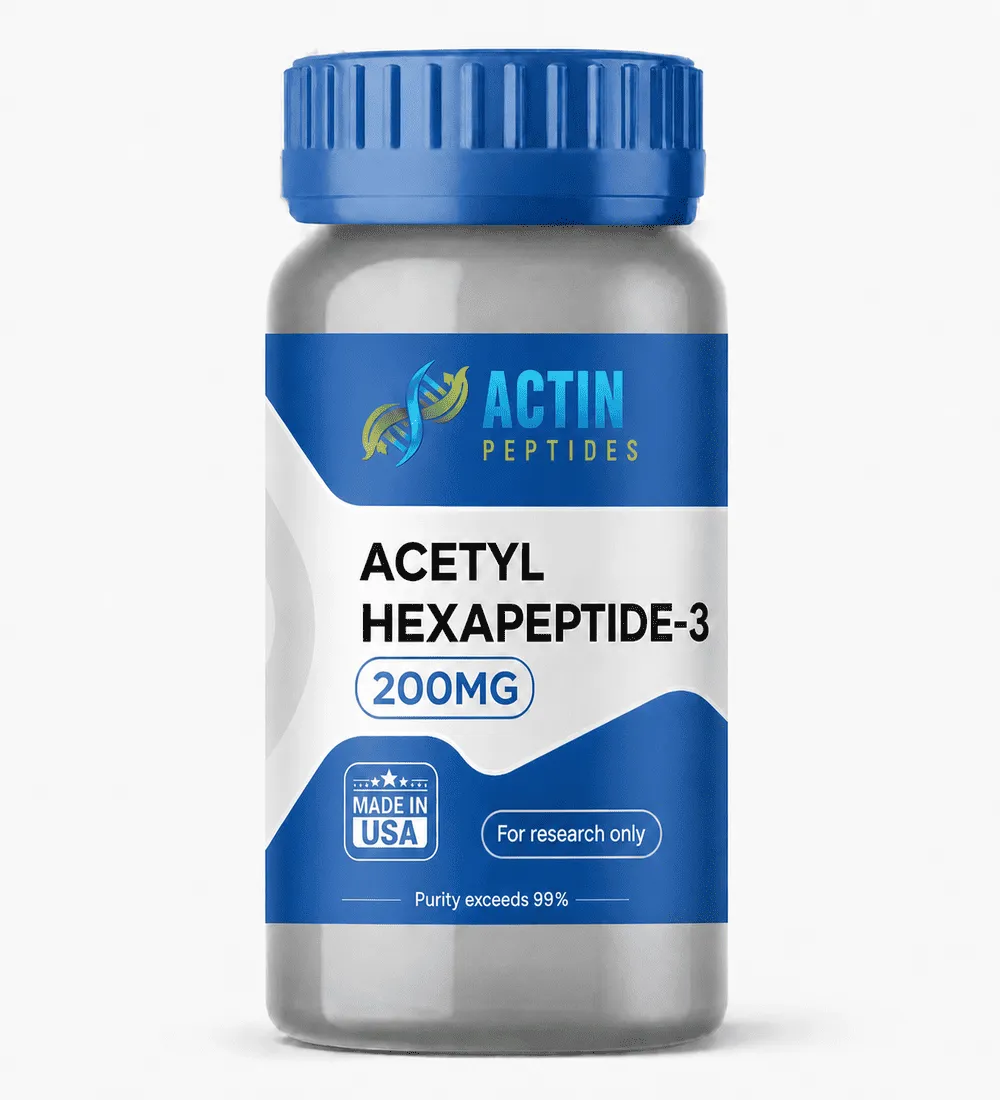
Description
Acetyl Hexapeptide-3 (Argireline): Research, Mechanisms, and Scientific Studies
What Is Acetyl Hexapeptide-3?
Acetyl Hexapeptide-3, commonly known as Argireline or Acetyl Hexapeptide-8, is a synthetic peptide widely studied for its potential effects on wrinkle formation, skin aging, muscle contraction, and cellular signaling pathways.
Researchers developed Acetyl Hexapeptide-3 as a peptide that mimics part of the SNAP-25 (Synaptosomal-Associated Protein 25 kDa) molecule. SNAP-25 is an essential component of the SNARE complex, a protein system involved in the release of neurotransmitters and other signaling molecules from cells.
Because of its structural similarity to SNAP-25, Acetyl Hexapeptide 3 is believed to interfere with SNARE complex formation. This mechanism may reduce neurotransmitter release, particularly acetylcholine, which plays a critical role in muscle contraction and communication between nerves and muscles.
Due to these properties, researchers have investigated Acetyl Hexapeptide-3 in studies involving:
- Skin aging and wrinkles
- Collagen remodeling
- Muscle contractions and spasms
- Scar formation
- Pain signaling pathways
- Neurotransmitter regulation
Its ability to influence cellular communication has made it one of the most extensively studied cosmetic peptides in dermatological research.
How Acetyl Hexapeptide-3 Works
The primary mechanism of Acetyl Hexapeptide-3 involves modulation of the SNARE protein complex.
The SNARE complex is responsible for facilitating calcium-dependent exocytosis, a process through which cells release neurotransmitters and signaling molecules.
Research suggests that Acetyl Hexapeptide-3 may:
- Interfere with SNARE complex assembly
- Reduce acetylcholine release
- Decrease muscle contractions
- Influence skin tension and wrinkle formation
- Affect cellular signaling pathways
Because the peptide is studied as a topical compound, researchers have viewed it as a potentially less invasive alternative for investigating pathways associated with muscle-mediated wrinkle formation.
In addition to skin research, modified versions of the peptide have been explored for potential applications involving pain perception and inflammatory signaling.
Chemical Properties
| Property | Value |
|---|---|
| Peptide Name | Acetyl Hexapeptide-3 |
| Alternative Names | Acetyl Hexapeptide-8, Argireline |
| Molecular Formula | C34H60N14O12S |
| Molecular Weight | 888.99 g/mol |
| Classification | Synthetic Neurotransmitter-Modulating Peptide |
Research and Scientific Studies
Wrinkle Reduction and Skin Aging Research
The most widely studied area of Acetyl Hexapeptide-3 research involves its potential role in reducing the appearance of facial wrinkles and fine lines.
Researchers designed the peptide to mimic certain aspects of neuromuscular signaling modulation while remaining suitable for topical application.
Several clinical investigations have examined its effects on skin appearance, hydration, and wrinkle morphology.
Potential Effects on Wrinkles
Research has suggested improvements in:
- Wrinkle depth
- Fine lines
- Skin smoothness
- Skin texture
- Facial appearance
One study reported that a topical formulation containing Acetyl Hexapeptide-3 was associated with an apparent reduction in wrinkle depth of up to 30% after 30 days of application.
Additional clinical investigations involving larger participant groups reported similar improvements in wrinkle appearance and overall skin quality.
Effects on Skin Hydration
Studies have also evaluated transepidermal water loss (TEWL), a measurement commonly used to assess skin barrier function.
Researchers observed potential reductions in TEWL, suggesting improved moisture retention and hydration within skin tissues.
Improved hydration may contribute to:
- Enhanced skin elasticity
- Reduced appearance of fine lines
- Improved skin texture
- Better barrier function
Potential Role in Collagen Remodeling
Experimental studies involving aged animal models suggest that Acetyl Hexapeptide-3 may influence collagen organization within skin tissue.
Researchers reported:
- Increased Type I collagen fibers
- Reduced Type III collagen fibers
- Improved skin structure
- Enhanced tissue organization
These findings have contributed to ongoing interest in Acetyl Hexapeptide-3 as a research tool for studying skin aging and tissue remodeling.
Muscle Spasm Research
Researchers have also explored Acetyl Hexapeptide-3 in studies involving muscle spasms and involuntary muscle contractions.
One area of investigation has focused on blepharospasm, a condition characterized by involuntary eyelid muscle contractions.
Potential Effects on Muscle Contractions
Clinical research has suggested that Acetyl Hexapeptide-3 may influence neuromuscular signaling pathways involved in muscle activity.
Observed findings included:
- Longer periods before symptom recurrence
- Reduced severity of muscle spasms
- Improved clinical assessment scores
Some participants demonstrated prolonged symptom control compared to placebo groups, suggesting potential effects on muscle contraction pathways.
Researchers believe these observations may be related to the peptide’s ability to modulate acetylcholine release at neuromuscular junctions.
Scar Formation and Tissue Remodeling Research
Another area of investigation involves the peptide’s potential influence on scar tissue formation and skin regeneration.
Researchers have examined changes in:
- Scar appearance
- Skin elasticity
- Tissue quality
- Collagen composition
Potential Effects on Scar Tissue
Studies suggest that Acetyl Hexapeptide-3 may affect the balance between different collagen types involved in tissue repair.
Because excessive Type III collagen is often associated with scar tissue formation, modulation of collagen remodeling may contribute to improved tissue organization.
Researchers observed improvements in skin elasticity and tissue quality following treatment protocols involving the peptide.
These findings have led to additional interest in studying Acetyl Hexapeptide-3 as part of broader investigations into wound healing and tissue regeneration.
Pain Perception and Neurotransmission Research
Modified versions of Acetyl Hexapeptide-3 have also been investigated for their potential effects on pain signaling pathways.
One notable derivative is DD04107, a palmitoylated form of Acetyl Hexapeptide-3 designed to improve biological activity and tissue penetration.
Potential Effects on Pain Signaling
Research suggests that DD04107 may influence:
- Neurotransmitter release
- Inflammatory signaling
- Sensory nerve activation
- Pain perception pathways
Investigators have proposed that this modified peptide may interfere with SNAP-25 activity, potentially reducing the release of signaling molecules involved in pain transmission.
Potential Interaction with TRPV1 Channels
Studies have also explored interactions with TRPV1 channels, which are involved in detecting:
- Heat
- Inflammation
- Chemical irritation
- Pain stimuli
Researchers suggest that modulation of neurotransmitter release may reduce activation of these channels and influence inflammatory pain responses.
Inflammatory Pain Research
Experimental models of both acute and chronic inflammation have been used to investigate the peptide’s potential effects on inflammatory pain.
Research has reported observations including:
- Reduced swelling
- Reduced mechanical sensitivity
- Reduced thermal hyperalgesia
- Reduced mechanical allodynia
Chronic Inflammation Models
In chronic inflammation studies, researchers examined responses using Complete Freund’s Adjuvant (CFA)-induced inflammatory models.
Findings suggested potential modulation of pathways involved in:
- Persistent inflammatory pain
- Peripheral neuropathy
- Sensory nerve activation
- Inflammatory signaling
Although these findings remain preliminary, they have generated interest in further investigating modified forms of Acetyl Hexapeptide-3 for neuroscience and pain-related research.
Why Researchers Study Acetyl Hexapeptide-3
Interest in Acetyl Hexapeptide-3 stems from its ability to influence neurotransmitter release and cellular signaling pathways.
Current areas of research include:
- Wrinkle reduction
- Skin aging
- Skin hydration
- Collagen remodeling
- Muscle contractions
- Blepharospasm
- Scar formation
- Tissue regeneration
- Pain signaling
- Inflammatory pathways
As research continues, Acetyl Hexapeptide-3 remains an important peptide for studying the relationship between neuromuscular signaling, skin biology, and cellular communication.
Frequently Asked Questions
What is Acetyl Hexapeptide-3?
Acetyl Hexapeptide-3 is a synthetic peptide commonly studied for its potential effects on wrinkle formation, neurotransmitter release, muscle contraction, and skin aging.
Is Acetyl Hexapeptide-3 the same as Argireline?
Yes. Argireline is one of the most common names used for Acetyl Hexapeptide-3. It is also frequently referred to as Acetyl Hexapeptide-8.
How does Acetyl Hexapeptide-3 work?
Research suggests that it may interfere with SNARE complex formation, reducing acetylcholine release and influencing muscle contractions associated with wrinkle formation.
What areas of research involve Acetyl Hexapeptide-3?
Current studies have explored its potential role in:
- Wrinkle reduction
- Skin hydration
- Collagen remodeling
- Muscle spasms
- Scar tissue research
- Pain signaling pathways
Does Acetyl Hexapeptide-3 affect collagen?
Experimental studies suggest that it may influence collagen organization within skin tissue, particularly the balance between Type I and Type III collagen fibers.
Is Acetyl Hexapeptide-3 being studied for pain research?
Yes. Modified versions such as DD04107 have been investigated for their potential effects on inflammatory and neuropathic pain pathways.
Is Acetyl Hexapeptide-3 approved for human use?
This peptide is commonly studied in cosmetic and laboratory settings. Researchers continue to investigate its biological mechanisms and potential applications.
Acetyl Hexapeptide-3 for Research Use
Acetyl Hexapeptide-3 is intended strictly for laboratory and scientific research purposes only. It is not approved for human consumption or therapeutic use.
Before placing an order, please review our Terms and Conditions.
 English
  French
Reviews
There are no reviews yet.