
Description
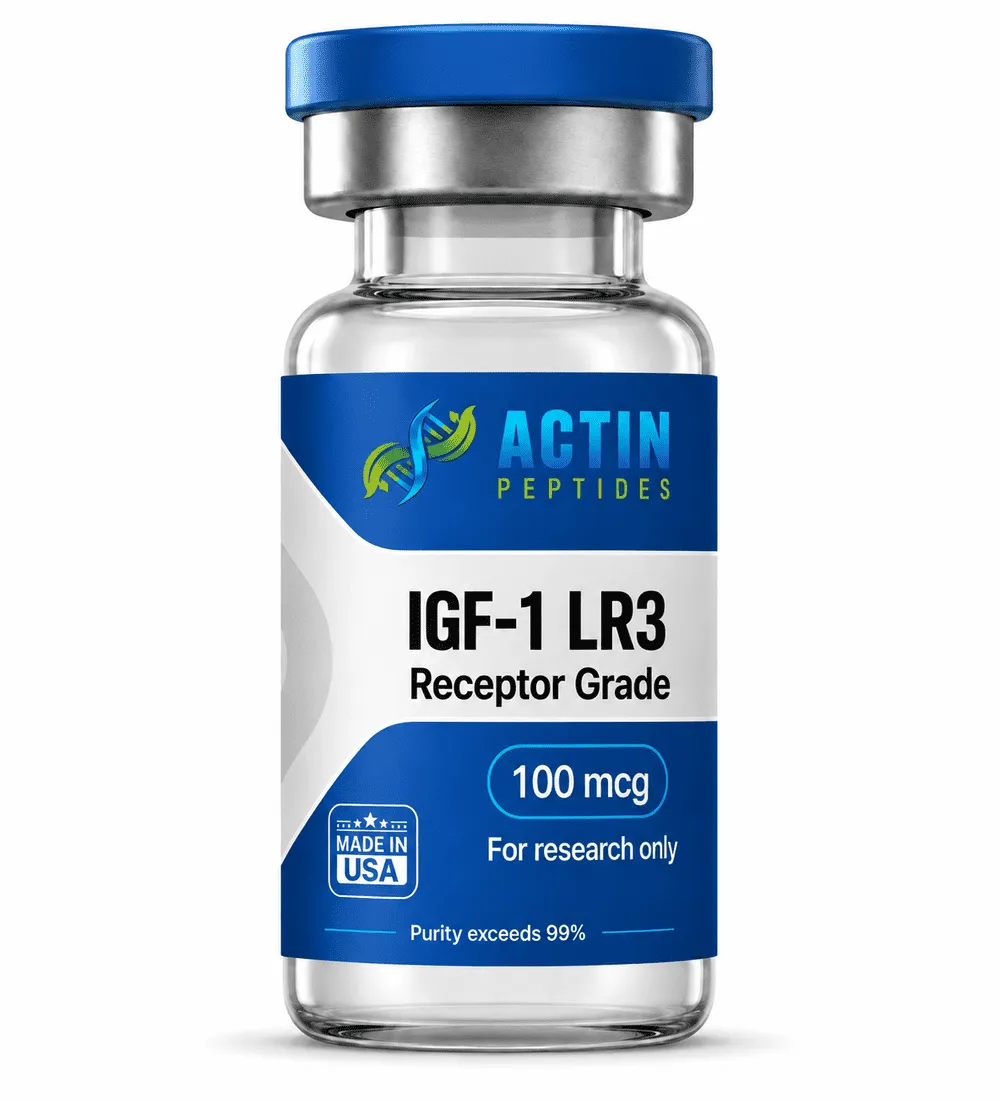
Receptor Grade IGF-1 LR3 Peptide: Research, Mechanism, and Cellular Signaling
Introduction
Receptor Grade IGF-1 LR3 peptide is a synthetic analog of insulin-like growth factor-1 (IGF-1), a naturally occurring 70-amino-acid protein involved in cellular growth, development, metabolism, and signaling. Researchers developed IGF-1 Long R3 by extending the N-terminal region of IGF-1 by 13 amino acids and replacing glutamic acid at position 3 with arginine.
These structural modifications distinguish IGF-1 LR3 from endogenous IGF-1 and have been studied for their effects on receptor interactions, binding-protein affinity, tissue distribution, and cellular signaling.
The term Receptor Grade describes a higher-purity research material intended for receptor- and cell-based laboratory applications. It does not indicate clinical approval or therapeutic status.
What Is Receptor Grade IGF-1 LR3?
Receptor Grade IGF-1 LR3 is a modified form of human IGF-1 containing an N-terminal extension and an arginine substitution at residue 3. Researchers study this analog because its structural modifications can alter interactions with IGF-binding proteins (IGFBPs), receptor signaling, and experimental tissue distribution.
IGF-1 research commonly examines pathways associated with cellular proliferation, differentiation, metabolism, protein synthesis, and survival.
Overview
IGF-1 belongs to a family of growth factors that share structural similarities with insulin. In biological systems, IGF-1 primarily interacts with the insulin-like growth factor-1 receptor (IGF-1R), a receptor tyrosine kinase involved in intracellular signaling.
Following receptor activation, downstream pathways can include:
- PI3K/Akt signaling
- MAPK/ERK signaling
- Cellular growth and differentiation pathways
- Glucose-utilization pathways
- Protein synthesis and cell-survival signaling
IGF-1 LR3 has attracted research interest because its modified structure appears to reduce its interaction with certain IGF-binding proteins compared with endogenous IGF-1. Researchers have consequently investigated whether this structural difference changes receptor availability, biological activity, and tissue distribution in experimental systems.
For related growth-factor research, researchers may also investigate MGF peptide and Follistatin-344 as distinct research compounds with different molecular targets.
Receptor Grade IGF-1 LR3 Mechanism of Action
IGF-1 Receptor Signaling
The primary research focus involves interaction with the IGF-1 receptor (IGF-1R). IGF-1R is located on the surface of numerous cell types and functions as a receptor tyrosine kinase.
When activated, IGF-1R can initiate intracellular signaling networks involving PI3K/Akt and MAPK/ERK. These pathways participate in processes such as:
- Cellular proliferation
- Differentiation
- Protein metabolism
- Cell survival
- Glucose utilization
- Cellular growth
The exact magnitude and biological consequences of these signals depend on the experimental model, receptor expression, peptide concentration, and cellular environment.
IGF-Binding Proteins
One distinguishing feature of IGF-1 LR3 research is its altered interaction with IGF-binding proteins (IGFBPs).
Endogenous IGF-1 normally circulates in association with IGFBPs, which can influence its stability, transport, receptor availability, and tissue distribution. Researchers have investigated whether the structural modifications in IGF-1 LR3 reduce this binding and consequently alter the peptide’s experimental bioavailability.
PI3K/Akt and MAPK/ERK Pathways
IGF-1 receptor signaling can activate multiple intracellular pathways.
The PI3K/Akt pathway participates in cellular metabolism, protein synthesis, and survival signaling. Meanwhile, the MAPK/ERK pathway is associated with cellular proliferation, differentiation, and gene-expression regulation.
These pathways provide an important mechanistic framework for understanding why IGF-1 analogs remain relevant to laboratory research involving growth-factor biology.
Chemical Makeup
| Property | Receptor Grade IGF-1 LR3 |
|---|---|
| Molecular Formula | C400H625N111O115S9 |
| Molecular Weight | 9117.5 g/mol |
| Peptide Type | Synthetic IGF-1 analog |
| Parent Molecule | Insulin-like Growth Factor-1 |
| Structural Modification | 13-amino-acid N-terminal extension + Arg substitution at position 3 |
| Other Names | Long-(Arg3) IGF-I; IGF-1 Long R3 |
The molecular structure distinguishes IGF-1 LR3 from endogenous IGF-1 and provides the basis for ongoing research into receptor interaction and IGFBP binding.
Research and Clinical Studies
Receptor Grade IGF-1 LR3 and Anabolic Signaling Research
Study Objective
Researchers have investigated modified IGF-1 analogs to determine whether structural changes can produce different biological activity from endogenous IGF-1.
Methodology
Preclinical experiments compared IGF-1 LR3 with IGF-I in normal and experimentally induced catabolic animal models. Researchers evaluated parameters including body weight, visceral organ weight, feed utilization, and markers associated with protein breakdown.
Findings
The supplied research describes IGF-1 LR3 as exhibiting greater anabolic activity than IGF-I across several experimental measurements. In dexamethasone-exposed models, the peptide was also associated with a greater reduction in Nτ-methylhistidine excretion, a laboratory marker associated with muscle protein breakdown.
Scientific Significance
These findings provide a basis for continued investigation of modified IGF-1 analogs in experimental growth-factor and protein-metabolism research. However, animal-model findings cannot establish equivalent effects in humans.
Receptor Grade IGF-1 LR3 and Cellular Growth Research
IGF-1 has been extensively investigated for its relationship with cellular growth and development.
Study Objective
Researchers have examined IGF-1 signaling in models involving altered or deficient IGF-1 activity.
Methodology
Experimental models were evaluated following exposure to IGF-1, with growth parameters compared against control conditions.
Findings
The research described increased growth and total length in peptide-exposed models compared with controls.
Scientific Significance
These findings reinforce the importance of the IGF-1 signaling system in experimental studies of growth and development. They also provide context for investigating modified analogs such as IGF-1 LR3.
Receptor Grade IGF-1 LR3 and Glucose Uptake Research
Study Objective
Researchers have investigated how IGF-family proteins influence glucose uptake and metabolic signaling.
Mechanism Investigated
IGF-1 receptor activation can interact with intracellular pathways such as PI3K and AMPK that participate in glucose metabolism.
Research has also explored whether modified IGF analogs can influence glucose uptake through mechanisms extending beyond conventional IGF-1 receptor signaling.
Scientific Significance
This work makes IGF-1 LR3 relevant to laboratory investigations involving growth-factor signaling, insulin sensitivity pathways, and cellular metabolism.
Importantly, these findings do not establish IGF-1 LR3 as a treatment for insulin resistance, diabetes, or any metabolic disorder.
Receptor Grade IGF-1 LR3 and Cellular Longevity Research
Study Objective
Researchers have examined the relationship between growth-hormone/IGF signaling and age-associated cellular changes.
Methodology
Experimental animal models were evaluated for physiological and neurological changes following exposure to IGF-related compounds.
Findings
The supplied research describes observations involving muscle and neurological function in experimental models.
Scientific Significance
These findings illustrate the complexity of IGF signaling across different stages of biological aging. Researchers continue to investigate how growth-factor pathways interact with cellular maintenance, metabolism, and age-related physiological changes.
Receptor Grade IGF-1 LR3 and Muscle-Cell Research
Study Objective
Researchers have examined IGF-1 analogs in relation to myostatin-associated signaling and muscle-cell biology.
Methodology
Animal models were exposed to IGF-1 analogs, including IGF-1 LR3, and researchers evaluated pathways associated with myostatin activity, cellular differentiation, and apoptosis.
Findings
The supplied research suggests that IGF-1 analogs may influence myostatin-associated signaling and cellular survival in experimental models.
Scientific Significance
Myostatin is a growth-regulating protein that researchers study extensively in relation to skeletal-muscle differentiation and development. Consequently, IGF-1 LR3 remains relevant to laboratory investigations of growth-factor and muscle-cell signaling.
For comparison with other compounds studied in muscle-related molecular research, see MGF and Follistatin-344.
Receptor Grade IGF-1 LR3 and Tissue Distribution
Study Objective
Researchers have compared the pharmacokinetic and tissue-distribution characteristics of IGF-1 LR3 with endogenous IGF-1.
Methodology
Experimental mouse models received labeled IGF-1 LR3, after which researchers evaluated peptide clearance and tissue localization.
Findings
The research described relatively rapid serum clearance of IGF-1 LR3 alongside detectable distribution in tissues including the kidneys, ovaries, and adrenal glands.
Researchers attributed some of these differences to the modified peptide’s reduced interaction with IGFBPs.
Scientific Significance
The findings demonstrate how relatively small structural modifications can influence peptide distribution and binding characteristics.
What Makes Receptor Grade IGF-1 LR3 Different From IGF-1?
The primary difference is structural. IGF-1 LR3 contains a 13-amino-acid N-terminal extension and replaces glutamic acid at position 3 with arginine.
These modifications may alter:
- IGFBP interactions
- Receptor accessibility
- Tissue distribution
- Experimental potency
- Cellular signaling characteristics
Therefore, IGF-1 LR3 should be considered a distinct research analog rather than simply another form of endogenous IGF-1.
Receptor Grade IGF-1 LR3 Benefits Research
Research involving IGF-1 LR3 focuses on potential biological effects rather than established therapeutic benefits.
Areas of scientific interest include:
- Growth-factor receptor signaling
- Cellular proliferation
- Cellular differentiation
- Protein metabolism
- Glucose utilization
- Cell-survival pathways
- Muscle-cell biology
- IGF-binding protein interactions
- Tissue distribution
- Growth-factor analog design
The available evidence is predominantly preclinical, and the supplied research does not establish clinical efficacy or safety in humans.
Receptor Grade IGF-1 LR3 vs. Other Growth-Factor Peptides
IGF-1 LR3 belongs to a broader category of research compounds involving growth-factor and cellular-signaling pathways.
For example:
- MGF is studied in relation to IGF-associated signaling and cellular responses.
- Follistatin-344 is researched for its interactions with myostatin and related growth-regulatory pathways.
- ACE-031 is investigated as a myostatin/activin pathway-related research compound.
- CJC-1295/IPAMORELIN research focuses on growth-hormone secretagogue pathways rather than direct IGF-1 receptor signaling.
These compounds should not be considered interchangeable because they interact with different molecular targets and signaling systems.
Frequently Asked Questions
What is Receptor Grade IGF-1 LR3?
Receptor Grade IGF-1 LR3 is a synthetic analog of IGF-1 containing a 13-amino-acid N-terminal extension and an arginine substitution at position 3. Researchers study it primarily in growth-factor, receptor-signaling, and cellular biology applications.
How does Receptor Grade IGF-1 LR3 work?
Research suggests IGF-1 LR3 can interact with IGF-related signaling systems, including IGF-1 receptor pathways. Its modified structure also appears to alter interactions with IGF-binding proteins.
What is Receptor Grade IGF-1 LR3 researched for?
IGF-1 LR3 research includes cellular growth, differentiation, protein metabolism, glucose signaling, muscle-cell biology, receptor signaling, and tissue-distribution studies.
What makes IGF-1 LR3 different from IGF-1?
IGF-1 LR3 contains an N-terminal extension and an Arg3 substitution. These structural modifications can alter its binding characteristics, tissue distribution, and behavior in experimental systems.
Is Receptor Grade IGF-1 LR3 FDA approved?
This research material should not be represented as FDA-approved. The product is supplied for laboratory and research applications only.
Conclusion
Receptor Grade IGF-1 LR3 peptide represents a structurally modified IGF-1 analog that researchers investigate for its distinctive receptor signaling, IGFBP interaction, cellular growth, metabolic, and tissue-distribution characteristics.
Preclinical research suggests that its modified structure may produce measurable differences from endogenous IGF-1, particularly regarding binding-protein interactions and experimental biological activity. However, available research does not establish human therapeutic efficacy or safety.
For researchers investigating growth-factor biology, IGF signaling provides a useful framework for examining how peptide structure influences receptor interaction, intracellular signaling, cellular metabolism, and tissue responses.
Research Disclaimer
Receptor Grade IGF-1 LR3 peptide is available strictly for research and laboratory purposes only. It is not approved for human consumption, therapeutic use, or diagnostic applications. Please review our Terms and Conditions before placing an order.
 English
Reviews
There are no reviews yet.