
Description
Tesamorelin Peptide – GHRH Analog Research and Cellular Signaling
Introduction
Tesamorelin peptide is a synthetic 44-amino-acid analog of growth hormone-releasing hormone (GHRH) that has been extensively studied for its interaction with the growth hormone-releasing hormone receptor (GHRHR). Research has focused particularly on the relationship between GHRH signaling, growth hormone (GH) secretion, insulin-like growth factor-1 (IGF-1), and adipose-tissue metabolism.
The molecule incorporates structural modifications at its termini that researchers designed to improve peptide stability and resistance to enzymatic degradation. Because of its ability to activate GHRH-related signaling, Tesamorelin research has examined downstream effects involving cyclic adenosine monophosphate (cAMP), protein kinase A (PKA), GH secretion, and IGF-1 production.
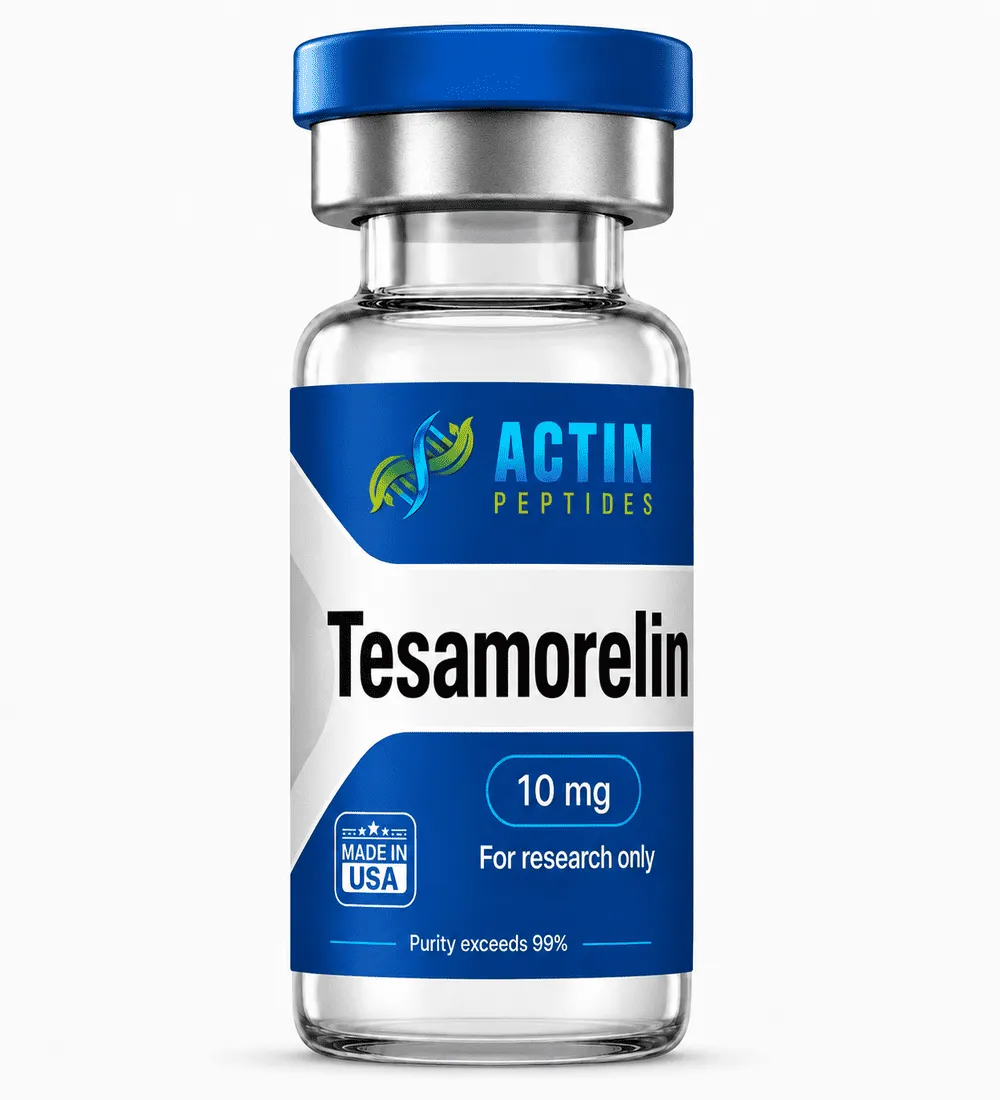
Actin Peptides offers Tesamorelin for laboratory and research applications. The company’s current product catalog lists Tesamorelin in 5 mg and 10 mg formats.
Overview of Tesamorelin Peptide
Tesamorelin is a synthetic polypeptide structurally related to human GHRH. Unlike native GHRH, researchers modified its molecular structure to potentially increase stability.
The compound has primarily been investigated in research involving:
- Growth hormone signaling
- IGF-1 regulation
- Visceral adipose tissue biology
- Lipid metabolism
- Hepatic fat accumulation
- Muscle-tissue composition
- GHRH receptor signaling
The relationship between GHRH, GH, and IGF-1 makes Tesamorelin particularly relevant to research involving growth factors, cellular signaling, metabolism, and body-composition biology.
For researchers comparing GHRH-related compounds, Actin Peptides also offers Sermorelin Peptide and Ipamorelin Peptide as related research compounds.
What Is Tesamorelin Peptide?
Tesamorelin is a synthetic 44-amino-acid GHRH analog studied for its ability to interact with GHRH receptors and influence downstream growth hormone and IGF-1 signaling.
How Does Tesamorelin Work?
Research suggests that Tesamorelin binds to GHRH receptors on somatotroph cells in the anterior pituitary. This interaction may activate cAMP-dependent signaling, including protein kinase A (PKA), which can promote growth hormone secretion.
What Is Tesamorelin Researched For?
Tesamorelin studies have investigated GHRH signaling, growth hormone secretion, IGF-1 regulation, visceral adipose tissue, hepatic fat, lipid metabolism, and changes in muscle-tissue composition.
What Makes Tesamorelin Unique?
Tesamorelin contains structural modifications compared with native GHRH. Researchers designed these modifications to improve molecular stability while retaining activity at the GHRH receptor.
Tesamorelin Mechanism of Action
GHRH Receptor Interaction
The Tesamorelin mechanism centers on interaction with the growth hormone-releasing hormone receptor, or GHRHR.
GHRHR occurs on somatotroph cells within the anterior pituitary gland. When a GHRH analog interacts with this receptor, it can initiate intracellular signaling that regulates GH secretion.
Research describes a signaling sequence involving:
Tesamorelin → GHRH receptor → adenylate cyclase → cAMP → PKA → GH secretion
This pathway provides the primary framework researchers use to understand the compound’s biological activity.
cAMP and PKA Signaling
Following GHRH receptor activation, adenylate cyclase may convert adenosine triphosphate (ATP) into cyclic adenosine monophosphate (cAMP).
Increased intracellular cAMP can activate protein kinase A (PKA). PKA subsequently phosphorylates downstream proteins involved in cellular signaling and hormone secretion.
This signaling cascade may increase the release of endogenous growth hormone from pituitary somatotroph cells.
Growth Hormone and IGF-1 Signaling
Growth hormone acts on multiple tissues, including hepatocytes. In the liver, GH can stimulate systemic production of insulin-like growth factor-1 (IGF-1).
IGF-1 represents an important downstream growth factor involved in cellular growth, differentiation, metabolism, and survival signaling.
Therefore, Tesamorelin research frequently examines the interconnected GHRH → GH → IGF-1 axis.
Structural Modifications
Researchers modified Tesamorelin relative to native GHRH at both termini.
The molecule incorporates:
- An N-terminal acetyl modification
- A C-terminal trans-3-hexenoic acid modification
- A 44-amino-acid peptide sequence
These modifications have been investigated for their potential to increase resistance to enzymatic degradation and improve molecular stability.
The compound may therefore provide researchers with a more stable GHRH analog for controlled experimental investigation.
Chemical Makeup of Tesamorelin
| Property | Details |
|---|---|
| Molecular Formula | C221H366N72O67S |
| Molecular Weight | 5136 g/mol |
| Peptide Length | 44 amino acids |
| Classification | Synthetic GHRH analog |
| Other Known Title | (3E)-hex-3-enoylsomatoliberin |
| Primary Research Target | Growth hormone-releasing hormone receptor |
Tesamorelin Research and Clinical Studies
Tesamorelin and Growth Hormone Signaling
Research has evaluated how Tesamorelin influences GH secretion and downstream IGF-1 signaling.
Study Objective
Researchers sought to determine whether the GHRH analog could stimulate endogenous growth hormone secretion.
Methodology
Experimental studies measured GH secretion patterns and IGF-1 concentrations following exposure to Tesamorelin.
Findings
The supplied research describes an approximately:
- 69% increase in overall GH exposure, measured by area under the curve
- 55% increase in mean GH pulse area
- 122% increase in IGF-1 levels
The research also indicated that Tesamorelin did not substantially alter GH pulse frequency or peak GH concentrations.
Scientific Significance
These findings support continued investigation of Tesamorelin as a research tool for studying the GHRH-GH-IGF-1 signaling axis.
Tesamorelin and Visceral Adipose Tissue Research
One of the most extensively studied areas involves the relationship between GHRH signaling and visceral adipose tissue.
Study Objective
Researchers investigated whether Tesamorelin could influence visceral adipose tissue and associated lipid parameters in experimental populations with abnormal fat distribution.
Methodology
Two Phase III studies included 806 participants over an initial 26-week period, followed by an additional 26-week extension. Participants were assigned to Tesamorelin or placebo groups.
Findings
At week 26, the supplied research reported:
- A significant reduction in visceral adipose tissue
- An approximately 15.4% reduction in visceral adipose tissue
- Reduced triglyceride levels
- Reduced cholesterol levels compared with placebo
Scientific Significance
These findings contributed to research examining the relationship between GHRH signaling and visceral adipose tissue metabolism.
Researchers interested in complementary metabolic peptide pathways can also explore AOD 9604 Peptide, Fragment 176-191 Peptide, and MOTS-c Peptide.
Tesamorelin and Hepatic Fat Research
Researchers have also investigated the relationship between Tesamorelin and hepatic fat fraction (HFF), particularly in populations with elevated hepatic fat.
Study Objective
The study examined whether GHRH-related signaling could influence hepatic fat accumulation.
Methodology
Researchers followed 61 participants with HIV and elevated hepatic fat fraction for 12 months. Participants received either Tesamorelin or placebo.
Findings
The supplied study reported that approximately 35% of participants receiving Tesamorelin demonstrated a reduction in hepatic fat fraction of less than 5%, compared with approximately 4% in the placebo group.
The study did not report a significant alteration in glucose levels.
Scientific Significance
These observations have contributed to research exploring the relationship between GH signaling, hepatic lipid metabolism, and fat distribution.
Tesamorelin and Cognitive Research
Scientists have also investigated whether GHRH signaling may interact with neurological and cognitive processes.
Study Objective
Researchers designed a clinical study to examine potential changes in neurocognitive performance.
Methodology
The study enrolled 100 participants over age 40 with mild cognitive impairment. Participants underwent alternating periods of Tesamorelin exposure and observation over an extended period.
Neurocognitive performance was assessed using the Global Deficit Score (GDS).
Findings
The supplied material states that this study remains ongoing and that final results have not yet been published.
Scientific Significance
Because the final findings remain unavailable, researchers cannot draw definitive conclusions from this study. Nevertheless, it illustrates continued interest in the relationship between GHRH signaling and neurological function.
Tesamorelin and Insulin-Sensitivity Research
Researchers have also evaluated how GHRH signaling interacts with glucose metabolism and insulin-related parameters.
Study Objective
The objective was to examine whether Tesamorelin could influence insulin sensitivity and glycemic measurements.
Methodology
A 12-week randomized study involved 53 participants with type 2 diabetes. Participants received different Tesamorelin concentrations or placebo.
Researchers measured:
- Fasting glucose
- Glycosylated hemoglobin (HbA1c)
- Diabetes-control parameters
Findings
The study did not report significant reductions in the measured glucose-related parameters compared with placebo.
Scientific Significance
These findings demonstrate why Tesamorelin research should be evaluated across individual endpoints rather than assuming that changes in GH or IGF-1 automatically produce changes in every metabolic parameter.
Tesamorelin and Muscle-Tissue Research
Researchers have investigated whether changes in GH and IGF-1 signaling correlate with changes in muscle composition.
Study Objective
The research examined potential changes in muscle density, muscle volume, and intramuscular fat.
Methodology
Computed tomography (CT) imaging was used to evaluate specific muscle groups, including the rectus abdominis, psoas major, and paraspinal muscles.
Findings
The supplied research reported changes involving:
- Muscle density
- Muscle volume
- Fat content within muscle tissue
Several of these changes differed significantly from placebo measurements.
Scientific Significance
These observations have contributed to research exploring how GHRH-GH-IGF-1 signaling may interact with skeletal muscle composition.
Researchers investigating related growth-factor pathways may also explore Receptor Grade IGF-1 LR3 and MGF Peptide.
Tesamorelin and Visceral Fat Research
Visceral adipose tissue refers to fat stored around internal organs. Researchers distinguish it from subcutaneous adipose tissue, which lies beneath the skin.
Tesamorelin research has focused particularly on the biological relationship between GHRH signaling and visceral adipose tissue.
The supplied research reports reductions in visceral adipose tissue in experimental and clinical research settings, with some studies reporting reductions approaching 25%.
However, these findings should remain within their original research context and should not be interpreted as evidence of therapeutic efficacy for individual users.
Tesamorelin Benefits Research: What Scientists Are Investigating
Rather than describing Tesamorelin as providing established benefits, researchers have investigated several potential biological effects.
Current research areas include:
- Growth hormone signaling: interaction with GHRH receptors and GH secretion
- IGF-1 regulation: downstream changes following GH stimulation
- Adipose biology: particularly visceral adipose tissue
- Lipid metabolism: investigation of triglyceride and cholesterol changes
- Hepatic fat: research involving hepatic fat fraction
- Muscle composition: evaluation of muscle density, volume, and intramuscular fat
- Cellular signaling: investigation of cAMP and PKA pathways
Related Peptide Research
Tesamorelin belongs to a broader research category involving growth hormone secretagogues, GHRH analogs, and growth-factor signaling.
Researchers exploring related compounds may also examine:
GHRH and Growth Hormone Research
Sermorelin Peptide is another GHRH-related research compound.
Ipamorelin Peptide provides a complementary research model for investigating growth hormone secretagogue signaling.
IGF-1 Research
Receptor Grade IGF-1 LR3 can be investigated when research focuses specifically on IGF-1-related cellular signaling.
Metabolic Peptide Research
Researchers studying metabolic signaling may also investigate MOTS-c and AOD 9604 as distinct experimental compounds.
Conclusion
Tesamorelin peptide research centers on the GHRH receptor and its downstream growth hormone signaling network. By interacting with GHRHR, the compound may activate cAMP-PKA signaling and increase endogenous GH secretion, which can subsequently influence IGF-1 production.
Research has examined Tesamorelin across several areas, including visceral adipose tissue, hepatic fat, lipid metabolism, muscle composition, insulin-related parameters, and neurocognitive function. Importantly, these research areas have produced different outcomes, emphasizing the need to evaluate each study and endpoint independently.
For laboratory researchers, Tesamorelin provides a useful experimental model for investigating the GHRH-GH-IGF-1 axis, growth-factor signaling, adipose biology, and related metabolic processes.
Frequently Asked Questions About Tesamorelin
What is Tesamorelin peptide?
Tesamorelin is a synthetic 44-amino-acid analog of growth hormone-releasing hormone (GHRH). Researchers study it primarily for its interaction with GHRH receptors and downstream effects on growth hormone and IGF-1 signaling.
How does Tesamorelin work?
Tesamorelin may bind to GHRH receptors on pituitary somatotroph cells, activating intracellular cAMP-PKA signaling that promotes growth hormone secretion.
What is Tesamorelin researched for?
Researchers have studied Tesamorelin in relation to growth hormone signaling, IGF-1, visceral adipose tissue, hepatic fat, lipid metabolism, muscle composition, and other aspects of metabolic biology.
Is Tesamorelin a growth hormone?
No. Tesamorelin is a synthetic GHRH analog. It is studied for its ability to stimulate the body’s endogenous growth hormone signaling pathway rather than serving as growth hormone itself.
What is the relationship between Tesamorelin, GH, and IGF-1?
Tesamorelin interacts with GHRH receptors, which may increase growth hormone secretion. Growth hormone can subsequently stimulate IGF-1 production, particularly in the liver. Researchers therefore study these molecules as interconnected components of the GHRH-GH-IGF-1 axis.
What is the molecular weight of Tesamorelin?
The supplied chemical information lists Tesamorelin’s molecular weight as approximately 5136 g/mol, with the molecular formula C221H366N72O67S.
Where to buy Tesamorelin peptide?
Actin Peptides currently lists Tesamorelin in 5 mg and 10 mg formats for its research-oriented product catalog.
Is Tesamorelin FDA approved?
Regulatory status depends on the specific formulation, indication, jurisdiction, and intended use. Research-grade material should not be represented as FDA-approved for human use. Actin Peptides identifies itself as a research-use-only chemical supplier.
Research Disclaimer
Tesamorelin peptide is available strictly for research and laboratory purposes only. It is not approved for human consumption, therapeutic use, or diagnostic applications. Please review our Terms and Conditions before placing an order.
 English
Reviews
There are no reviews yet.