
Description
GHK-Cu Peptide: Collagen, Skin, Hair, and Tissue Remodeling Studies
Introduction
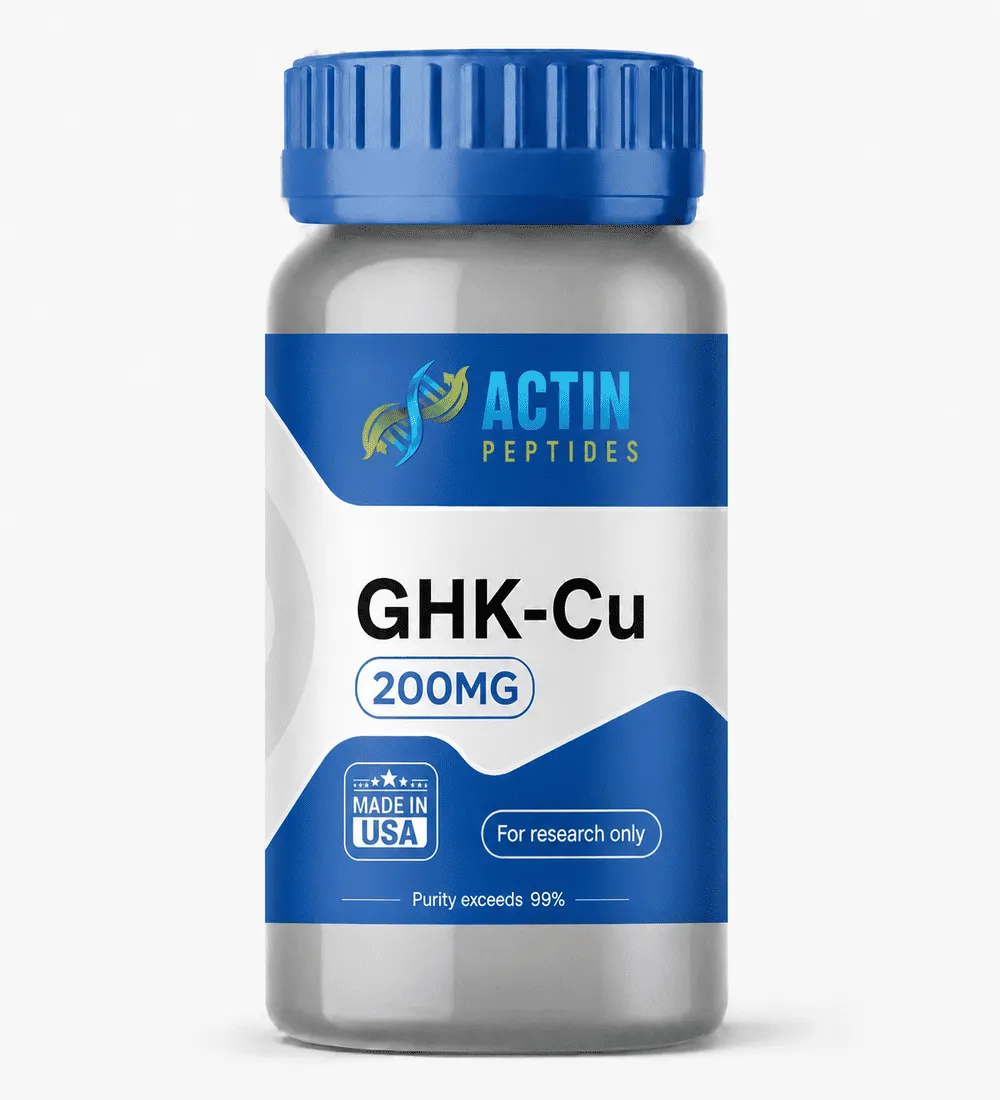
GHK-Cu Peptide 200mg is a copper-bound tripeptide research compound investigated for its interactions with extracellular matrix biology, fibroblast activity, collagen-related processes, wound-repair models, angiogenesis, and cellular signaling. It is supplied for research and laboratory use only and is not intended for human consumption, therapeutic use, or diagnostic applications.
GHK occurs naturally in biological fluids, including human plasma, and researchers have investigated how its copper-bound form interacts with fibroblasts, endothelial cells, keratinocytes, and other cell types. As a result, GHK-Cu research spans both laboratory models and a smaller body of human skin studies.
At Actin Peptides, this GHK-Cu peptide is offered for laboratory and research purposes. Please note: this product is not supplied in a vial.
For researchers investigating related skin and connective-tissue compounds, relevant Actin Peptides products include AHK-Cu, Pal-AHK, and Matrixyl.
What Is GHK-Cu Peptide?
GHK-Cu is the copper-bound form of the tripeptide GHK: glycine, histidine, and lysine. The histidine-containing peptide coordinates copper and forms a biologically studied metal-peptide complex.
Researchers have investigated the compound primarily in relation to:
- Collagen production
- Extracellular matrix remodeling
- Skin biology
- Wound-healing models
- Fibroblast activity
- Angiogenesis
- Hair follicle research
- Antioxidant mechanisms
- Inflammatory signaling
- Gene-expression regulation
The distinction between GHK and GHK-Cu matters. Free GHK has its own molecular identity, while the copper complex incorporates Cu²⁺ as part of the researched structure.
Quick Facts About GHK-Cu
| Property | Details |
|---|---|
| Common Name | GHK-Cu |
| Primary Peptide | Gly-His-Lys (GHK) |
| Copper Ion | Cu²⁺ |
| Common Alternative Name | Copper Tripeptide-1 |
| Research Focus | Skin, collagen, tissue remodeling, hair, cellular signaling |
| Product Presentation | Not supplied in a vial |
Important Chemical Note
The molecular weight of free GHK is 340.38 g/mol. The copper-bound complex has a different molecular composition and molecular weight because the Cu²⁺ ion forms part of the complex. This distinction is important when identifying and characterizing research material.
Overview of GHK-Cu Research
GHK-Cu occupies an unusual place in peptide research because its activity combines small-peptide biology with copper coordination chemistry.
Researchers first identified GHK in human plasma and subsequently investigated its ability to bind copper. Over time, studies connected the GHK-Cu complex with extracellular matrix remodeling, collagen synthesis, cellular migration, and tissue-repair processes.
More recent research has expanded beyond structural proteins. Scientists have also examined how the copper peptide may influence broad patterns of gene expression, antioxidant defenses, inflammatory mediators, and cellular responses to injury.
This broad research profile makes the compound relevant to several interconnected fields:
- Dermatological research
- Cosmetic science
- Regenerative biology
- Extracellular matrix research
- Fibroblast biology
- Hair follicle research
- Vascular biology
- Oxidative-stress research
How Does GHK-Cu Work?
Copper Binding and Cellular Activity
The defining feature of GHK-Cu is its ability to coordinate copper.
Researchers propose that GHK helps transport or buffer copper in a form that cells can utilize. Because copper serves as a cofactor for numerous enzymes, the copper component may contribute to several downstream biological processes.
Studies have therefore investigated the complex in relation to:
- Collagen maturation
- Antioxidant enzyme activity
- Extracellular matrix remodeling
- Cellular signaling
- Oxidative stress
- Vascular responses
Fibroblasts and Extracellular Matrix Remodeling
Fibroblasts play a central role in connective tissue biology.
These cells produce structural molecules such as:
- Collagen
- Elastin
- Glycosaminoglycans
- Proteoglycans
Research suggests GHK-Cu may influence fibroblast behavior and stimulate production of several extracellular matrix components.
This mechanism has become one of the most important areas of GHK-Cu peptide research, particularly in skin and tissue-remodeling studies.
Collagen Signaling
Research has consistently examined the relationship between GHK-Cu and collagen synthesis.
Scientists have studied its effects on collagen types including:
- Type I collagen
- Type III collagen
- Type IV collagen
Researchers have also investigated interactions with metalloproteinases and their inhibitors, which collectively regulate how the extracellular matrix breaks down and rebuilds.
Consequently, GHK-Cu provides a useful research model for studying the balance between matrix synthesis and matrix degradation.
GHK-Cu and Collagen Synthesis
Why Is Collagen Important in GHK-Cu Research?
Collagen provides structural support to skin, connective tissue, blood vessels, cartilage, bone, and other tissues.
Researchers have investigated whether GHK-Cu can stimulate collagen production in fibroblast cultures and experimental wound models.
Early laboratory research reported increased collagen synthesis following exposure to the copper tripeptide. Later investigations expanded these observations into skin models and extracellular matrix studies.
Key Areas Studied
Scientists have investigated:
- Collagen production
- Procollagen synthesis
- Fibroblast proliferation
- Glycosaminoglycan production
- Proteoglycan formation
- Matrix metalloproteinase activity
- Tissue remodeling
For related collagen-focused research, see Syn-Coll Palmitoyl Tripeptide-5 and Matrixyl.
GHK-Cu and Wound-Healing Research
Wound Repair and Extracellular Matrix Studies
Researchers have investigated GHK-Cu extensively in experimental wound models.
In animal studies involving open ischemic wounds, scientists reported changes in inflammatory mediators and extracellular matrix enzymes following exposure to the copper peptide.
Researchers observed reductions in markers including:
- TNF-α
- MMP-2
- MMP-9
These molecules participate in inflammation and extracellular matrix turnover. Their modulation may therefore provide insight into how copper peptides interact with the wound environment.
Other studies examined GHK-containing collagen matrices and observed increased cellular proliferation, antioxidant activity, collagen organization, and wound contraction.
GHK-Cu and Granulation Tissue
Granulation tissue contains newly formed connective tissue and small blood vessels. It represents an important stage of tissue remodeling.
Research models involving GHK-Cu have reported:
- Earlier granulation tissue formation
- Increased vascular development
- Greater cellular activity
- Changes in collagen deposition
- Altered antioxidant activity
These findings have encouraged researchers to continue investigating copper peptides in tissue-engineering and wound-biology models.
Researchers studying complementary tissue-repair pathways may also explore BPC-157 and TB-500.
GHK-Cu and Angiogenesis Research
How Is GHK-Cu Connected to Blood Vessel Formation?
Angiogenesis describes the formation of new blood vessels from existing vessels. Researchers study angiogenesis because endothelial migration, proliferation, and organization play important roles in tissue remodeling.
Studies suggest GHK-Cu may influence angiogenic signaling by affecting vascular endothelial growth factor (VEGF) and endothelial cell behavior.
Laboratory investigations have examined:
- Endothelial cell proliferation
- Endothelial migration
- Tube formation
- VEGF expression
- Vascular remodeling
Researchers have also investigated the role of copper in enzymes and signaling systems associated with vascular development.
These findings help explain why the peptide appears repeatedly in research involving wound repair, tissue engineering, and regenerative biology.
GHK-Cu and Antioxidant Research
Oxidative Stress and Free Radicals
Oxidative stress occurs when reactive molecules such as reactive oxygen species (ROS) exceed the capacity of cellular antioxidant systems to control them.
Researchers have studied GHK-Cu for its potential influence on:
- Reactive oxygen species
- Reactive nitrogen species
- Reactive carbonyl species
- Protein oxidation
- Lipid oxidation
- Antioxidant enzyme activity
Laboratory studies suggest the peptide may interact with several chemically reactive species and may also influence the activity of antioxidant enzymes.
Copper, Ferritin, and Oxidative Chemistry
Researchers have also investigated whether GHK-Cu changes the release of iron from ferritin.
Free iron can participate in chemical reactions that generate additional oxidative stress. Experimental studies reported substantial reductions in iron release in the presence of GHK-Cu.
These observations have encouraged further research into copper-peptide interactions with oxidative pathways.
GHK-Cu and Inflammatory Signaling
Researchers have examined the peptide’s effects on inflammatory signaling in several laboratory and animal models.
In macrophage studies, GHK-Cu appeared to reduce:
- Reactive oxygen species
- TNF-α
- IL-6
Scientists proposed that the peptide may regulate NF-κB, a central transcription factor involved in inflammatory responses.
Animal investigations involving lung inflammation also reported changes in:
- Inflammatory-cell infiltration
- Myeloperoxidase activity
- TNF-α
- IL-6
- Tissue injury markers
These findings remain primarily preclinical and help researchers understand how copper peptides may influence cellular responses to inflammatory stress.
GHK-Cu and Skin Research
Skin Remodeling and Dermal Biology
Skin research represents one of the largest areas of interest surrounding GHK-Cu.
Researchers have investigated its effects on:
- Dermal fibroblasts
- Keratinocytes
- Collagen
- Elastin
- Skin thickness
- Skin density
- Skin elasticity
- Extracellular matrix turnover
Controlled skin studies have also examined changes in wrinkle appearance, skin firmness, photodamage, and tissue hydration.
Importantly, human cosmetic research exists, but the overall evidence base remains much smaller than the volume of laboratory and animal research. Scientists therefore continue to evaluate how findings from cellular and animal models translate to people.
Related cosmetic-peptide research at Actin Peptides includes Acetyl Hexapeptide-3 (Argireline), SNAP-8, and Nonapeptide-1.
GHK-Cu and Wrinkle Research
What Do Skin Studies Investigate?
Researchers have conducted controlled studies examining GHK-Cu formulations in participants with varying levels of photodamaged skin.
Investigations have measured:
- Wrinkle depth
- Skin density
- Skin thickness
- Firmness
- Elasticity
- Skin clarity
- Photodamage
- Keratinocyte proliferation
Several studies reported favorable changes in these measures after repeated topical exposure.
However, researchers should distinguish between cosmetic research findings and evidence for medical treatment. Existing studies do not establish GHK-Cu as an approved treatment for any medical condition.
GHK-Cu and Hair Follicle Research
Hair Growth and Follicle Biology
Scientists have also investigated GHK-Cu in hair follicle models.
Research suggests the copper peptide may influence:
- Hair follicle size
- Dermal papilla cell activity
- Fibroblast signaling
- VEGF-related pathways
- Follicular cellular survival
- Angiogenic signaling
Dermal papilla cells sit at the base of hair follicles and play an important role in follicular signaling.
Researchers have therefore explored whether compounds that influence dermal papilla cells or their surrounding microenvironment can alter hair follicle behavior in experimental models.
For related hair-focused research, see AHK-Cu and Pal-AHK.
GHK-Cu and Cellular Gene Expression
One of the more interesting developments in the field involves gene-expression research.
Scientists have used gene-expression profiling to investigate whether GHK-Cu changes the activity of broad groups of genes associated with:
- Tissue remodeling
- Antioxidant defense
- Extracellular matrix regulation
- Cellular stress
- Inflammation
- DNA repair
This broad effect distinguishes GHK-Cu from compounds designed to activate only one receptor or one signaling pathway.
Researchers continue to investigate whether these gene-expression changes represent direct peptide signaling, copper-dependent effects, or a combination of mechanisms.
GHK-Cu and Fibroblast Research
Fibroblasts remain central to research involving this copper peptide.
These cells produce and organize extracellular matrix components, making them essential for studying connective tissue structure.
Experimental findings suggest GHK-Cu may influence:
- Fibroblast proliferation
- Cell survival
- Collagen production
- Elastin production
- Glycosaminoglycan synthesis
- Matrix metalloproteinase activity
This research helps explain why the peptide appears across studies involving skin, wound models, scar remodeling, and tissue engineering.
Chemical Makeup of GHK-Cu
| Property | Details |
|---|---|
| Peptide | Glycyl-L-Histidyl-L-Lysine (GHK) |
| Sequence | Gly-His-Lys |
| Copper | Cu²⁺ |
| Free GHK Molecular Formula | C14H24N6O4 |
| Free GHK Molecular Weight | 340.38 g/mol |
| Common Name | GHK-Cu |
| Alternative Name | Copper Tripeptide-1 |
| Research Classification | Copper-Binding Research Peptide |
Note: The free peptide and copper-bound complex have different molecular compositions. For analytical work, researchers should confirm the identity and purity of the specific material being tested.
Research and Clinical Evidence
What Does the Research Actually Show?
The GHK-Cu literature includes in-vitro experiments, animal studies, biomaterial research, and a smaller number of human skin studies.
The strongest recurring research themes include:
| Research Area | Evidence Commonly Investigated |
|---|---|
| Collagen | Fibroblast collagen synthesis |
| Extracellular Matrix | Glycosaminoglycans, proteoglycans, MMP activity |
| Wound Research | Tissue remodeling and vascular formation |
| Skin Biology | Elasticity, density, firmness, wrinkle morphology |
| Hair Research | Follicle and dermal papilla activity |
| Inflammation | NF-κB and inflammatory cytokines |
| Oxidative Stress | ROS and antioxidant pathways |
| Angiogenesis | VEGF and endothelial behavior |
| Gene Expression | Broad transcriptional changes |
The research therefore provides a broad scientific foundation for continued investigation, but it does not mean every proposed application has been established in humans.
What Is GHK-Cu Researched For?
Scientists have investigated GHK-Cu in connection with:
- Collagen synthesis
- Skin remodeling
- Wound-healing models
- Extracellular matrix regulation
- Fibroblast activity
- Hair follicle biology
- Angiogenesis
- Oxidative stress
- Inflammatory signaling
- Cellular gene expression
- Tissue engineering
What Makes GHK-Cu Unique?
GHK-Cu combines a very small biologically active peptide with copper coordination chemistry.
That combination gives researchers two interconnected areas to study:
Peptide biology: how GHK interacts with cells and extracellular matrix pathways.
Copper biology: how the coordinated Cu²⁺ ion participates in enzymatic and redox-related processes.
This dual nature helps explain why researchers continue to investigate the compound across such a wide range of cellular systems.
Related Research Peptides
Researchers exploring copper peptides and related tissue-remodeling compounds may also consider:
- AHK-Cu
- Pal-AHK
- Pal-GHK
- Matrixyl
- Syn-Coll Palmitoyl Tripeptide-5
- Acetyl Hexapeptide-3 (Argireline)
- SNAP-8
- BPC-157
These links create a natural topical cluster around copper peptides, collagen research, skin biology, cellular remodeling, and regenerative peptide research.
Frequently Asked Questions
What is GHK-Cu peptide?
GHK-Cu is the copper-bound form of glycyl-L-histidyl-L-lysine, a naturally occurring tripeptide. Researchers study it extensively for collagen synthesis, extracellular matrix remodeling, skin biology, wound models, hair follicle research, and cellular signaling.
Is GHK-Cu naturally occurring?
Yes. GHK occurs naturally in biological fluids, including human plasma. Researchers identified the peptide decades ago and subsequently investigated its copper-bound form, GHK-Cu.
What is the difference between GHK and GHK-Cu?
GHK is the three-amino-acid peptide Gly-His-Lys. GHK-Cu is the copper complex formed when GHK coordinates a Cu²⁺ ion. The two materials therefore have different chemical compositions and analytical properties.
What is GHK-Cu researched for?
Scientists have investigated the compound for collagen synthesis, extracellular matrix remodeling, wound biology, skin research, hair follicle studies, angiogenesis, oxidative stress, inflammatory signaling, and gene-expression research.
Does GHK-Cu research involve collagen?
Yes. Collagen synthesis represents one of the longest-running research areas. Laboratory studies have examined fibroblast collagen production as well as collagen accumulation and remodeling in animal tissue models.
Is GHK-Cu studied for skin research?
Yes. Researchers have studied GHK-Cu peptides in fibroblast cultures, skin models, and controlled human cosmetic studies examining characteristics such as skin density, elasticity, firmness, wrinkles, and photodamage.
Is GHK-Cu researched for hair follicles?
Yes. Experimental studies have investigated its potential influence on hair follicle size, dermal papilla cells, fibroblast activity, and VEGF-related signaling.
Does GHK-Cu affect inflammatory signaling?
Research suggests it may influence inflammatory pathways involving NF-κB and cytokines such as TNF-α and IL-6. Much of this evidence comes from laboratory and animal research.
What is the molecular weight of GHK-Cu?
The free GHK tripeptide has a molecular weight of 340.38 g/mol. The copper-bound complex has a different molecular composition and should be characterized separately for research purposes.
Does GHK-Cu contain copper?
Yes. Copper is an integral part of the GHK-Cu complex. Researchers study the compound partly because GHK has a strong affinity for Cu²⁺.
Is GHK-Cu the same as AHK-Cu?
No. Both are copper-binding peptides, but they contain different amino-acid sequences. GHK-Cu contains glycine, histidine, and lysine, while AHK-Cu contains alanine, histidine, and lysine.
Researchers can compare them through the Actin Peptides AHK-Cu research product.
Can researchers buy GHK-Cu peptide from Actin Peptides?
Yes. Actin Peptides offers GHK-Cu for laboratory and scientific research purposes. Please note that this product is not supplied in a vial.
Is GHK-Cu approved as a medical treatment?
The research discussed here does not establish GHK-Cu as an approved treatment for a medical condition. Much of the literature remains preclinical, while human research is comparatively limited.
Conclusion
GHK-Cu peptide stands out because it combines a naturally occurring tripeptide with copper coordination, giving researchers a versatile model for studying cellular signaling, extracellular matrix remodeling, collagen biology, oxidative stress, and tissue repair.
The strongest body of research centers on fibroblasts, collagen synthesis, extracellular matrix regulation, wound models, and skin biology. Researchers have also explored angiogenesis, inflammatory signaling, hair follicle behavior, antioxidant mechanisms, and broad gene-expression changes.
At the same time, the evidence should be interpreted carefully. Laboratory and animal findings can reveal useful biological mechanisms, but they do not automatically establish equivalent effects in humans. Controlled human cosmetic research exists, yet the overall evidence base remains substantially smaller than the preclinical literature.
For researchers interested in copper-peptide biology, GHK-Cu can also be examined alongside related compounds such as AHK-Cu, Pal-AHK, Matrixyl, and Syn-Coll to investigate different aspects of collagen, skin, and extracellular matrix research.
Research Use Disclaimer
GHK-Cu peptide is available strictly for research and laboratory purposes only. It is not approved for human consumption, therapeutic use, or diagnostic applications. Please review our Terms and Conditions before placing an order.
Please Note: This GHK-Cu product is not supplied in a vial.

 English
 French
Reviews
There are no reviews yet.