
Description
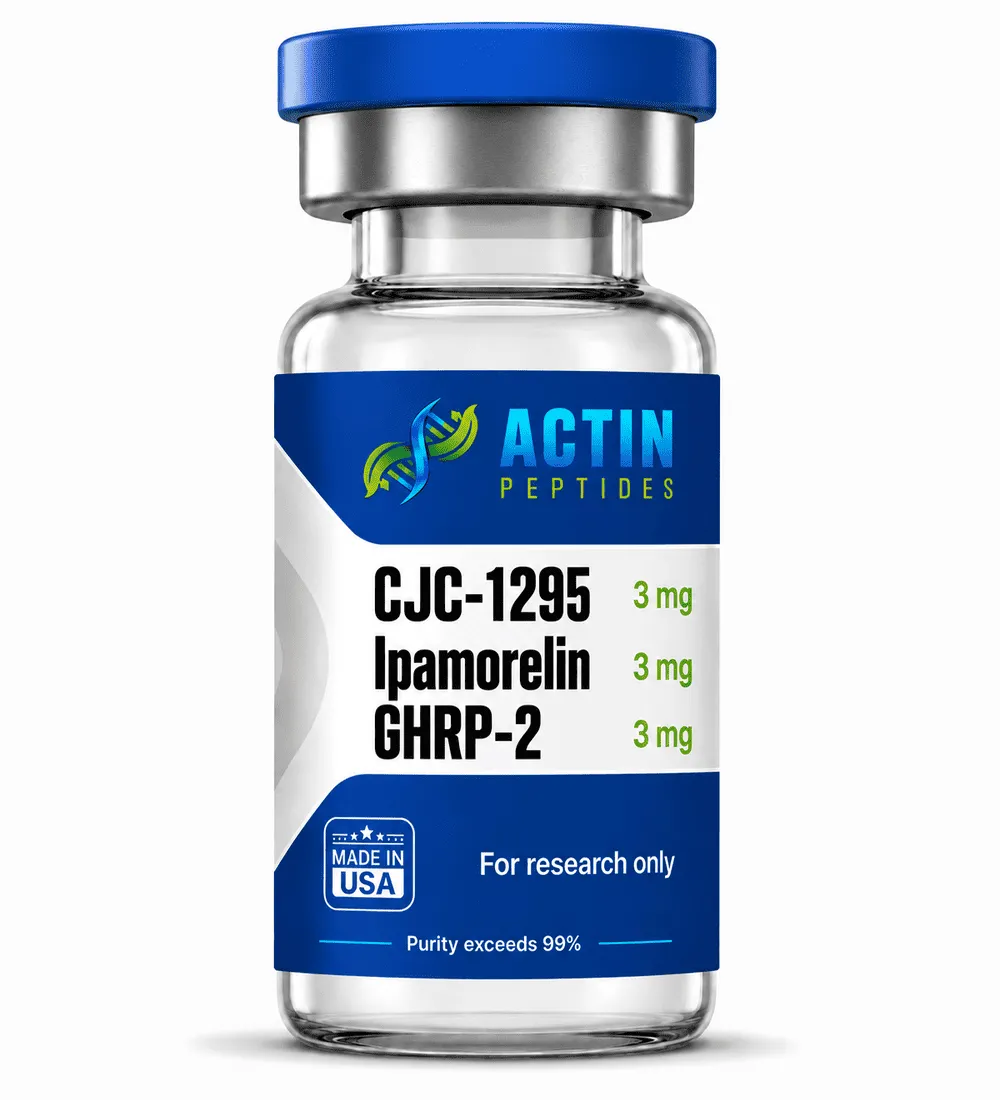
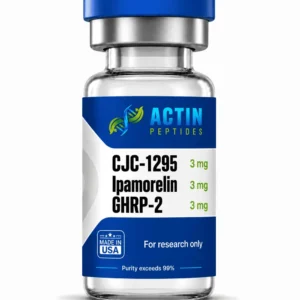
CJC-1295 (Mod GRF 1-29) & Ipamorelin & GHRP-2 Peptide Blend
Introduction
CJC-1295 (Mod GRF 1-29) & Ipamorelin & GHRP-2 is a three-peptide research blend combining two growth hormone secretagogues with a modified growth hormone-releasing hormone (GHRH) analog. Research on these individual compounds has focused primarily on growth hormone signaling, pituitary activity, ghrelin-receptor pathways, appetite regulation, bone biology, and lean-tissue metabolism.
CJC-1295 (Mod GRF 1-29), Ipamorelin, and GHRP-2 interact with different components of the growth hormone regulatory system. Consequently, scientists have investigated whether combining GHRH- and GHS-related signaling may provide a useful model for studying the interaction between these pathways.
Importantly, research has not established that this specific three-peptide combination produces a synergistic effect. Most available evidence evaluates the individual compounds rather than the blend itself.
What Is CJC-1295 (Mod GRF 1-29) & Ipamorelin & GHRP-2?
This blend contains three synthetic peptides studied for their effects on growth hormone-related signaling:
- CJC-1295 (Mod GRF 1-29): a modified analog related to the first 29 amino acids of GHRH.
- Ipamorelin: a pentapeptide studied as a selective growth hormone secretagogue.
- GHRP-2: a hexapeptide researched for its interaction with the growth hormone secretagogue receptor (GHS-R1a).
Together, these compounds provide a research model for investigating interactions between GHRH receptors and growth hormone secretagogue receptors.
Aperçu
The three components operate through related but distinct signaling mechanisms.
CJC-1295 (Mod GRF 1-29)
CJC-1295 (Mod GRF 1-29) is a modified form of the truncated GHRH sequence commonly referred to as GHRH (1-29). Researchers have investigated its interaction with the growth hormone-releasing hormone receptor (GHRHR) on pituitary somatotroph cells.
The modified structure distinguishes it from unmodified GHRH (1-29). Research has also examined CJC-1295 variants incorporating a drug-affinity component, although the exact properties depend on the specific molecular form being studied.
For accurate product research, it is therefore important to distinguish Mod GRF 1-29 from CJC-1295 DAC, as they are not interchangeable molecular descriptions.
Ipamorelin
Ipamorelin is a synthetic pentapeptide investigated as a growth hormone secretagogue. It interacts with the growth hormone secretagogue receptor type 1a (GHS-R1a), a receptor associated with ghrelin signaling.
Research has primarily examined its ability to stimulate pulsatile growth hormone release while investigating whether it produces fewer effects on other pathways compared with some earlier growth hormone-releasing peptides.
GHRP-2
GHRP-2, also known as pralmorelin, is a synthetic hexapeptide researched for its interaction with GHS-R1a.
Because GHS-R1a participates in ghrelin-related signaling, research has examined both growth hormone secretion and potential effects on feeding behavior and energy regulation.
CJC-1295, Ipamorelin & GHRP-2 Mechanism of Action
GHRH and Growth Hormone Signaling
CJC-1295 (Mod GRF 1-29) research centers on the GHRH–GHRHR pathway. GHRH binds to receptors on pituitary somatotroph cells and activates intracellular signaling involved in growth hormone secretion.
This provides one side of the growth hormone regulatory system represented in the blend.
GHS-R1a and Ghrelin Signaling
Ipamorelin and GHRP-2 primarily relate to GHS-R1a, the receptor through which ghrelin and several synthetic growth hormone secretagogues exert biological effects.
Activation of this receptor can influence growth hormone secretion and may also intersect with hypothalamic pathways associated with appetite and energy balance.
Pituitary Somatotroph Activity
Growth hormone is produced by specialized pituitary cells called somatotrophs. Research involving GHRH analogs and growth hormone secretagogues has examined whether these compounds alter the frequency or magnitude of growth hormone pulses.
Therefore, the three compounds provide researchers with multiple entry points for studying the hypothalamic–pituitary growth hormone axis.
Composition chimique
| Peptide | Molecular Formula | Molecular Weight | Other Known Titles |
|---|---|---|---|
| CJC-1295 (Mod GRF 1-29) | C152H252N44O42 | 3367.9 g/mol | Modified GHRH (1-29) |
| Ipamorelin | C38H49N9O5 | 711.9 g/mol | Ipamorelin Acetate, IPA |
| GHRP-2 | C45H55N9O6 | 817.9 g/mol | Pralmorelin, Growth Hormone-Releasing Peptide-2 |
Recherche et études cliniques
CJC-1295, Ipamorelin & GHRP-2 Research and Growth Hormone Signaling
Objectif de l'étude
Researchers have investigated growth hormone-releasing peptides in experimental models involving reduced or impaired growth hormone secretion.
Méthodologie
Studies have evaluated different growth hormone secretagogues in subjects with growth hormone deficiency while monitoring episodic growth hormone secretion and tolerability.
Résultats
Research has reported increases in circulating growth hormone following exposure to growth hormone-releasing peptides. However, individual studies differ in their experimental designs, peptide combinations, populations, and outcomes.
Importance scientifique
These findings make GHRH analogs and GHS compounds useful research tools for studying pituitary growth hormone secretion and hypothalamic–pituitary signaling.
Importantly, these studies do not establish therapeutic efficacy for this particular blend.
GHRP-2 Research and Food Intake
Objectif de l'étude
Researchers have examined whether activation of GHS-R1a influences both growth hormone secretion and feeding behavior.
Méthodologie
In one experimental study, subjects received GHRP-2 and subsequently had unrestricted access to food. Researchers compared food consumption with a control condition.
Résultats
The study reported increased food intake alongside elevated growth hormone concentrations following GHRP-2 exposure.
Importance scientifique
These observations demonstrate why GHS-R1a signaling remains important in research involving both growth hormone physiology and appetite regulation.
Because GHRP-2 interacts with a receptor associated with ghrelin biology, researchers continue to investigate its broader metabolic effects.
Ipamorelin Research and Body Composition
Objectif de l'étude
Research has investigated whether Ipamorelin influences growth-related and metabolic parameters in experimental models.
Méthodologie
Experimental animals were exposed to Ipamorelin and compared with control groups. Researchers evaluated body weight, body composition, nitrogen metabolism, and related biochemical markers.
Résultats
Some studies reported changes in body weight and nitrogen-related measurements following exposure to Ipamorelin. Researchers also investigated changes in fat mass, leptin concentrations, and nitrogen balance.
Importance scientifique
These observations provide a basis for studying the relationship between growth hormone signaling, protein metabolism, nitrogen balance, and body composition.
They do not, however, establish that Ipamorelin produces predictable changes in human muscle mass or body composition.
Ipamorelin Research and Bone Biology
Objectif de l'étude
Researchers have examined whether growth hormone secretagogues influence bone mineral content and bone structure.
Méthodologie
Experimental animals received Ipamorelin or a control compound. Researchers used dual-energy X-ray absorptiometry (DXA) and peripheral quantitative computed tomography (pQCT) to evaluate bone characteristics.
Résultats
The research reported changes in bone mineral content and bone dimensions. However, volumetric bone mineral density did not consistently increase after accounting for changes in body size.
Importance scientifique
These findings suggest that growth hormone-related signaling may influence skeletal growth and bone dimensions without necessarily producing proportional changes in volumetric bone density.
CJC-1295 Research and Lean Tissue
Objectif de l'étude
Researchers have explored the potential relationship between GHRH signaling and lean tissue development.
Méthodologie
One experimental study used models with disrupted GHRH signaling and evaluated the effects of CJC-1295-related stimulation on growth and body composition.
Résultats
Research observations indicated that GHRH-related stimulation could influence lean body mass and growth-related measurements in experimental models.
Researchers also observed changes involving pituitary growth hormone-related messenger RNA (mRNA), suggesting an interaction with somatotroph activity.
Importance scientifique
These findings contribute to research into how GHRH signaling regulates growth hormone production and downstream growth-related processes.
What Is the CJC-1295 & Ipamorelin & GHRP-2 Blend Researched For?
The individual peptides in this blend have been investigated in relation to:
- Growth hormone secretion
- GHRH and GHS-R1a signaling
- Pituitary somatotroph activity
- Appetite and feeding behavior
- Nitrogen metabolism
- Bone mineral content
- Lean-tissue biology
- Growth hormone-related metabolic pathways
The specific three-peptide combination remains comparatively less characterized than its individual components.
What Makes This Peptide Blend Unique?
The primary research interest lies in the fact that the three peptides target complementary components of growth hormone regulation.
CJC-1295 (Mod GRF 1-29) relates primarily to GHRH signaling, while Ipamorelin and GHRP-2 act through GHS-R1a-related pathways. This makes the combination a useful conceptual model for investigating how distinct growth hormone secretagogue pathways interact.
However, available research should not be interpreted as proof that combining these compounds produces additive or synergistic effects.
Related Peptide Research at Actin Peptides
Researchers interested in growth hormone and related peptide pathways may also explore:
- GHRP-2 Peptide — research involving growth hormone secretagogue receptor signaling.
- Ipamorelin Peptide — research involving GHS-R1a and growth hormone secretion.
- CJC-1295 DAC Peptide — a distinct CJC-1295 formulation incorporating a drug-affinity component.
- Sermorelin Peptide — a GHRH-related peptide used in growth hormone signaling research.
- IGF-1 LR3 de qualité récepteur — research involving IGF-related cellular signaling downstream of growth hormone biology.
These products represent related but distinct research compounds and should not be considered interchangeable.
Foire aux questions
How does CJC-1295 (Mod GRF 1-29) work?
Research suggests that Mod GRF 1-29 interacts with the growth hormone-releasing hormone receptor, providing a model for studying GHRH-mediated stimulation of pituitary somatotroph cells and growth hormone secretion.
How does Ipamorelin work?
Ipamorelin has been studied as a growth hormone secretagogue that interacts with GHS-R1a, the growth hormone secretagogue receptor associated with ghrelin signaling.
What is GHRP-2?
GHRP-2, also called pralmorelin, is a synthetic hexapeptide studied for its interaction with GHS-R1a and its effects on growth hormone secretion and related physiological signaling.
Is CJC-1295 the same as Mod GRF 1-29?
They are related but should not automatically be treated as identical. Mod GRF 1-29 refers to a modified GHRH (1-29) analog, while CJC-1295 can refer to specific modified forms, including versions containing a drug-affinity complex. Product specifications should therefore be checked carefully.
Are CJC-1295, Ipamorelin, and GHRP-2 studied together?
Research has extensively examined these compounds individually, but evidence directly evaluating this exact three-peptide blend remains limited. Therefore, claims of proven synergy should be avoided.
What is CJC-1295, Ipamorelin & GHRP-2 researched for?
The combination is relevant to laboratory research involving growth hormone signaling, GHRH/GHS receptor interactions, pituitary function, appetite-related signaling, bone biology, and metabolic pathways.
Conclusion
CJC-1295 (Mod GRF 1-29) & Ipamorelin & GHRP-2 combines three synthetic peptides associated with distinct components of growth hormone-related signaling. CJC-1295 (Mod GRF 1-29) provides a GHRH-related research component, while Ipamorelin and GHRP-2 provide GHS-R1a-related signaling pathways.
Studies involving the individual compounds have investigated growth hormone secretion, pituitary activity, appetite signaling, bone biology, nitrogen metabolism, and lean-tissue research. Nevertheless, research directly evaluating the complete three-peptide combination remains limited.
For that reason, the available evidence should be interpreted as preclinical and research-oriented rather than evidence of therapeutic efficacy or established human benefits.
Avertissement relatif à la recherche
CJC-1295 (Mod GRF 1-29) & Ipamorelin & GHRP-2 Peptide Blend is available strictly for research and laboratory purposes only. It is not approved for human consumption, therapeutic use, or diagnostic applications. Please review our Termes et conditions avant de passer commande.
 English
  French
Avis
Il n’y a pas encore d’avis.