
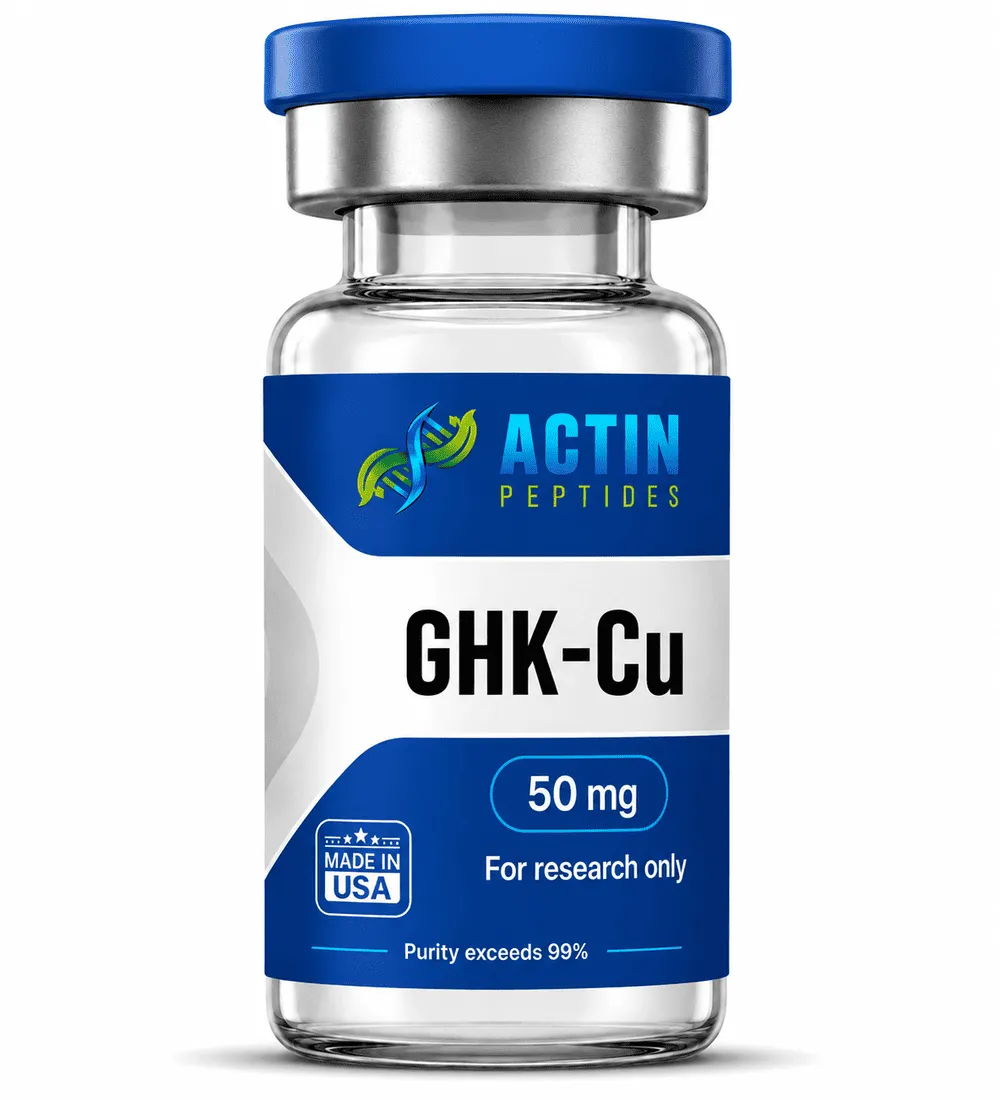
Description
GHK-Cu (Copper) Peptide: Research, Mechanism, Benefits & Cellular Signaling
Introduction
GHK-Cu peptide injection, also known as copper peptide GHK-Cu, is a naturally occurring copper-binding complex composed of the tripeptide glycyl-L-histidyl-L-lysine (GHK) and a divalent copper ion (Cu²⁺). Researchers have studied GHK-Cu extensively for its potential involvement in cellular signaling, extracellular matrix regulation, collagen synthesis, oxidative stress, inflammation-related pathways, and tissue remodeling.
GHK is naturally present in human plasma and has also been identified in tissues and extracellular environments. Research has suggested that GHK concentrations may change with age and that the peptide can bind copper ions to form the biologically active GHK-Cu complex.
Because copper participates in numerous enzymatic and cellular processes, scientists have investigated whether GHK-Cu may influence several biological systems simultaneously. Current research includes skin and connective-tissue models, fibroblast activity, angiogenesis, antioxidant signaling, inflammatory pathways, and cellular gene expression.
For researchers exploring related compounds, Actin Peptides also offers research products involving BPC-157, TB-500, and other peptide compounds used in laboratory research.
What Is GHK-Cu Peptide?
GHK-Cu is a copper-binding tripeptide complex consisting of glycyl-L-histidyl-L-lysine (GHK) and Cu²⁺. Research has investigated its potential effects on extracellular matrix signaling, collagen-related processes, fibroblast activity, oxidative stress, and inflammatory pathways.
GHK-Cu is particularly notable because the GHK peptide can bind copper, creating a complex that researchers have associated with biological signaling and tissue-remodeling processes.
The peptide has been investigated in several areas, including:
- Collagen and extracellular matrix research
- Fibroblast signaling
- Skin biology and structural remodeling
- Angiogenesis and endothelial cell behavior
- Oxidative stress research
- Inflammatory signaling
- Gene-expression studies
- Cellular repair and tissue-remodeling models
Overview of GHK-Cu
GHK-Cu research began with investigations into the naturally occurring GHK peptide and its ability to bind copper ions. Researchers subsequently examined the biological properties of the resulting copper-peptide complex.
Studies suggest that GHK-Cu can interact with biological systems at relatively low concentrations and may influence multiple cellular processes. Rather than functioning through one isolated pathway, research indicates that the complex may interact with several signaling mechanisms associated with extracellular matrix organization, cell proliferation, antioxidant defenses, and inflammatory regulation.
One particularly important research area involves gene expression. Scientists have investigated whether GHK-Cu can influence the expression of genes involved in tissue structure and cellular responses.
This broad activity has made GHK-Cu an important compound in peptide research involving:
- Fibroblasts
- Collagen
- Extracellular matrix proteins
- Endothelial cells
- Growth factors
- Oxidative stress
- Reactive oxygen species (ROS)
- Cellular differentiation
- Tissue remodeling
Researchers studying related connective-tissue compounds may also be interested in Matrixyl and Syn-Coll Palmitoyl Tripeptide-5.
GHK-Cu Peptide Mechanism of Action
How Does GHK-Cu Work?
GHK-Cu may influence cellular behavior through copper-dependent biochemical interactions, extracellular matrix signaling, gene-expression changes, and modulation of oxidative and inflammatory pathways.
The precise mechanism remains an active area of research. However, scientists have investigated several interconnected mechanisms.
Copper Binding and Cellular Signaling
The GHK sequence has a strong affinity for copper ions. When GHK binds Cu²⁺, it forms the GHK-Cu complex.
Copper itself functions as a cofactor for numerous enzymes involved in cellular metabolism, antioxidant defense, connective-tissue biology, and vascular processes.
Consequently, researchers have investigated whether GHK-Cu can influence cellular behavior by delivering or regulating copper within biological environments.
Extracellular Matrix Regulation
The extracellular matrix (ECM) provides structural support around cells and contains proteins such as collagen, elastin, proteoglycans, and glycoproteins.
Research suggests that GHK-Cu may influence the production and organization of extracellular matrix components, particularly collagen-related proteins.
This has made the compound relevant to research involving:
- Fibroblast activity
- Collagen synthesis
- Tissue remodeling
- Skin structure
- Connective-tissue biology
Fibroblast Signaling
Fibroblasts produce and remodel extracellular matrix proteins. Studies have investigated whether GHK-Cu can influence fibroblast proliferation, migration, and protein production.
Because fibroblasts play an important role in collagen-rich tissues, their behavior represents a major area of GHK-Cu peptide research.
Angiogenesis and Endothelial Cells
Researchers have also examined GHK-Cu in relation to angiogenesis, the biological process through which new blood vessels develop.
Some experimental studies suggest that GHK-Cu may influence vascular endothelial growth factor (VEGF), endothelial cell proliferation, migration, and tube formation.
These observations have contributed to research into the relationship between copper peptides, vascular signaling, and tissue remodeling.
Oxidative Stress and Antioxidant Signaling
Reactive oxygen species (ROS) can influence cellular signaling and contribute to oxidative stress when their production exceeds cellular antioxidant defenses.
Research has investigated whether GHK and GHK-Cu can interact with specific reactive oxygen species, including hydroxyl and peroxyl radicals.
Scientists have also examined possible relationships between GHK-Cu and antioxidant pathways such as Nrf2, a transcription factor involved in cellular responses to oxidative stress.
Inflammatory Signaling
GHK-Cu has also been studied for its potential influence on inflammatory signaling.
Experimental research has investigated changes in mediators including:
- TNF-α
- IL-1β
- IL-6
- NF-κB
- Myeloperoxidase (MPO)
These findings remain primarily experimental and do not establish clinical efficacy.
Chemical Makeup of GHK-Cu
| Property | Specification |
|---|---|
| Peptide | GHK-Cu |
| Full Name | Glycyl-L-histidyl-L-lysine copper complex |
| Peptide Structure | GHK + Cu²⁺ |
| Molecular Formula | C14H23CuN6O4 |
| Molecular Weight | 340.38 g/mol |
| Peptide Type | Copper-binding tripeptide |
| Primary Research Areas | Cellular signaling, extracellular matrix, collagen, oxidative stress, fibroblasts |
The molecular characteristics of GHK-Cu distinguish it from non-copper-binding peptide compounds. The copper component is particularly important because Cu²⁺ participates in numerous enzymatic and cellular processes.
GHK-Cu Research and Clinical Studies
GHK Peptide and Initial Tissue Research
Study Objective
Early research investigated the naturally occurring GHK peptide and its relationship with copper and tissue-repair signaling.
Methodology
Researchers used experimental animal models involving dermal injury and examined biological responses associated with GHK and copper.
Findings
The research suggested that GHK could bind copper ions and may influence the production of extracellular matrix components, including collagen-associated proteins.
Researchers also investigated decorin, a proteoglycan involved in extracellular matrix organization and collagen regulation.
Subsequent research examined whether GHK-Cu could influence tissue inhibitor of metalloproteinases (TIMPs), including TIMP-1 and TIMP-2.
Scientific Significance
These findings established an early research foundation for investigating GHK-Cu as a signaling molecule associated with extracellular matrix biology.
GHK-Cu and Tissue Remodeling Research
Study Objective
Researchers have investigated whether topical GHK-Cu exposure influences tissue remodeling following experimentally induced injury.
Methodology
Animal models with experimentally created wounds received GHK-Cu, comparison compounds, or placebo preparations over defined observation periods.
Findings
Some experimental studies reported differences in wound closure, inflammatory-cell presence, and vascularization between GHK-Cu-treated and control groups.
Additional experiments compared GHK-Cu with other interventions, including low-level laser exposure.
Scientific Significance
The findings contributed to research into how copper-binding peptides may interact with extracellular matrix remodeling, vascular responses, and inflammatory processes.
These observations should be interpreted as experimental findings rather than evidence of therapeutic effectiveness in humans.
GHK-Cu and Collagen Research
Study Objective
Researchers have examined whether GHK-Cu influences collagen-related pathways and extracellular matrix organization.
Methodology
Cell and animal models have been used to examine collagen production, fibroblast activity, and extracellular matrix-associated proteins.
Findings
Research suggests that GHK-Cu may influence collagen-related protein production and fibroblast behavior.
Because fibroblasts are major producers of extracellular matrix components, changes in fibroblast activity may contribute to the structural effects observed in laboratory models.
Scientific Significance
This research has made GHK-Cu relevant to studies involving collagen biology, extracellular matrix remodeling, and connective-tissue structure.
For researchers investigating other collagen-related peptide compounds, Syn-Coll Palmitoyl Tripeptide-5 provides another research model involving extracellular matrix signaling.
GHK-Cu and Angiogenesis Research
Study Objective
Scientists have investigated whether GHK-Cu injection can influence the cellular processes involved in angiogenesis.
Methodology
Experimental models have examined endothelial-cell proliferation, migration, vascular signaling, and formation of tube-like structures in laboratory environments.
Findings
Some research has associated GHK-Cu exposure with changes in VEGF expression and endothelial-cell behavior.
The compound has therefore been studied in relation to signaling pathways that regulate vascular development.
Scientific Significance
Angiogenesis research is relevant because endothelial-cell migration and vascular formation are interconnected with extracellular matrix remodeling and tissue biology.
However, laboratory observations do not establish that GHK-Cu produces the same effects in humans.
GHK-Cu and Cancer-Related Research
GHK-Cu has also appeared in experimental research involving abnormal cell growth and apoptosis.
Study Objective
Researchers investigated whether GHK or GHK-Cu could influence the behavior of cancer-cell models and non-cancerous fibroblasts.
Methodology
Laboratory studies examined different cell lines exposed to GHK-containing compounds and evaluated changes in cell proliferation, apoptosis-related signaling, and gene expression.
Findings
Some experimental models reported differences in cancer-cell growth and apoptosis-associated pathways following exposure to GHK-related compounds.
Researchers have also observed different effects in non-cancerous fibroblast models, where GHK may influence cell growth and proliferation.
Scientific Significance
These findings highlight the context-dependent nature of peptide signaling. They do not demonstrate that GHK-Cu is an anticancer treatment, nor should they be interpreted as evidence of clinical efficacy.
GHK-Cu and Ulcer Research
Researchers have also studied GHK-Cu preparations in controlled wound models involving diabetic ulcers.
Study Objective
The objective was to investigate whether a GHK-Cu topical preparation could influence wound closure compared with standard care or placebo.
Methodology
Participants received controlled wound-care protocols and were divided into comparison groups involving GHK-Cu gel or control treatment.
Findings
The reported study results described differences in ulcer closure between the experimental and control groups.
Scientific Significance
This research provides clinical data relevant to the historical investigation of GHK-Cu and wound biology. Nevertheless, individual clinical studies should not be interpreted as establishing a general therapeutic indication.
GHK-Cu and Oxidative Stress Research
Reactive Oxygen Species
Researchers have investigated whether GHK can interact with reactive oxygen species (ROS), particularly hydroxyl and peroxyl radicals.
Experimental measurements using techniques such as flow cytometry and electron spin resonance suggested that GHK may influence certain oxidative-stress markers.
The findings have led scientists to investigate GHK-Cu as a potential model for studying endogenous antioxidant signaling.
Nrf2 Signaling
Nuclear factor erythroid 2-related factor 2 (Nrf2) regulates the expression of numerous genes involved in cellular antioxidant defense.
Experimental studies have examined whether GHK-Cu can influence Nrf2 expression and nuclear translocation.
This research is relevant to understanding how copper-binding peptides may interact with cellular defenses against oxidative stress.
GHK-Cu and Inflammatory Signaling
Research has investigated the potential relationship between GHK-Cu and inflammatory signaling pathways.
One area of interest involves NF-κB, a transcription factor that regulates the expression of numerous inflammatory mediators.
Experimental studies have reported changes in inflammatory markers such as:
- TNF-α
- IL-1β
- IL-6
- MPO
- Oxidative-stress markers
Researchers have also investigated possible interactions between GHK-Cu, NF-κB, and Nrf2 signaling.
Together, these studies provide a basis for further research into how copper-binding peptides may influence the balance between inflammatory and antioxidant cellular responses.
GHK-Cu and Lipid Peroxidation
Scientists have proposed that GHK may interact with iron-storage systems such as ferritin.
Free iron can participate in chemical reactions that generate reactive species capable of damaging cellular lipids. This process, known as lipid peroxidation, represents an important research area in oxidative-stress biology.
Experimental models have therefore investigated whether GHK could influence iron release and subsequently alter lipid-peroxidation pathways.
These observations remain mechanistic and experimental rather than evidence of a clinical effect.
GHK-Cu Peptide Benefits: What Does Research Suggest?
When discussing GHK-Cu peptide benefits research, it is important to distinguish experimental observations from established clinical outcomes.
Research has investigated GHK-Cu in connection with:
- Collagen and extracellular matrix biology
- Fibroblast proliferation and activity
- Endothelial-cell behavior
- Angiogenesis signaling
- Oxidative-stress pathways
- Antioxidant signaling
- Inflammatory signaling
- Gene-expression regulation
- Cellular remodeling
- Skin and connective-tissue research
The available evidence varies considerably by research model. Cell-culture and animal findings cannot automatically be extrapolated to humans.
What Makes GHK-Cu Unique?
GHK-Cu is particularly interesting to peptide researchers because it combines a short endogenous peptide sequence with a copper ion.
The GHK sequence provides the peptide component, while Cu²⁺ contributes properties associated with copper-dependent biological processes.
This combination has allowed researchers to investigate relationships among:
GHK-Cu → copper binding → cellular signaling → fibroblast activity → extracellular matrix → collagen → oxidative stress → inflammatory pathways
The compound therefore represents a useful research model for studying interconnected cellular processes rather than a single biological pathway.
GHK-Cu and Skin Research
GHK-Cu peptides injections has been widely investigated in research involving skin structure, fibroblasts, collagen, extracellular matrix proteins, and oxidative stress.
Researchers have examined whether the complex can influence cellular processes associated with:
- Collagen production
- Fibroblast activity
- Extracellular matrix organization
- Skin-barrier biology
- Cellular oxidative stress
- Tissue remodeling
For broader peptide research involving skin and extracellular matrix signaling, researchers may also explore Matrixyl and Syn-Coll Palmitoyl Tripeptide-5.
GHK-Cu and Hair Research
Researchers have also investigated copper-containing peptides in relation to hair-follicle biology and cellular signaling.
Research in this area has focused on whether GHK-Cu may influence cellular behavior around hair follicles and pathways associated with tissue structure.
For comparison, AHK-Cu represents another copper-binding peptide studied specifically in relation to hair-related research.
GHK-Cu vs. Other Research Peptides
GHK-Cu differs from peptides such as BPC-157 and TB-500 because its defining characteristic is its copper-binding structure.
| Peptide | Primary Research Focus |
|---|---|
| GHK-Cu | Copper-dependent signaling, extracellular matrix, collagen, fibroblasts, oxidative stress |
| BPC-157 | Cellular signaling, vascular biology, tissue-repair models |
| TB-500 | Actin regulation, cellular migration, angiogenesis |
| Matrixyl | Extracellular matrix and collagen-related signaling |
| AHK-Cu | Copper-peptide and hair-related research |
This distinction can help researchers select compounds according to the biological pathway or cellular system under investigation.
Frequently Asked Questions About GHK-Cu
What is GHK-Cu peptide?
GHK-Cu is a copper-binding complex formed from the tripeptide glycyl-L-histidyl-L-lysine (GHK) and a divalent copper ion (Cu²⁺). Researchers study it for potential effects on cellular signaling, extracellular matrix biology, fibroblasts, collagen, oxidative stress, and inflammation-related pathways.
How does GHK-Cu work?
Research suggests GHK-Cu injection may influence biological processes through copper-dependent interactions, extracellular matrix signaling, fibroblast activity, gene-expression regulation, antioxidant pathways, and inflammatory signaling.
What is GHK-Cu researched for?
Scientists have investigated GHK-Cu in skin and connective-tissue models, collagen biology, fibroblast activity, angiogenesis, oxidative stress, inflammatory signaling, cellular remodeling, and gene-expression research.
What is the molecular weight of GHK-Cu?
The molecular weight listed for GHK-Cu is approximately 340.38 g/mol, with the molecular formula C14H23CuN6O4.
Is GHK-Cu naturally occurring?
The GHK peptide occurs naturally in biological systems, while GHK-Cu refers specifically to its copper-bound complex. Researchers have studied the relationship between endogenous GHK, copper binding, and cellular signaling.
Is GHK-Cu injection FDA approved?
GHK-Cu injection should not be represented as an FDA-approved therapeutic or as an FDA-approved treatment. The research described on this page concerns experimental and scientific investigation.
Can GHK-Cu research findings be considered clinical evidence?
Not necessarily. Findings from cell cultures and animal models provide mechanistic or preclinical information, but they do not automatically establish safety, effectiveness, dosing, or therapeutic use in humans.
Conclusion
GHK-Cu is a well-studied copper-binding tripeptide that has attracted scientific interest because of its potential involvement in multiple interconnected cellular processes.
Research has investigated its relationship with fibroblasts, collagen, extracellular matrix remodeling, endothelial cells, angiogenesis, oxidative stress, inflammatory signaling, and gene expression.
The compound’s combination of the GHK peptide sequence and Cu²⁺ makes it particularly relevant to research examining how peptide signaling and metal-dependent biological processes interact.
Although experimental findings have identified several potentially important mechanisms, the evidence varies according to the model and experimental conditions. Further research is necessary to clarify the biological significance of these observations and their relevance to human biology.
For researchers evaluating related compounds, Actin Peptides provides additional research-focused products spanning copper peptides, tissue-signaling peptides, growth-factor-related compounds, and extracellular-matrix research.
Research Disclaimer
GHK-Cu (Copper) peptide is available strictly for research and laboratory purposes only. It is not approved for human consumption, therapeutic use, or diagnostic applications. Please review our Terms and Conditions before placing an order.
 English
Reviews
There are no reviews yet.