
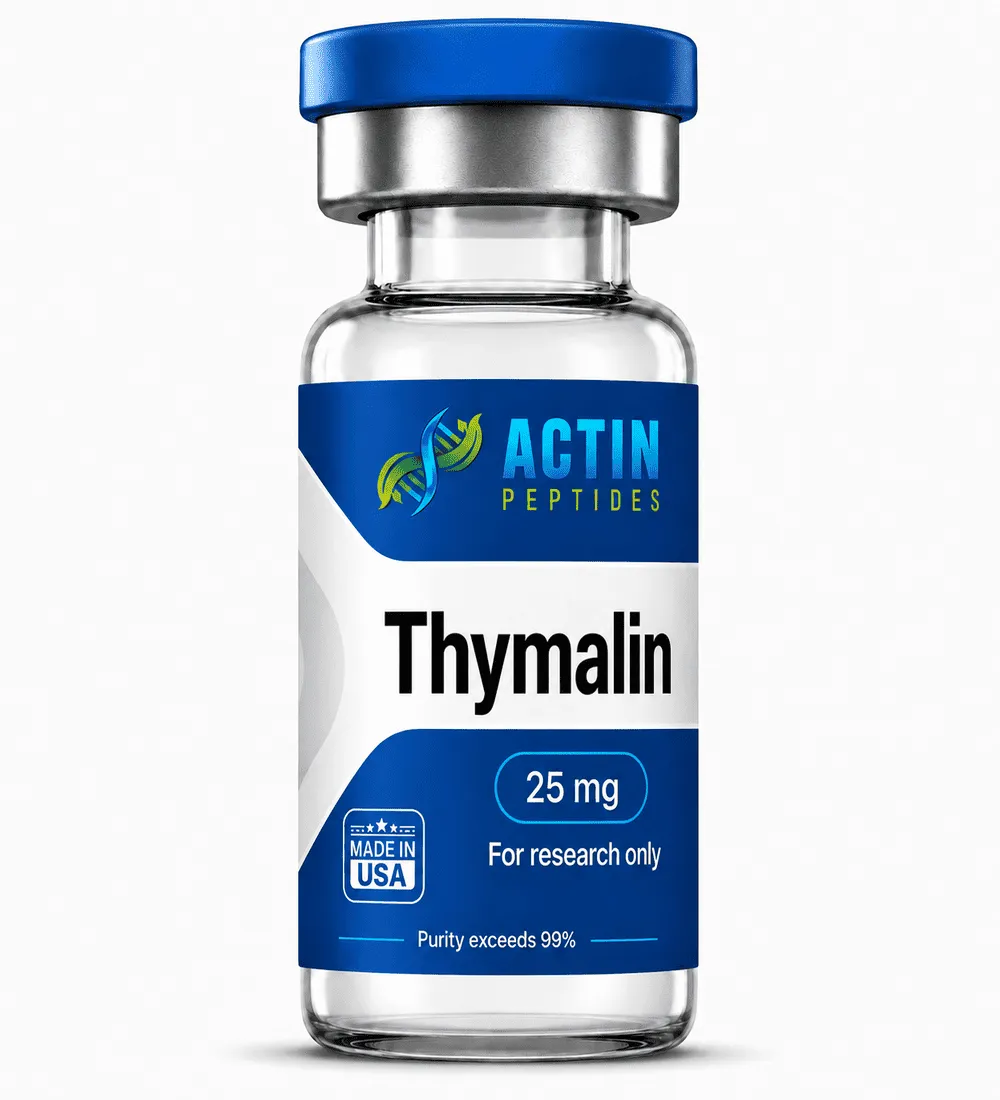
Description
Thymalin Peptide – Research on Thymic Signaling, Immune Regulation, and Cellular Aging
Introduction
Thymalin peptide is a thymus-derived polypeptide that researchers have investigated for its potential involvement in thymic function, immune regulation, cellular signaling, and age-associated biological processes. Natural thymic peptides have attracted scientific interest because thymic activity and immune-cell function can change with age.
Research on Thymalin has primarily examined its potential influence on T-cell differentiation, cytokine signaling, antioxidant responses, and other pathways associated with immune-system regulation. Scientists have also studied related thymic peptides, including Thymogen and Vilon, to better understand how short peptide sequences may influence cellular communication.
Thymalin research remains largely focused on experimental and preclinical models. Consequently, findings from laboratory and animal studies should not be interpreted as evidence of therapeutic efficacy in humans.
What is Thymalin Peptide?
Thymalin Peptide is a naturally derived biomolecule originally sourced from the thymus gland. Known for its role in regulating immune functions and restoring balance to the body, this peptide has gained recognition for its multifaceted benefits, particularly in supporting healthy aging and promoting overall wellness. It’s a reliable solution for those looking to fortify their health at a foundational level.
Thymalin should also be distinguished from Thymulin, a zinc-dependent thymic nonapeptide. Although both compounds belong to the broader family of thymic factors, they have different structures and proposed mechanisms.
Overview of Thymalin Peptide Research
Scientists have investigated natural and synthetic thymic peptides to understand their potential biological functions. Three compounds frequently discussed in this research include:
- Thymalin — a naturally derived thymic polypeptide
- Thymogen — a synthetic thymic peptide
- Vilon — a short peptide derived from thymic peptide research
Studies indicate that these compounds may influence pathways associated with T-cell differentiation, cytokine production, nucleotide signaling, and lymphocyte activity.
However, researchers have reported differences between individual thymic peptides. For example, experimental research has suggested that Thymalin may influence antioxidant responses more substantially than some synthetic analogues.
This distinction is important because thymic peptide research does not establish that all thymic peptides produce identical biological effects.
For researchers examining related immune-signaling compounds, Actin Peptides also offers Thymosin Alpha-1 for laboratory research.
Thymalin Peptide Mechanism of Action
T-Cell Differentiation
One major area of Thymalin mechanism research involves T lymphocytes. T cells are essential components of adaptive immunity, and thymic signaling plays an important role in their maturation and differentiation.
Research suggests that thymic peptides may influence the differentiation and functional characteristics of T-cell populations.
Cytokine and Immune-Cell Signaling
Studies have investigated potential changes in cytokine levels following exposure to thymic peptides. Cytokines are signaling proteins that allow immune cells to communicate and coordinate responses.
Research models have examined cytokines including:
- Interferon-gamma (IFN-γ)
- Interleukin-2 (IL-2)
- Interleukin-4 (IL-4)
- Interleukin-10 (IL-10)
These observations have contributed to interest in how thymic peptides may selectively influence immune signaling rather than producing broad immune activation.
Antioxidant Signaling
Research has also explored the relationship between Thymalin and oxidative stress. Oxidative stress occurs when reactive molecules exceed the capacity of cellular antioxidant systems to neutralize them.
Experimental findings have suggested that natural Thymalin may influence antioxidant responses. Researchers continue to investigate whether these effects result from direct peptide signaling or downstream changes in cellular regulation.
Cellular Signaling and Nucleotide Regulation
Thymalin-related research has also examined changes in cyclic nucleotides and other intracellular signaling molecules. These compounds participate in communication pathways that regulate cellular activity, differentiation, and metabolism.
Chemical Makeup of Thymalin
| Property | Details |
|---|---|
| Molecular Formula | C33H54N12O15 |
| Molecular Weight | 858.864 g/mol |
| Classification | Thymic polypeptide |
| Other Known Titles | Thymulin, Thymic Factor |
| Associated Peptide | L-Glu-L-Trp |
The L-Glu-L-Trp dipeptide has received particular attention in research examining thymic peptide activity. Scientists have investigated whether this short sequence contributes to some of the biological signaling attributed to thymic peptide preparations.
Research and Clinical Studies on Thymalin Peptide
Thymalin and Carcinogenesis Research
Study Objective
Researchers investigated whether Thymalin exposure could influence tumor development, survival, and immune-related biological markers in experimental animal models.
Methodology
The study involved 76 female rats. Researchers divided the animals into control and Thymalin-exposed groups and monitored them for approximately one year.
The investigators assessed mortality, tumor incidence, and other biological parameters during the observation period.
Findings
The reported findings included:
- A longer average lifespan in the Thymalin-exposed group
- A lower reported incidence of tumors
- A more pronounced difference in some hematopoietic tumor models
- Changes in immune-related cellular activity
Researchers also investigated the L-Glu-L-Trp component and reported changes involving T-cell differentiation, cyclic nucleotide signaling, neutrophil chemotaxis, and phagocytic activity.
Scientific Significance
These observations have contributed to Thymalin research examining relationships between thymic signaling, immune-cell differentiation, and age-associated cellular changes.
However, animal-model findings cannot establish that Thymalin prevents or treats cancer in humans.
Thymalin and Viral-Related Immune Research
Study Objective
Researchers examined whether thymic peptide exposure could influence immune-cell markers and cytokine signaling in individuals with human herpesvirus type 1 (HHV-1).
Methodology
The study included female participants with HHV-1 alongside a control group. Researchers collected peripheral blood samples before and after a period of thymic peptide exposure.
They evaluated immune-cell populations, cytokines, and immune-exhaustion markers.
Findings
Researchers reported changes involving:
- CD4+ T cells
- CD8+ T cells
- IFN-γ
- IL-2
- PD-1
- PD-L1
The researchers also reported no observed HHV-1 reactivation during the study period.
Scientific Significance
These observations have contributed to research examining whether thymic peptides can influence immune-cell signaling and markers associated with immune exhaustion.
Because the research involved a specific experimental population and peptide preparation, the findings should not be generalized to therapeutic outcomes.
Thymalin and Toxic Goiter Research
Study Objective
Researchers investigated whether Thymalin could influence biological markers associated with mild diffuse toxic goiter (DTG).
Methodology
The study enrolled 104 participants with mild DTG. Researchers monitored medium-molecular-weight peptides and lipid oxidation parameters while comparing different treatment groups.
Findings
The researchers reported changes in the monitored parameters among groups receiving Thymalin alone or in combination with other compounds.
Scientific Significance
This study provides additional context for research into thymic peptides and systemic cellular signaling. However, it does not establish Thymalin as an approved treatment for thyroid disorders.
Thymalin and Lymphoid Leukemia Research
Study Objective
Researchers explored the potential effects of combining thymic peptide exposure with plasmapheresis in subjects with chronic lymphoid leukemia.
Methodology
The research examined a combination of immune-modulating intervention and plasmapheresis alongside conventional chemotherapy-related management.
Findings
The researchers reported improvements in certain physiological parameters over a relatively short observation period.
Scientific Significance
The findings contributed to broader research into immune correction and thymic peptide signaling. Nevertheless, these observations should not be interpreted as evidence that Thymalin treats leukemia.
Thymalin and Geroprotective Research
Study Objective
Researchers investigated the long-term biological effects of Thymalin and Epithalamin in mature subjects.
Methodology
The study followed 266 subjects over approximately six to eight years. Different groups received Thymalin, Epithalamin, or combinations of the peptides at different concentrations, followed by extended monitoring.
Findings
The reported observations included changes in several physiological systems, including:
- Cardiovascular function
- Neurological parameters
- Immune-system activity
- Metabolic markers
- Hemostatic processes
Researchers also reported changes involving T-cell quantity and functionality, systemic inflammatory markers, stress-related signaling, glucose regulation, and lipid metabolism.
Scientific Significance
This research has contributed to interest in the relationship between thymic peptides and age-associated changes in immune and metabolic systems.
The findings remain dependent on the specific study populations, protocols, and peptide preparations used.
Thymalin Peptide and Immune Signaling
Thymalin research primarily centers on the relationship between thymic peptides and immune-cell regulation.
The thymus plays an important role in the maturation of T lymphocytes. Consequently, researchers have investigated whether thymic-derived peptides may influence this process through changes in cellular signaling.
Potential research areas include:
- T-cell differentiation
- Lymphocyte signaling
- Cytokine regulation
- Immune-cell communication
- Oxidative-stress responses
- Cellular metabolism
For researchers interested in related thymic peptide compounds, Thymosin Alpha-1 provides another research model for investigating peptide-mediated immune signaling.
Thymalin Peptide and Cellular Aging Research
One of the most prominent areas of interest surrounding Thymalin involves age-associated changes in thymic function.
Research has proposed that thymic activity changes over time and that this process may coincide with alterations in T-cell populations and immune regulation.
Studies involving Thymalin and related peptides have therefore examined:
- T-cell functionality
- Cytokine signaling
- Oxidative stress
- Metabolic stability
- Cellular differentiation
- Systemic inflammatory markers
These findings provide a basis for continued investigation into thymic biology and age-associated cellular changes.
Researchers studying broader peptide-aging pathways may also explore Epithalon peptide as a separate research compound.
Thymalin Peptide and Antioxidant Research
Oxidative stress represents another area of interest in Thymalin studies.
Research suggests that natural Thymalin may influence antioxidant responses, potentially distinguishing it from certain synthetic thymic analogues. Scientists have proposed that changes in oxidative signaling could influence downstream inflammatory and cellular processes.
Importantly, antioxidant activity observed in experimental models does not establish a clinical antioxidant effect in humans.
What Is Thymalin Researched For?
Thymalin is researched primarily for its potential involvement in thymic function, T-cell differentiation, cytokine signaling, antioxidant responses, and age-associated cellular regulation.
What Makes Thymalin Unique?
Thymalin is distinguished by its association with natural thymic peptide research and its proposed influence on multiple immune and cellular signaling pathways. Researchers have studied its potential effects on T-cell biology, cytokine signaling, oxidative stress, and metabolic regulation.
Thymalin vs. Thymulin
Thymalin and Thymulin are related but distinct thymic factors.
| Feature | Thymalin | Thymulin |
|---|---|---|
| General classification | Thymic polypeptide | Zinc-dependent thymic nonapeptide |
| Research focus | Thymic and immune regulation | T-cell and immune signaling |
| Structure | Polypeptide preparation | Nonapeptide |
| Research areas | Immune signaling, aging, oxidative stress | Immune-cell regulation |
Because the names are similar, researchers should carefully distinguish the two compounds when reviewing scientific literature or laboratory materials.
Related Peptide Research
Thymalin belongs to a broader category of compounds investigated for immune and cellular signaling.
Relevant research compounds include:
- Thymosin Alpha-1 — studied in relation to thymic and immune signaling
- BPC-157 — investigated in experimental models involving cellular signaling and tissue biology
- TB-500 — studied for cellular migration and tissue-related signaling
- GHK-Cu — researched for cellular signaling, extracellular matrix biology, and fibroblast-related processes
These compounds have different molecular structures and proposed mechanisms, so research findings for one peptide should not automatically be applied to another.
Frequently Asked Questions
Is Thymalin a natural peptide?
Thymalin has been described in the research literature as a thymus-derived polypeptide. Natural thymic peptide preparations have been studied for their potential involvement in immune and cellular regulation.
What is Thymalin peptide researched for?
Scientists have investigated Thymalin for potential effects involving T-cell differentiation, cytokine signaling, antioxidant responses, cellular metabolism, and age-associated thymic function.
Is Thymalin the same as Thymulin?
No. Although the names are similar and both are associated with thymic biology, Thymalin and Thymulin represent different peptide factors with distinct structures and proposed mechanisms.
Does Thymalin affect T cells?
Research suggests that thymic peptides may influence T-cell differentiation and functionality. However, the specific effects depend on the experimental model and peptide preparation.
Benefits of Thymalin Peptide
Thymalin Peptide offers remarkable benefits, particularly in enhancing immune efficiency, promoting cell regeneration, and improving overall resilience. It is widely regarded for its ability to support the body’s natural defense mechanisms, optimize physical performance, and maintain physiological balance. Users have also reported its potential to improve skin vitality and promote overall well-being.
Who Can Benefit from Thymalin Peptide?
Whether you’re looking to support a healthy immune system, enhance recovery processes, or explore anti-aging solutions, Thymalin Peptide could be the right fit for you. It’s suitable for a broad audience, including those aiming to boost their overall health, manage the natural effects of aging, or recover from stress-related physical and immune strain.
Thymalin Peptide is a versatile option for your wellness routine, offering a potent yet natural way to promote longevity and optimal health. Empower your body today with the transformative potential of Thymalin Peptide.
What is the Thymalin mechanism?
The proposed Thymalin mechanism involves modulation of thymic and immune-cell signaling, including potential effects on T-cell differentiation, cytokine production, nucleotide signaling, and antioxidant pathways.
Where can researchers buy Thymalin peptide?
Researchers evaluating Thymalin peptide for sale should verify peptide identity, analytical documentation, purity information, and research-use restrictions before purchasing. Actin Peptides provides Thymalin as a research-use product.
Conclusion
Thymalin peptide research has explored the relationship between thymic peptides, immune-cell differentiation, cytokine signaling, oxidative stress, cellular metabolism, and age-associated biological changes.
Experimental studies have reported potential changes in T-cell activity, immune markers, antioxidant responses, and metabolic parameters. Researchers have also investigated Thymalin in models involving tumor biology, viral-related immune signaling, thyroid-related conditions, lymphoid disorders, and aging.
Nevertheless, these findings represent specific research observations rather than established therapeutic outcomes. Additional controlled research is necessary to clarify Thymalin’s molecular targets, pharmacological properties, biological mechanisms, and potential applications.
Research Disclaimer
Thymalin peptide is available strictly for research and laboratory purposes only. It is not approved for human consumption, therapeutic use, or diagnostic applications. Please review our Terms and Conditions before placing an order.
 English
Reviews
There are no reviews yet.