
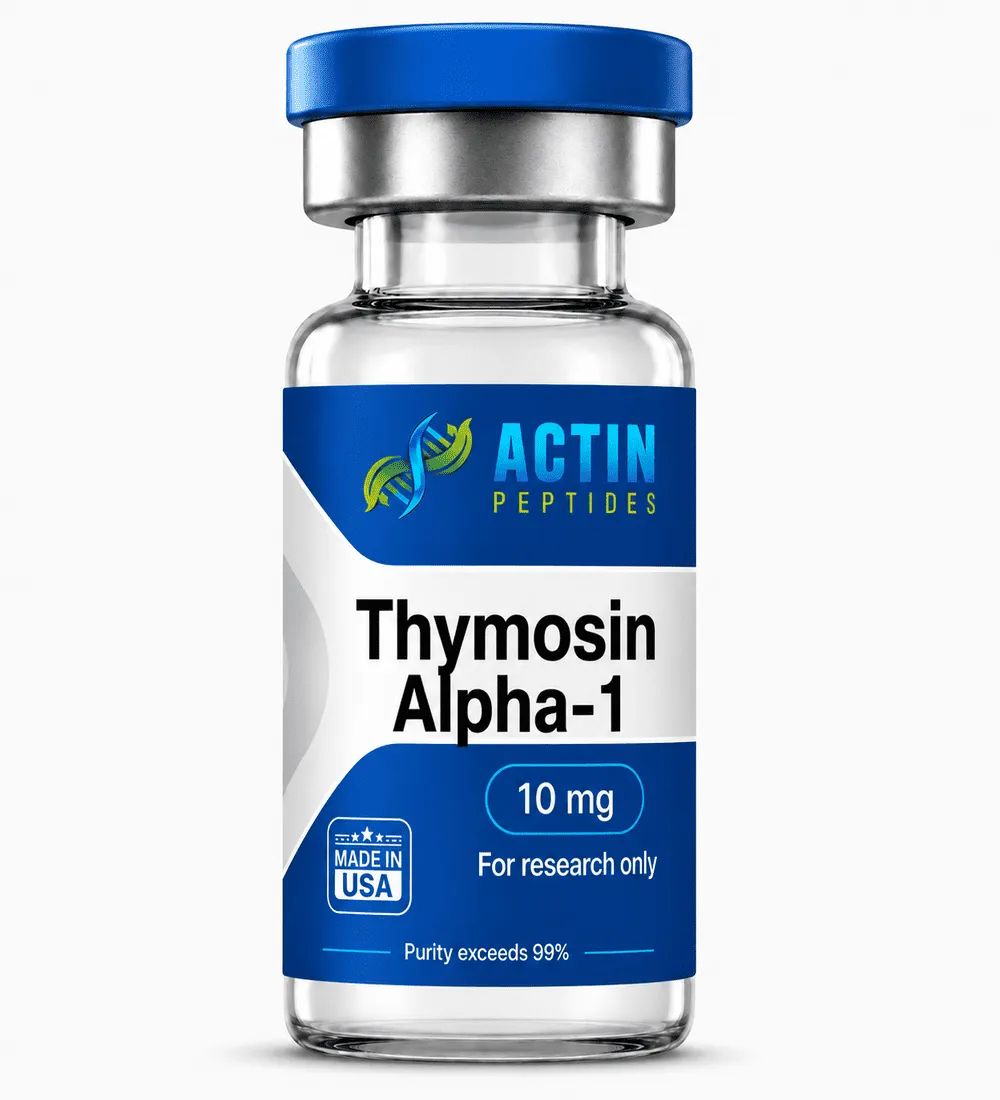
Description
Thymosin Alpha-1 Peptide: Research Overview, Immune Signaling and Cellular Studies
Introduction
Thymosin Alpha-1 peptide (Tα1) is a 28-amino-acid polypeptide studied extensively for its interactions with the immune system. Also known as TA1, Tα1, and thymalfasin, it originated from research into thymic peptides and the longer precursor protein prothymosin alpha.
Scientists have investigated Tα1 primarily for its potential immunomodulatory activity, including interactions with T cells, natural killer (NK) cells, macrophages, dendritic cells, cytokine signaling, and Toll-like receptor (TLR) pathways. Research has also examined its role in immune signaling models involving infectious disease, inflammatory responses, and cellular stress.
Importantly, research findings vary by experimental model and clinical setting. Therefore, the available evidence should not be interpreted as establishing therapeutic efficacy.
What Is Thymosin Alpha-1 Peptide?
Thymosin Alpha-1 is a 28-amino-acid peptide studied for its potential ability to modulate innate and adaptive immune signaling. Research has examined its interactions with immune cells, TLR pathways, cytokines, major histocompatibility complex (MHC) expression, and natural killer cell activity.
Synthetic Tα1 is also known as thymalfasin. The peptide corresponds to a segment of prothymosin alpha, a larger 113-amino-acid precursor.
Overview of Thymosin Alpha-1
Early Thymosin Alpha-1 research focused on understanding how thymic peptides might influence immune-cell function.
Studies have investigated whether Tα1 may:
- Modulate T-cell differentiation and activation
- Influence natural killer cell activity
- Affect macrophage function
- Alter cytokine signaling
- Influence MHC class I expression
- Interact with Toll-like receptors
- Affect dendritic-cell signaling
- Influence inflammatory and immune-response pathways
The peptide’s research profile differs from compounds primarily investigated for tissue remodeling or growth-factor signaling. For example, BPC-157 and TB-500 have attracted substantial research interest around cellular migration and tissue-repair mechanisms, whereas Tα1 research centers more strongly on immune regulation.
Thymosin Alpha-1 Mechanism of Action
Toll-Like Receptor Signaling
Research suggests that Tα1 can interact with several Toll-like receptors (TLRs) involved in innate immune recognition.
Studies have associated Tα1 with TLR2, TLR3, TLR4, TLR7, and TLR9 signaling. These interactions may influence downstream pathways including:
- NF-κB
- IRF3
- MyD88
- p38 MAPK
These pathways regulate the expression of numerous cytokines and immune-response genes.
T-Cell Signaling
Scientists have investigated Tα1 for its potential effects on T-cell maturation, differentiation, and activation.
Research has particularly examined markers associated with CD4+ and CD8+ T-cell populations and thymic output. However, individual studies have produced different results, emphasizing the importance of experimental context.
Natural Killer Cell Activity
Natural killer cells form part of the innate immune system and participate in recognition of abnormal or stressed cells.
Early research investigated whether Tα1 could increase NK-cell activity. However, the supplied clinical study involving 11 subjects with immune dysfunction reported limited changes, with only three subjects showing an improvement in lymphokine-activated killer-cell activity.
Cytokine Regulation
Tα1 research also examines cytokines such as:
- Interleukin-2 (IL-2)
- Interleukin-6 (IL-6)
- Interleukin-10 (IL-10)
- Tumor necrosis factor-alpha (TNF-α)
- Interferon-gamma (IFN-γ)
Rather than functioning as a single-direction immune stimulant, researchers have proposed that Tα1 may influence immune signaling according to the surrounding cellular environment.
Chemical Makeup
| Property | Details |
|---|---|
| Molecular Formula | C129H215N33O55 |
| Molecular Weight | 3108.31 g/mol |
| Amino Acids | 28 |
| Other Names | TA1, Tα1, Thymalfasin |
| Peptide Type | Synthetic form of Thymosin Alpha-1 |
Research and Clinical Studies
Thymosin Alpha-1 and Immune-System Research
Study Objective
Researchers investigated whether Tα1 could influence immune-cell activity in individuals with immune-system dysfunction.
Methodology
An early clinical study evaluated 11 subjects with different immune deficiencies. Researchers measured natural killer (NK) and lymphokine-activated killer (LAK) cell activity before and after peptide exposure.
Findings
The researchers reported that the immunodeficient subjects had substantially lower LAK-cell activity than controls. After Tα1 exposure, only three subjects showed an improvement of up to approximately 30%, while the remaining subjects showed no major change.
Scientific Significance
The findings illustrate an important point for Thymosin Alpha-1 studies: immune modulation does not necessarily produce the same measurable response in every experimental subject.
Thymosin Alpha-1 and Hepatitis Research
Study Objective
Researchers have investigated Tα1 in clinical studies involving hepatitis B and hepatitis C to understand its potential influence on immune and viral-response pathways.
Methodology
Clinical studies evaluated subjects with hepatitis B or C who received Tα1 under controlled research protocols. Some hepatitis C studies evaluated Tα1 alongside interferon-based approaches.
Findings
The supplied research describes an increased virological response in some hepatitis B research populations and additional activity when Tα1 was combined with interferon-alpha in hepatitis C studies.
Scientific Significance
These findings contributed to interest in Tα1 as an immune-modulating research compound. However, results from disease-specific clinical studies should not be generalized to other populations or interpreted as evidence that research-grade peptide material is suitable for human use.
Thymosin Alpha-1 and TLR-Mediated Immune Signaling
Study Objective
Researchers have explored how Tα1 may influence innate and adaptive immune signaling through Toll-like receptors.
Mechanism Investigated
Studies associate Tα1 with TLR2, TLR3, TLR4, TLR7, and TLR9. Activation of these receptor systems can influence downstream signaling involving NF-κB, IRF3, p38 MAPK, and MyD88.
Findings
Research suggests these interactions may influence cytokine production and the activity of immune cells including:
- T cells
- B cells
- Macrophages
- Dendritic cells
- Natural killer cells
Scientific Significance
This work provides a mechanistic framework for understanding why scientists continue to investigate Tα1 as an immunomodulatory peptide.
Thymosin Alpha-1 and Sepsis Research
Study Objective
Researchers have evaluated whether immune modulation with Tα1 could influence outcomes in experimental and clinical sepsis research.
Methodology
Multiple systematic reviews and meta-analyses have assessed randomized controlled trials involving Tα1.
Findings
Earlier meta-analyses reported associations between Tα1 exposure and lower mortality in selected sepsis trials. However, researchers repeatedly noted limitations involving sample size, study quality, and heterogeneity.
More recent evidence provides a more nuanced picture. A 2025 systematic review analyzed 11 randomized controlled trials involving nearly 2,000 participants and found an overall association with lower 28-day mortality. However, the higher-quality and multicenter subgroup analyses did not demonstrate a statistically significant mortality benefit, and the authors concluded that the available sample size remained inadequate for definitive conclusions.
A large multicenter, double-blind, randomized, placebo-controlled phase 3 trial was also published in 2025, highlighting the continuing effort to establish the clinical significance of Tα1 in sepsis research.
Scientific Significance
Sepsis research demonstrates why Thymosin Alpha-1 benefits research should be interpreted carefully. Immune responses differ substantially between individuals and disease stages, and pooled results can change as larger and higher-quality trials become available.
Thymosin Alpha-1 and HIV-Related Immune Research
Study Objective
Researchers investigated whether Tα1 could influence immune-cell recovery in clinically stable individuals receiving highly active antiretroviral therapy (HAART).
Methodology
A randomized phase II open-label study evaluated 20 subjects. Thirteen received Tα1 twice weekly while seven received placebo. Researchers monitored CD4/CD8 cells, CD45 markers, and signal-joint T-cell receptor excision circles (sjTRECs).
Findings
The study did not report significant changes in overall CD4, CD8, or CD45 measurements between groups. However, sjTREC levels increased among subjects receiving Tα1.
Scientific Significance
The increase in sjTRECs raised the possibility of altered thymic output, although the change did not correspond to a substantial increase in total T-cell numbers during the study period.
Thymosin Alpha-1 and Cancer-Cell Research
Study Objective
Laboratory researchers have investigated whether Tα1 influences oxidative stress, cellular proliferation, and signaling in cancer-cell models.
Methodology
One study examined mice with liver carcinoma and evaluated leukomonocytes and HepG2 cells following Tα1 exposure.
Findings
Researchers observed different responses between immune-cell populations and HepG2 cells. The study also examined Akt signaling and reported changes in Akt phosphorylation in HepG2 cells.
Additional laboratory research involving A549 lung-cancer cells reported concentration-dependent changes in cell viability, antioxidant enzyme activity, cellular migration, and reactive oxygen species (ROS).
Scientific Significance
These observations demonstrate that Tα1 can influence multiple cellular processes in vitro and in animal models. They do not, however, establish that Tα1 treats or prevents cancer in humans.
What Is Thymosin Alpha-1 Researched For?
Thymosin Alpha-1 is being researched primarily for its potential effects on immune-cell signaling and immunomodulation. Research areas include T-cell activity, natural killer cells, macrophages, dendritic cells, cytokine signaling, Toll-like receptors, viral-response models, and immune dysfunction.
What Makes Thymosin Alpha-1 Unique?
Its primary research distinction is its broad interaction with immune signaling rather than a single receptor or cellular pathway. Studies have connected Tα1 with multiple TLRs and downstream pathways that influence innate and adaptive immune responses.
Thymosin Alpha-1 Research vs. Other Peptide Categories
Researchers study peptides according to their molecular targets and biological functions. Tα1 occupies a different research category from many peptides marketed around tissue remodeling or growth-factor signaling.
For example:
- Immune signaling: Thymosin Alpha-1
- Tissue-repair signaling: BPC-157
- Cellular migration and actin signaling: TB-500
- Copper-dependent peptide research: GHK-Cu
- Growth-factor research: IGF-1 LR3
These distinctions can help researchers evaluate peptide compounds according to their molecular mechanisms rather than grouping them together based solely on their peptide structure.
Frequently Asked Questions
What is Thymosin Alpha-1 peptide?
Thymosin Alpha-1 is a 28-amino-acid peptide studied extensively for its potential effects on immune-cell signaling, T-cell function, natural killer cells, macrophages, cytokines, and Toll-like receptor pathways.
How does Thymosin Alpha-1 work?
Research suggests that Tα1 may interact with several Toll-like receptors, including TLR2, TLR3, TLR4, TLR7, and TLR9, influencing downstream pathways such as NF-κB, IRF3, MyD88, and p38 MAPK.
What is Thymosin Alpha-1 researched for?
Scientists have investigated Tα1 in immune-system research involving T-cell signaling, natural killer cells, cytokine regulation, viral-response models, sepsis research, and cellular immune modulation.
Is Thymosin Alpha-1 FDA approved?
This product page does not represent an FDA approval or therapeutic-use determination. Regulatory status depends on the specific product, jurisdiction, formulation, and intended use. Research-grade material should not be represented as an approved medicine.
What is the difference between Thymosin Alpha-1 and Thymalfasin?
Thymalfasin is the synthetic form of Thymosin Alpha-1 commonly used in clinical research literature. Both terms refer to the same 28-amino-acid peptide sequence in that context.
What does current sepsis research show?
Evidence remains mixed. Earlier meta-analyses reported potential benefits, while more recent research has emphasized heterogeneity and limitations in the available evidence. A 2025 systematic review found an overall mortality association but no statistically significant benefit in higher-quality and multicenter subgroup analyses.
Conclusion
Thymosin Alpha-1 peptide research spans immunology, cellular signaling, infectious-disease models, inflammatory pathways, and immune-cell biology. Its proposed mechanisms involve multiple immune-cell populations and Toll-like receptor pathways, making it an important subject for continued peptide research.
At the same time, the scientific literature demonstrates why individual findings require careful interpretation. Results differ according to study design, population, disease state, experimental model, and endpoint. Consequently, laboratory and clinical findings should remain clearly separated from claims of therapeutic efficacy.
For researchers investigating peptide biology, Tα1 provides a useful model for studying how a short peptide can interact with interconnected innate and adaptive immune pathways.
Research Disclaimer
Thymosin Alpha-1 peptide is available strictly for research and laboratory purposes only. It is not approved for human consumption, therapeutic use, or diagnostic applications. Please review our Terms and Conditions before placing an order.
 English
Reviews
There are no reviews yet.