
Description
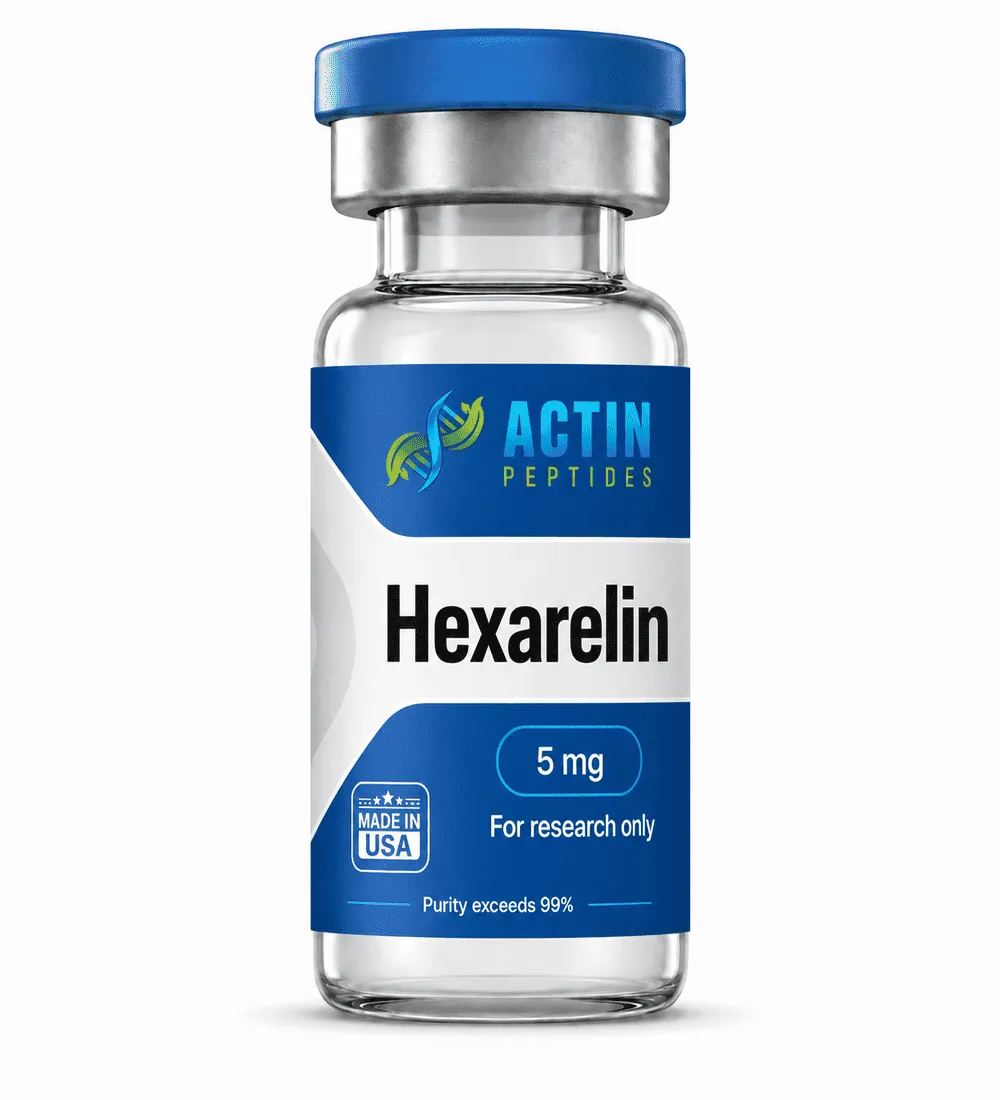
Hexarelin Peptide – Growth Hormone Secretagogue Research and Cellular Signaling
Introduction
Hexarelin peptide, also known as examorelin, is a synthetic hexapeptide classified as a growth hormone-releasing peptide (GHRP). Researchers have studied Hexarelin for its ability to interact with growth hormone secretagogue receptors (GHS-Rs) and influence growth hormone (GH) secretion in experimental models.
Research on Hexarelin focuses primarily on growth hormone signaling, receptor activation, appetite-related pathways, cardiovascular biology, body-composition research, and muscle-tissue models. Scientists have also investigated how Hexarelin may interact with pathways associated with GHRH, protein kinase C (PKC), cyclic adenosine monophosphate (cAMP), and pituitary hormone secretion.
Although Hexarelin has demonstrated biological activity in several laboratory and animal studies, these findings remain experimental and should not be interpreted as evidence of therapeutic efficacy or established human-use benefits.
What Is Hexarelin Peptide?
Hexarelin is a synthetic six-amino-acid growth hormone secretagogue studied for its potential interaction with GHS-R1a receptors and subsequent modulation of growth hormone release.
Unlike growth hormone-releasing hormone (GHRH), which primarily regulates GH through the GHRH receptor pathway, Hexarelin belongs to the GHRP class and has been investigated for its ability to stimulate GH through the growth hormone secretagogue receptor (GHS-R) system.
Researchers initially developed Hexarelin as part of a broader class of synthetic compounds designed to reproduce some of the biological signaling associated with ghrelin, a naturally occurring 28-amino-acid peptide involved in GH secretion and appetite regulation.
Hexarelin Peptide Overview
Hexarelin research centers on the interaction between the peptide and GHS-R1a, the active form of the growth hormone secretagogue receptor.
These receptors occur in several tissues, including the:
- Hypothalamus
- Pituitary gland
- Central nervous system
- Peripheral tissues
When Hexarelin interacts with GHS-R1a in experimental models, researchers propose that it may trigger intracellular signaling that promotes GH secretion from pituitary cells.
The peptide has also been investigated for potential interactions with other endocrine and cellular pathways. Importantly, researchers have reported that GHRP activity may not be completely selective for GH, with experimental studies also examining possible changes in adrenocorticotropic hormone (ACTH) and prolactin.
Because of this broader receptor activity, scientists continue to investigate the selectivity, signaling behavior, and physiological implications of Hexarelin.
How Does Hexarelin Work?
GHS-R1a Receptor Activation
The primary Hexarelin mechanism investigated in research involves GHS-R1a activation.
GHS-R1a is a G-protein-coupled receptor associated with the growth hormone secretagogue system. When activated, the receptor may initiate intracellular signaling cascades that influence pituitary GH release.
Researchers have proposed that these signaling events can involve pathways such as:
- Protein kinase C (PKC)
- Calcium-dependent signaling
- G-protein-mediated intracellular communication
- Growth hormone secretion mechanisms
This mechanism differs from direct GHRH receptor activation, making Hexarelin useful in research investigating alternative routes for regulating GH secretion.
Relationship With GHRH
Scientists have also investigated whether GHRPs and GHRH may operate through distinct but complementary pathways.
Experimental findings suggest that Hexarelin may stimulate GH secretion even in models with reduced sensitivity to GHRH. This observation has led researchers to investigate whether the two signaling systems can produce additive effects under certain experimental conditions.
However, these observations do not establish that combining the compounds produces a specific outcome in humans.
Receptor Desensitization
Repeated exposure to growth hormone secretagogues has also been studied in relation to receptor responsiveness.
Research suggests that Hexarelin exposure may contribute to temporary receptor desensitization, potentially reducing responsiveness following repeated stimulation. Scientists continue to investigate the mechanisms responsible for this phenomenon.
Hexarelin and Appetite-Related Research
GHS-R1a receptors also occur in areas of the nervous system associated with appetite and energy regulation.
Consequently, researchers have investigated whether Hexarelin may influence appetite-related signaling involving neuropeptides such as:
- Neuropeptide Y (NPY)
- Agouti-related peptide (AgRP)
- α-melanocyte-stimulating hormone (α-MSH)
These signaling molecules participate in the regulation of food intake and energy balance.
Potential Research-Observed Benefits in Appetite and Energy Regulation
Within experimental models, Hexarelin-associated GHS-R signaling has been studied for several observed biological effects, including:
- Modulation of appetite-related neuropeptide activity in the hypothalamus
- Influence on feeding behavior pathways linked to energy intake regulation
- Interaction with ghrelin-like signaling systems involved in hunger signaling
- Potential effects on energy balance signaling in preclinical models
These findings are strictly research-based observations and do not represent confirmed physiological outcomes in humans.
Chemical Makeup of Hexarelin
| Property | Details |
|---|---|
| Peptide Name | Hexarelin |
| Alternative Name | Examorelin |
| Molecular Formula | C47H58N12O6 |
| Molecular Weight | 887.05 g/mol |
| Peptide Type | Synthetic hexapeptide |
| Research Classification | Growth hormone-releasing peptide (GHRP) |
Research and Clinical Studies
Hexarelin Peptide and Growth Hormone Release
Study Objective
Researchers have investigated Hexarelin to determine how effectively it may stimulate GH secretion across different developmental stages.
Research Methodology
One study compared experimental models representing adolescent, mature, and older stages. Researchers evaluated GH responses following exposure to Hexarelin, GHRH, or GHRH combined with arginine.
Findings
The experimental results suggested that Hexarelin could produce measurable GH responses in several research groups.
The magnitude of the response varied according to developmental stage and comparison compound. In some models, Hexarelin produced a stronger GH response than GHRH alone, while other groups demonstrated stronger responses to GHRH combined with arginine.
Scientific Significance
These findings support continued investigation into Hexarelin research as a model for understanding GHS-R-mediated GH secretion and how this pathway changes with age.
The findings also demonstrate why researchers distinguish between GHRP-mediated and GHRH-mediated GH signaling.
Hexarelin and GHRH Signaling
Study Objective
Researchers investigated whether Hexarelin and GHRH stimulate GH release through the same cellular mechanism.
Research Methodology
Researchers compared normal pituitary cells with GH1 cell models that showed limited sensitivity to GHRH. The experimental systems were then exposed to Hexarelin, GHRH, or combinations of the two compounds.
Findings
The research suggested that GHRH and Hexarelin can act through distinct signaling mechanisms.
In the experimental GH1 model, GHRH alone produced limited effects, whereas Hexarelin continued to demonstrate GH-secretagogue activity. The researchers therefore proposed that GHRPs and GHRH may operate through different receptor systems.
Scientific Significance
This research is important for understanding the Hexarelin mechanism because it demonstrates why GHS-R signaling can be investigated separately from conventional GHRH signaling.
The findings also support continued research into interactions between different GH-regulatory pathways.
Hexarelin and Cardiovascular Research
Study Objective
Scientists have investigated Hexarelin in experimental cardiovascular models to understand whether GHS-R signaling may interact with cardiac function.
Research Methodology
Experimental studies evaluated cardiac function following Hexarelin exposure, including models involving altered coronary blood flow and ischemic cardiac tissue.
Researchers examined parameters including:
- Left ventricular ejection fraction
- Cardiac output
- Arterial pressure
- Stroke volume
- Electrophysiological characteristics
- Cellular apoptosis
Findings
Experimental results reported changes in cardiac performance following Hexarelin exposure. Some studies observed increased left ventricular ejection fraction and cardiac output without corresponding changes in heart rate or blood pressure under particular experimental conditions.
Potential Research-Observed Benefits in Cardiovascular Models
Across preclinical studies, Hexarelin has been associated with several observed experimental effects, including:
- Improved cardiac output parameters in certain models
- Enhanced left ventricular performance in ischemia-related studies
- Modulation of cardiomyocyte survival signaling pathways
- Reduced markers of cellular stress in some experimental conditions
These outcomes are strictly laboratory findings and should not be interpreted as clinical cardiovascular benefits.
Scientific Significance
These findings have prompted additional research into the relationship between GHS-R signaling and cardiovascular cellular biology.
Importantly, these are experimental findings and do not establish Hexarelin as a cardiovascular treatment.
Hexarelin and Cardiac Tissue Research
Additional experimental research has examined Hexarelin in myocardial injury models.
Researchers reported changes in parameters such as:
- Stroke volume
- Cardiac output
- Peripheral vascular resistance
These observations suggest that growth hormone secretagogue signaling may interact with cardiovascular physiology through mechanisms extending beyond GH release alone.
Scientists continue to investigate whether these observations result from direct receptor-mediated effects, secondary endocrine signaling, or other cellular mechanisms.
Hexarelin and Body Composition Research
Study Objective
Researchers have examined whether differences in body composition influence the GH response following Hexarelin exposure.
Findings
Experimental findings suggested an inverse relationship between fat mass and the GH response following stimulation with Hexarelin.
In other words, research models with greater fat mass appeared to demonstrate a reduced GH response under the experimental conditions studied.
Researchers also reported that sex did not produce a significant difference in the observed GH response.
Potential Research-Observed Benefits in Body Composition Models
Within experimental frameworks, Hexarelin has been associated with:
- GH response patterns influenced by metabolic state
- Differential hormonal responsiveness based on adiposity levels
- Maintenance of GH signaling activity across varied physiological conditions
These findings are observational and preclinical only.
Scientific Significance
These findings provide a basis for further investigation into the relationship between growth hormone signaling, adipose tissue, and body composition.
They also demonstrate why researchers consider metabolic status an important variable when studying growth hormone secretagogues.
Hexarelin and Muscle Tissue Research
Study Objective
Researchers have investigated whether Hexarelin-associated GH signaling may influence muscle tissue under experimental catabolic conditions.
Research Methodology
In one experimental model, researchers exposed subjects to catabolic agents known to promote muscle-mass and strength loss. They subsequently compared outcomes between control groups and groups exposed to Hexarelin.
Findings
The experimental findings suggested that Hexarelin exposure was associated with a smaller reduction in muscle mass compared with the control condition.
One reported model showed approximately a 12% loss of muscle mass under the catabolic condition, compared with approximately 7% in the Hexarelin-exposed group.
Potential Research-Observed Benefits in Muscle Models
Preclinical studies have associated Hexarelin with:
- Reduced magnitude of muscle loss in catabolic models
- Preservation of lean tissue markers under stress conditions
- Modulation of GH-related anabolic signaling pathways
- Influence on muscle cell survival signaling in experimental systems
These effects remain non-clinical and not validated in humans.
Scientific Significance
These findings have contributed to ongoing Hexarelin studies examining the relationship between growth hormone secretagogue signaling and muscle-tissue biology.
However, these preclinical observations should not be interpreted as evidence that Hexarelin produces muscle-building or performance-enhancing effects in humans.
What Is Hexarelin Researched For?
Hexarelin has primarily been studied in relation to:
- Growth hormone secretion
- GHS-R1a receptor signaling
- GHRP and GHRH interactions
- Pituitary hormone regulation
- Appetite-related signaling
- Cardiovascular cellular research
- Muscle-tissue research
- Body-composition research
- Cellular survival and apoptosis pathways
What Makes Hexarelin Unique?
Hexarelin is notable because it belongs to the GHRP class while interacting with the GHS-R1a receptor system rather than directly reproducing GHRH receptor signaling.
Research also distinguishes Hexarelin from some other secretagogues because scientists have investigated its effects across multiple biological systems, including endocrine, cardiovascular, metabolic, and cellular models.
For researchers studying growth hormone signaling, compounds such as Sermorelin provide a useful comparison because Sermorelin belongs to the GHRH class rather than the GHRP class.
Hexarelin Research Compared With Other Growth Hormone Peptides
Growth hormone research involves several peptide classes with different receptor targets.
| Peptide Class | Primary Research Focus |
|---|---|
| Hexarelin | GHS-R1a / growth hormone secretagogue signaling |
| Sermorelin | GHRH receptor signaling |
| GHRH analogs | Growth hormone-releasing hormone pathways |
| IGF-related peptides | Growth-factor and downstream signaling research |
For broader research into growth-factor pathways, researchers can also explore IGF-1 LR3, which represents a different area of growth-factor research rather than a GHS-R agonist.
Hexarelin Peptide Research: Key Takeaways
- Hexarelin is a synthetic hexapeptide classified as a growth hormone-releasing peptide.
- Researchers primarily study it for its interaction with GHS-R1a receptors.
- GHS-R1a activation may stimulate GH secretion through intracellular signaling pathways.
- Research indicates that Hexarelin and GHRH may operate through distinct signaling systems.
- Scientists have investigated its potential effects in cardiovascular, appetite, body-composition, and muscle-tissue models.
- Experimental studies have also examined possible changes in other pituitary hormones, including ACTH and prolactin.
- Preclinical research suggests potential biological effects in appetite regulation, cardiovascular function, and tissue preservation models, but these are not confirmed human benefits.
- Current evidence remains primarily preclinical and does not establish therapeutic efficacy or approved human applications.
Frequently Asked Questions
What is Hexarelin peptide?
Hexarelin is a synthetic six-amino-acid peptide classified as a growth hormone-releasing peptide (GHRP). Research primarily examines its interaction with GHS-R1a receptors and its effects on growth hormone secretion in experimental models.
How does Hexarelin work?
Research suggests Hexarelin activates GHS-R1a, a growth hormone secretagogue receptor associated with G-protein-mediated intracellular signaling. This activation may stimulate GH release from pituitary cells.
What is Hexarelin researched for?
Scientists have investigated Hexarelin for growth hormone signaling, GHS-R1a receptor activity, GHRH interactions, appetite-related pathways, cardiovascular biology, body-composition research, and muscle-tissue models.
Is Hexarelin the same as GHRH?
No. Hexarelin belongs to the growth hormone-releasing peptide class and primarily acts through GHS-R signaling, whereas GHRH acts through the GHRH receptor pathway. Research suggests the two systems may operate independently and may interact under certain experimental conditions.
Is Hexarelin a growth hormone?
No. Hexarelin is a synthetic peptide that researchers study as a growth hormone secretagogue. It is not growth hormone itself.
What is the molecular weight of Hexarelin?
The molecular weight provided for Hexarelin is approximately 887.05 g/mol, with the molecular formula C47H58N12O6.
Is Hexarelin approved for human use?
This product is offered for research and laboratory purposes only. The experimental findings discussed above should not be interpreted as evidence of regulatory approval, therapeutic efficacy, or suitability for human consumption.
Conclusion
Hexarelin represents an extensively investigated member of the growth hormone secretagogue peptide class. Research has primarily focused on its interaction with GHS-R1a, its influence on growth hormone release, and its relationship with distinct GHRH signaling pathways.
Beyond GH research, scientists have explored Hexarelin in experimental models involving appetite regulation, cardiovascular signaling, body composition, muscle tissue, and cellular survival. These studies provide useful insights into GHS-R-mediated biology while also highlighting the complexity of growth hormone secretagogue signaling.
As research continues, Hexarelin remains a laboratory compound of interest for scientists studying peptide signaling, endocrine regulation, growth hormone pathways, and cellular physiology.
Research Disclaimer
Hexarelin peptide is available strictly for research and laboratory purposes only. It is not approved for human consumption, therapeutic use, or diagnostic applications. Please review our Terms and Conditions before placing an order.
 English
Reviews
There are no reviews yet.