
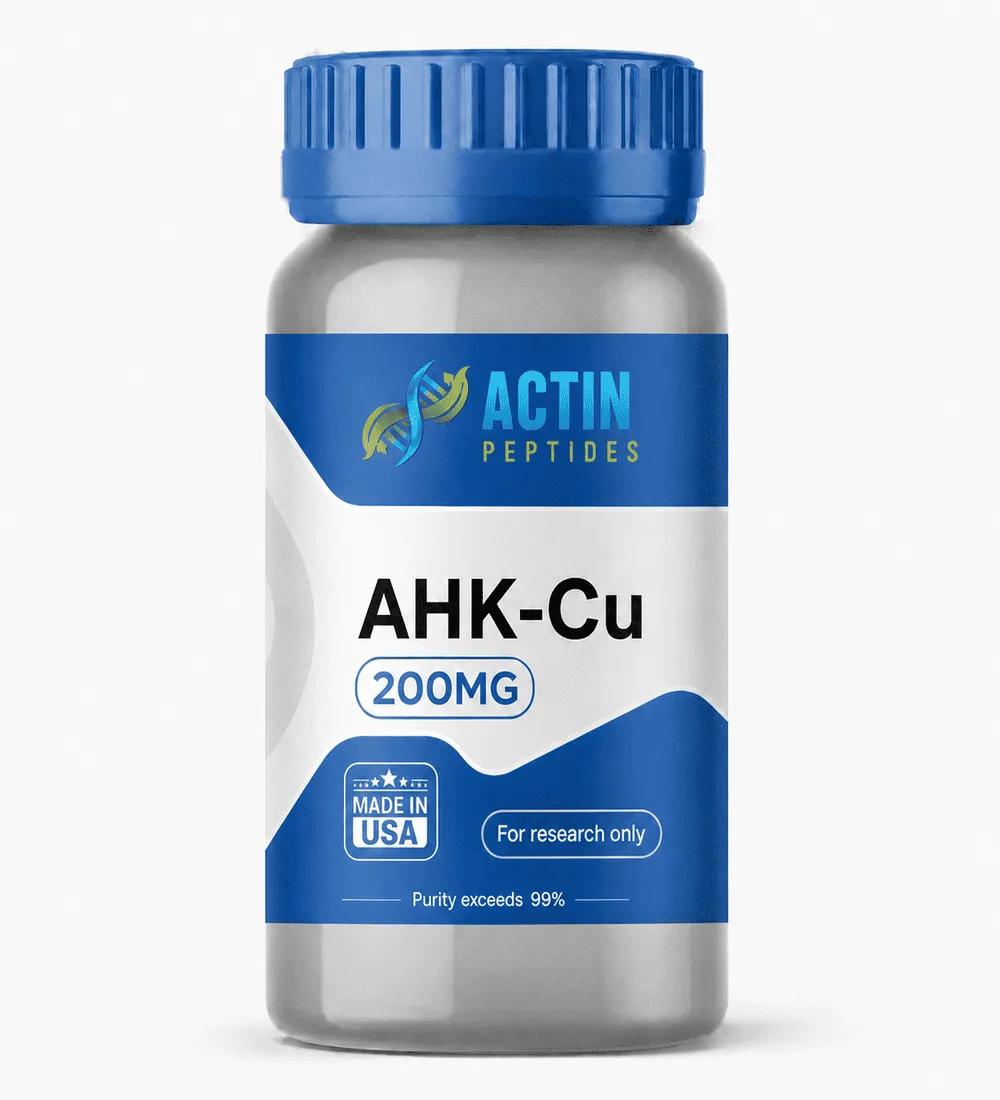
Description
AHK-Cu Peptide Research: Hair Growth, Fibroblast Activity & Skin Health Studies
What Is AHK-Cu?
AHK-Cu is a copper-binding tripeptide composed of alanine, histidine, and lysine coordinated with a copper ion. Researchers have identified AHK-Cu naturally within biological systems, where it appears to participate in cellular signaling, extracellular matrix regulation, and vascular endothelial cell activity.
Scientists have extensively investigated AHK-Cu peptide for its potential role in hair follicle biology, collagen production, fibroblast activity, angiogenesis, and skin tissue integrity. Because of its copper-binding properties, AHK-Cu has attracted significant interest in peptide research involving cellular regeneration, extracellular matrix maintenance, and age-related biological processes.
Researchers studying peptides associated with skin and hair biology frequently compare AHK-Cu with compounds such as GHK-Cu, Matrixyl, and Syn-Coll Palmitoyl Tripeptide-5.
Overview of AHK-Cu Research
AHK-Cu has been studied primarily for its interactions with fibroblasts, endothelial cells, and growth factor signaling pathways.
Research suggests that AHK-Cu may:
- Support fibroblast proliferation
- Influence extracellular matrix remodeling
- Promote collagen and elastin synthesis pathways
- Modulate angiogenesis-related signaling
- Support hair follicle development research
- Participate in cellular antioxidant mechanisms
- Influence apoptosis-related pathways
Because fibroblasts regulate many structural components of the extracellular matrix, scientists continue investigating how AHK-Cu may influence skin health and tissue regeneration at the cellular level.
How Does AHK-Cu Work?
AHK-Cu Mechanism of Action
AHK-Cu appears to exert its biological activity through copper-mediated cellular signaling and growth factor regulation.
Research indicates that the peptide may interact with:
- Dermal fibroblasts
- Dermal papilla cells (DPCs)
- Vascular endothelial cells
- Extracellular matrix proteins
- Growth factor signaling pathways
These interactions may influence collagen production, angiogenesis, cellular survival, and tissue remodeling.
Copper-Mediated Cellular Signaling
Copper serves as an essential cofactor for numerous enzymes involved in extracellular matrix maintenance.
Studies indicate that the copper component of AHK-Cu may contribute to:
- Collagen synthesis
- Elastin formation
- Antioxidant enzyme activity
- Cellular repair mechanisms
- Structural protein organization
Researchers continue investigating how copper-peptide complexes influence biological signaling networks involved in tissue maintenance and regeneration.
Growth Factor Regulation
Scientists have investigated AHK-Cu for its relationship with key growth factors, including:
Vascular Endothelial Growth Factor (VEGF)
VEGF plays a critical role in angiogenesis, the process by which new blood vessels develop from existing vasculature.
Research suggests that AHK-Cu may influence VEGF expression, potentially supporting nutrient and oxygen delivery to tissues surrounding hair follicles and skin cells.
Transforming Growth Factor Beta-1 (TGF-β1)
TGF-β1 regulates numerous cellular functions, including:
- Cell differentiation
- Cellular proliferation
- Tissue remodeling
- Apoptosis signaling
Studies indicate that AHK-Cu may influence TGF-β1 activity, which researchers believe could contribute to its observed effects on fibroblast behavior and hair follicle development.
Chemical Makeup
| Property | Value |
|---|---|
| Peptide Name | AHK-Cu |
| Molecular Formula | C15H25CuN6O4 |
| Molecular Weight | 416.9 g/mol |
| Peptide Type | Copper Tripeptide |
| Alternate Names | Copper AHK, ALA-HIS-LYS-CU |
| Research Category | Hair Growth, Skin Health, Cellular Signaling |
Research and Clinical Studies
AHK-Cu Peptide and Antioxidant Research
Study Objective
Researchers investigated whether AHK-Cu possesses antioxidant properties capable of supporting cellular health and tissue maintenance.
Methodology
Scientists evaluated AHK-Cu in laboratory models focused on fibroblast activity, hair follicle biology, and extracellular matrix function.
Findings
Studies suggest that AHK-Cu may exhibit antioxidant activity through its copper-binding structure. Researchers observed increased fibroblast viability and enhanced cellular activity associated with collagen production.
Scientific Significance
These findings have positioned AHK-Cu as an important compound in peptide research involving skin health, extracellular matrix maintenance, and age-related cellular processes.
Researchers interested in tissue regeneration frequently explore related compounds such as BPC-157, TB-500, and KPV Peptide.
AHK-Cu Peptide and Hair Follicle Development
Study Objective
Scientists investigated whether AHK-Cu influences hair follicle growth and dermal papilla cell function.
Methodology
Researchers exposed cultured hair follicles and dermal papilla cells to AHK-Cu and evaluated markers associated with cellular proliferation and apoptosis.
Findings
Studies indicate that AHK-Cu may:
- Promote hair follicle elongation
- Increase dermal papilla cell proliferation
- Influence VEGF signaling
- Reduce apoptosis-related markers
- Increase cellular survival pathways
Researchers also observed changes involving the Bcl-2/Bax ratio, a biological marker commonly associated with cell survival regulation.
Scientific Significance
These observations suggest that AHK-Cu may support biological processes involved in hair follicle maintenance and development.
Scientists frequently compare AHK-Cu research with findings involving GHK-Cu due to similarities in copper-peptide signaling and tissue biology.
AHK-Cu Peptide and Alopecia Research
Study Objective
Researchers evaluated formulations containing growth factors and copper peptides to assess hair follicle viability.
Methodology
Laboratory investigations utilized keratinocyte and fibroblast cell models while examining biological markers associated with hair growth.
Findings
Research suggested positive effects on hair follicle viability and growth-related cellular activity.
The formulations demonstrated favorable biological responses in experimental models designed to investigate mechanisms related to hair follicle maintenance.
Scientific Significance
These findings support continued AHK-Cu research in the broader field of peptide-based hair growth investigations.
AHK-Cu Peptide and Skin Health Research
Study Objective
Scientists investigated whether AHK-Cu could influence fibroblast activity and collagen production.
Methodology
Researchers cultured dermal fibroblasts with varying concentrations of AHK-Cu and measured collagen production and cellular viability.
Findings
Studies indicate that AHK-Cu may:
- Increase fibroblast proliferation
- Improve cell viability
- Support collagen type I production
- Enhance extracellular matrix activity
Researchers observed notable increases in collagen production compared with untreated controls.
Scientific Significance
These findings suggest that AHK-Cu may contribute to ongoing research involving skin health, extracellular matrix biology, and cellular regeneration.
Researchers often evaluate AHK-Cu alongside compounds such as:
What Is AHK-Cu Researched For?
Researchers have studied AHK-Cu for:
- Hair growth research
- Hair follicle biology
- Fibroblast activity
- Collagen production
- Skin health studies
- Extracellular matrix regulation
- Angiogenesis research
- Cellular signaling
- Antioxidant mechanisms
- Tissue regeneration research
What Makes AHK-Cu Unique?
AHK-Cu combines a biologically active tripeptide with a copper ion, allowing researchers to investigate both peptide signaling and copper-mediated cellular processes simultaneously. This dual-function structure distinguishes AHK-Cu from many other research peptides focused solely on receptor signaling.
Conclusion
AHK-Cu remains one of the most extensively studied copper peptides in hair growth and skin health research. Scientists continue investigating its interactions with fibroblasts, dermal papilla cells, growth factors, extracellular matrix proteins, and angiogenic signaling pathways.
Current AHK-Cu studies suggest potential relevance in peptide research involving collagen production, tissue regeneration, cellular signaling, and hair follicle biology. As additional research emerges, scientists may gain a deeper understanding of the mechanisms that drive its biological activity.
Researchers seeking to buy AHK-Cu peptide for sale frequently examine related compounds including GHK-Cu, Matrixyl, and Syn-Coll Palmitoyl Tripeptide-5 for complementary peptide research applications.
Frequently Asked Questions
What is AHK-Cu?
AHK-Cu is a copper-binding tripeptide composed of alanine, histidine, and lysine. Researchers study it for hair growth, fibroblast activity, collagen production, and skin health applications.
How does AHK-Cu work?
Research suggests that AHK-Cu influences fibroblast activity, growth factor signaling, angiogenesis pathways, and extracellular matrix remodeling through copper-mediated cellular interactions.
What is AHK-Cu researched for?
Scientists have investigated AHK-Cu for hair follicle development, collagen production, skin health, extracellular matrix regulation, angiogenesis, and cellular signaling research.
What are the potential AHK-Cu benefits in research?
Studies indicate that AHK-Cu may support investigations involving fibroblast proliferation, collagen synthesis, hair follicle biology, antioxidant activity, and tissue regeneration mechanisms.
Where can researchers buy AHK-Cu peptide?
Researchers can purchase AHK-Cu peptide for sale through Actin Peptides for laboratory and research applications.
Research Disclaimer
AHK-Cu is available strictly for research and laboratory purposes only. It is not approved for human consumption, therapeutic use, or diagnostic applications. Please review and adhere to our Terms and Conditions before ordering.
 English
Reviews
There are no reviews yet.