

Description
Bronchogen Peptide (AEDL): Research, Mechanism of Action, Gene Regulation & Cellular Renewal
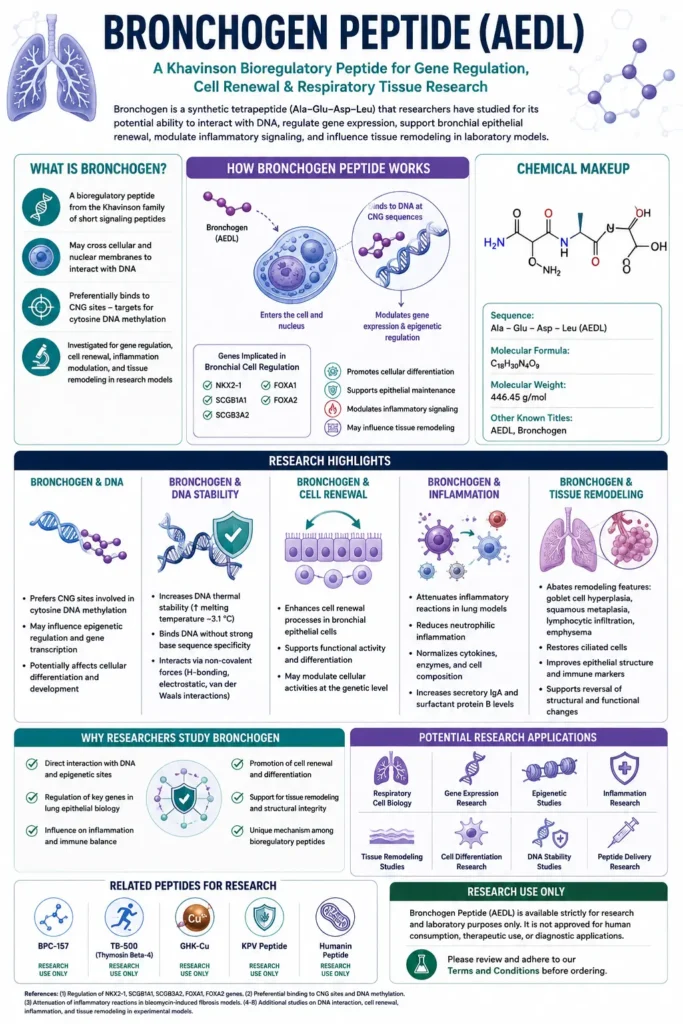
Bronchogen Peptide, also known as AEDL, is a synthetic tetrapeptide belonging to the family of Khavinson bioregulatory peptides. Scientists have investigated Bronchogen for its potential interactions with genetic signaling, bronchial epithelial cells, inflammatory pathways, and tissue remodeling in laboratory models. Unlike conventional peptides that primarily interact with cell-surface receptors, research suggests Bronchogen may enter cells and interact with nuclear DNA, making it a unique subject in peptide research.
Current Bronchogen peptide research focuses on gene regulation, epithelial cell renewal, inflammatory signaling, and pulmonary tissue biology. Studies indicate that the peptide may influence the expression of genes involved in maintaining bronchial cell identity while supporting normal cellular communication within respiratory tissues. Consequently, researchers continue to investigate Bronchogen as a promising research compound for understanding cellular repair mechanisms and molecular regulation.
What is Bronchogen Peptide?
Bronchogen is a short synthetic peptide consisting of four amino acids:
Alanine – Glutamic Acid – Aspartic Acid – Leucine (AEDL)
Scientists classify Bronchogen as a bioregulatory peptide, meaning it has been studied for its potential ability to influence gene expression rather than simply activating membrane receptors.
Unlike many research peptides that primarily target extracellular signaling pathways, Bronchogen has been investigated for its possible interaction with DNA sequences associated with epigenetic regulation. Research suggests these interactions may influence cellular differentiation, inflammatory signaling, and tissue maintenance within bronchial epithelial cells.
Because of these characteristics, Bronchogen peptide has become an area of interest in studies exploring:
- Gene expression regulation
- Cellular signaling
- Bronchial epithelial biology
- Tissue remodeling
- Cellular renewal
- Respiratory tissue research
- DNA stabilization
- Epigenetic mechanisms
Overview
Bronchogen peptide has attracted growing scientific attention because of its unique molecular behavior. Rather than functioning solely through receptor-mediated signaling, studies indicate that Bronchogen may penetrate cellular and nuclear membranes, allowing it to interact directly with DNA-associated regulatory regions.
Researchers have specifically investigated its relationship with several genes involved in respiratory epithelial development, including:
- NKX2-1
- SCGB1A1
- SCGB3A2
- FOXA1
- FOXA2
These genes contribute to maintaining normal bronchial epithelial structure, cellular differentiation, and respiratory tissue homeostasis. Scientists therefore hypothesize that Bronchogen may help regulate transcriptional activity involved in epithelial maintenance.
In addition, laboratory investigations suggest Bronchogen may influence inflammatory signaling, epithelial regeneration, and tissue remodeling without disrupting normal cellular architecture.
Researchers continue to study these mechanisms to better understand how small regulatory peptides influence complex biological systems.
How Does Bronchogen Peptide Work?
Direct Interaction with DNA
Research suggests Bronchogen differs from many synthetic peptides because it may interact directly with genetic material.
Scientists have proposed that Bronchogen preferentially binds to DNA regions containing specific nucleotide sequences associated with cytosine methylation. These regions participate in epigenetic regulation, which controls whether particular genes become more or less active.
Rather than altering DNA structure itself, Bronchogen appears to influence the regulation of genes involved in cellular maintenance and differentiation.
This mechanism has positioned Bronchogen as a valuable research tool for studying:
- Epigenetic regulation
- Gene transcription
- DNA-protein interactions
- Cellular differentiation
- Nuclear peptide signaling
Regulation of Respiratory Gene Expression
Scientists have investigated Bronchogen for its possible influence on several genes responsible for maintaining bronchial epithelial integrity.
Current laboratory studies suggest the peptide may regulate expression of:
NKX2-1
NKX2-1 plays an important role in respiratory epithelial development and maintenance. Proper regulation of this transcription factor contributes to cellular identity within lung tissue.
SCGB1A1 and SCGB3A2
These secretoglobin family proteins contribute to epithelial protection and normal respiratory cellular function.
Research suggests Bronchogen may influence their expression as part of broader epithelial regulatory pathways.
FOXA1 and FOXA2
FOXA transcription factors regulate cellular differentiation and developmental signaling.
Scientists continue investigating whether Bronchogen may support normal transcriptional activity involving these genes within bronchial epithelial cells.
Potential Influence on Epigenetic Signaling
Another unique characteristic of Bronchogen peptide research involves its potential interaction with epigenetic regulatory mechanisms.
DNA methylation serves as one of the body’s primary methods for controlling gene expression. Studies suggest Bronchogen may bind near methylation-sensitive DNA regions, potentially influencing transcription without modifying DNA sequences themselves.
Researchers continue investigating whether this interaction contributes to:
- Cellular renewal
- Tissue homeostasis
- Gene regulation
- Controlled cellular differentiation
- Nuclear signaling
These findings make Bronchogen one of the more distinctive peptides currently being explored in molecular biology research.
Chemical Makeup
| Property | Bronchogen Peptide |
|---|---|
| Sequence | Ala–Glu–Asp–Leu (AEDL) |
| Molecular Formula | C18H30N4O9 |
| Molecular Weight | 446.45 g/mol |
| Other Names | AEDL, Bronchogen |
Research and Clinical Studies
Although Bronchogen research remains in the preclinical stage, scientists have explored its biological activity across multiple laboratory and experimental models. Current investigations focus on its potential influence on gene regulation, DNA stability, epithelial cell renewal, inflammatory signaling, and tissue remodeling.
Importantly, these findings are limited to laboratory and experimental research. Additional studies are necessary to better understand the peptide’s molecular mechanisms and broader biological interactions.
Bronchogen Peptide and DNA Regulation
Research Objective
Researchers have investigated whether Bronchogen peptide may directly interact with DNA and influence gene expression involved in respiratory tissue maintenance.
Unlike many signaling peptides that activate membrane-bound receptors, Bronchogen appears capable of interacting with genetic material inside the cell nucleus. This characteristic has generated significant interest within peptide research because relatively few synthetic peptides demonstrate this type of molecular behavior.
Proposed Mechanism
Laboratory investigations suggest Bronchogen may preferentially bind to nucleotide regions containing cytosine-guanine (CNG) sequences associated with DNA methylation.
DNA methylation serves as one of the primary epigenetic mechanisms responsible for regulating whether genes remain active or inactive. Rather than altering the genetic code itself, methylation controls how efficiently genes are expressed.
Scientists therefore hypothesize that Bronchogen may influence:
- Epigenetic regulation
- Gene transcription
- Cellular differentiation
- Nuclear signaling
- DNA-protein interactions
By interacting with these regulatory regions, Bronchogen may contribute to maintaining normal cellular function within bronchial epithelial tissues.
Bronchogen Peptide and DNA Stability
Research Objective
Another area of investigation examines whether Bronchogen influences the structural stability of DNA molecules.
Researchers evaluated purified DNA samples using differential scanning microcalorimetry, a laboratory technique used to measure thermal stability during DNA denaturation.
Findings
Experimental observations suggested Bronchogen increased DNA melting temperature, indicating improved molecular stability under laboratory conditions.
Interestingly, investigators also noted that the peptide appeared capable of binding across multiple nucleotide regions rather than demonstrating strict sequence specificity.
Scientists propose that Bronchogen may interact through non-covalent molecular forces, including:
- Hydrogen bonding
- Electrostatic interactions
- Van der Waals forces
These interactions may stabilize DNA without disrupting its natural double-helical structure.
Scientific Significance
DNA stability plays an important role in molecular biology, genomic integrity, and cellular replication.
Consequently, researchers continue studying Bronchogen as a potential research tool for understanding:
- DNA structural biology
- Nuclear peptide interactions
- Molecular stability
- Epigenetic regulation
- Gene expression mechanisms
Bronchogen Peptide and Cell Renewal
Research Objective
Scientists have also explored Bronchogen for its potential influence on cellular renewal within bronchial epithelial tissues.
Bronchial epithelial cells serve as an essential protective barrier throughout the respiratory tract. Maintaining their structure and function supports normal tissue homeostasis.
Laboratory Findings
Research suggests Bronchogen may support cellular renewal by influencing genetic pathways involved in epithelial maintenance.
Investigators observed that the peptide appeared to promote:
- Cellular differentiation
- Functional maturation of epithelial cells
- Maintenance of normal epithelial architecture
- Cellular organization
Because Bronchogen may act at the level of gene regulation rather than direct receptor activation, researchers believe it represents a unique class of signaling peptide.
Scientific Significance
Although these findings remain preliminary, they suggest Bronchogen may provide valuable insight into mechanisms governing epithelial biology and tissue regeneration.
Scientists continue investigating whether similar regulatory mechanisms extend to additional cell populations beyond bronchial tissues.
Bronchogen Peptide and Inflammatory Signaling
Research Objective
Another important research area involves Bronchogen’s interaction with inflammatory signaling pathways.
Scientists have evaluated the peptide in experimental models designed to mimic chronic respiratory tissue injury and inflammation.
Experimental Findings
Laboratory observations suggest Bronchogen may influence several markers associated with inflammatory activity.
Researchers reported trends indicating:
- Reduced inflammatory cell infiltration
- Improved epithelial organization
- Balanced cytokine expression
- Restoration of bronchial cellular composition
Additional findings suggested increased production of secretory Immunoglobulin A (IgA), an important component of mucosal immune defense, together with improved expression of surfactant proteins involved in maintaining respiratory tissue function.
Proposed Mechanism
Scientists hypothesize that Bronchogen may help regulate inflammatory signaling indirectly through modulation of gene expression rather than direct suppression of immune pathways.
Further investigation is necessary to clarify these molecular interactions.
Bronchogen Peptide and Tissue Remodeling
Research Objective
Researchers have also investigated whether Bronchogen may influence structural remodeling of bronchial tissues following prolonged cellular stress.
Tissue remodeling involves coordinated regulation of extracellular matrix proteins, epithelial differentiation, inflammatory signaling, and cellular turnover.
Findings
Experimental studies reported that Bronchogen exposure appeared to support more organized bronchial epithelial architecture.
Investigators observed laboratory evidence suggesting reduced structural abnormalities commonly associated with chronic tissue remodeling, including:
- Goblet cell hyperplasia
- Squamous metaplasia
- Lymphocytic infiltration
- Emphysematous changes
At the same time, researchers noted improved preservation of ciliated epithelial cells and increased markers associated with epithelial barrier integrity.
Scientific Significance
These observations suggest Bronchogen may participate in biological pathways involved in maintaining tissue architecture during cellular stress.
However, scientists emphasize that additional experimental validation remains necessary before drawing broader conclusions regarding its biological activity.
Why Researchers Study Bronchogen Peptide
Current Bronchogen peptide research focuses on several interconnected areas of molecular biology, including:
- Gene regulation
- DNA stabilization
- Epigenetic signaling
- Cellular renewal
- Bronchial epithelial biology
- Tissue remodeling
- Cellular differentiation
- Nuclear peptide signaling
- Inflammatory pathway regulation
Researchers continue exploring how these mechanisms interact to better understand cellular communication within respiratory tissues.
For laboratories investigating complementary areas of cellular repair and tissue regeneration, related research compounds include:
- BPC-157 for studies involving connective tissue biology and angiogenesis: https://actinpeptides.com/product/bpc-157-5mg-10mg/
- TB-500 (Thymosin Beta-4) for research into cellular migration and extracellular matrix remodeling: https://actinpeptides.com/product/tb-500-thymosin-beta-4-5mg-10mg/
- GHK-Cu for investigations involving collagen synthesis, fibroblast activity, and skin biology: https://actinpeptides.com/product/ghk-cu-200mg/
- KPV Peptide for laboratory research focused on inflammatory signaling: https://actinpeptides.com/product/kpv-peptide-4mg/
- Humanin Peptide for cellular protection and mitochondrial research: https://actinpeptides.com/product/humanin-peptide-10mg/
Conclusion
Bronchogen (AEDL) represents a distinctive member of the Khavinson peptide family because of its proposed ability to interact directly with genetic regulatory mechanisms. Rather than functioning exclusively through conventional receptor-mediated pathways, research suggests the peptide may influence DNA stability, gene transcription, epithelial cell biology, and inflammatory signaling.
Although available evidence remains limited to laboratory investigations, Bronchogen continues to attract scientific interest due to its unique molecular characteristics. Future studies will help clarify its biological mechanisms and further define its role within peptide research.
Frequently Asked Questions
What is Bronchogen peptide?
Bronchogen is a synthetic tetrapeptide (AEDL) belonging to the Khavinson family of bioregulatory peptides. Scientists study it for its potential interactions with DNA, gene regulation, epithelial cell biology, and inflammatory signaling.
How does Bronchogen work?
Research suggests Bronchogen may enter the cell nucleus and interact with DNA-associated regulatory regions involved in gene expression and epigenetic signaling. Scientists continue investigating these molecular mechanisms.
What is Bronchogen researched for?
Bronchogen research includes studies involving DNA stability, bronchial epithelial renewal, cellular differentiation, inflammatory signaling, tissue remodeling, and gene regulation.
What makes Bronchogen unique?
Unlike many research peptides, Bronchogen has been investigated for its potential to influence gene expression directly through interactions with DNA rather than acting solely through cell-surface receptors.
Research Disclaimer
Bronchogen Peptide (AEDL) is available strictly for research and laboratory purposes only. It is not approved for human consumption, therapeutic use, or diagnostic applications. Please review and adhere to our Terms and Conditions before ordering.





 English
Reviews
There are no reviews yet.