
Description
LL-37 Peptide – Antimicrobial Peptide Research, Immune Signaling & Tissue Biology
Introduction
LL-37 peptide, also known as cathelicidin or CAP-18, is a naturally occurring cationic antimicrobial peptide composed of 37 amino acids. Scientists have investigated LL-37 extensively because of its potential interactions with microbial membranes, immune signaling pathways, inflammatory responses, and tissue-repair processes.
Research suggests that the peptide forms from the extracellular processing of the human cathelicidin precursor hCAP18 by proteolytic enzymes. Because LL-37 can interact with both microbial structures and host-cell signaling systems, researchers continue to study its biological activity across antimicrobial defense, inflammation, angiogenesis, and tissue biology.
For researchers evaluating LL-37 research compounds, its distinctive combination of membrane activity and immunomodulatory signaling makes it an important subject in peptide research.
What Is LL-37 Peptide?
LL-37 is a 37-amino-acid α-helical antimicrobial peptide derived from the human cathelicidin precursor hCAP18. Research has examined its ability to interact with microbial membranes as well as receptors and intracellular pathways involved in immune signaling.
Scientists have studied LL-37 in several areas, including:
- Antimicrobial peptide research
- Microbial membrane interactions
- Innate immune signaling
- Inflammatory pathway regulation
- Angiogenesis and endothelial-cell behavior
- Wound and tissue-repair models
- Gastrointestinal biology
- Cancer-cell signaling research
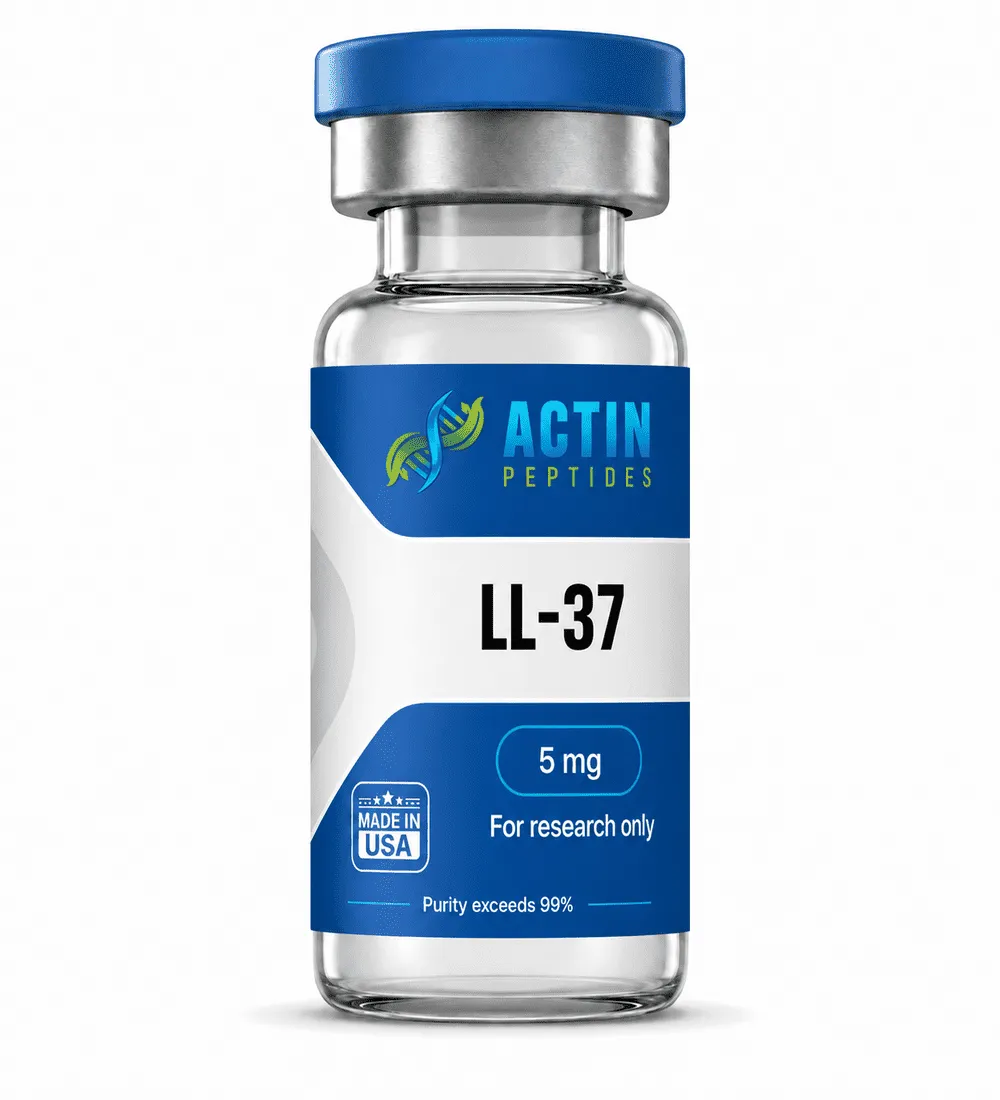
Actin Peptides currently lists LL-37 as a research-use peptide.
Overview of LL-37
LL-37 belongs to the cathelicidin family of antimicrobial peptides. Unlike many conventional antimicrobial compounds that target a specific molecular structure, antimicrobial peptides can interact directly with microbial membranes through electrostatic and structural interactions.
LL-37 research has particularly focused on its positively charged structure and α-helical configuration. Researchers propose that these characteristics allow the peptide to associate with negatively charged components of microbial membranes.
Studies have investigated several possible membrane-interaction models, including:
- Electrostatic attraction between LL-37 and membrane lipids
- Lateral diffusion across the microbial membrane
- Peptide aggregation at membrane surfaces
- Membrane pore formation
- Lipid-peptide complex formation
- Membrane destabilization and disruption
These mechanisms help explain why scientists continue to investigate LL-37 as a model antimicrobial peptide.
LL-37 Peptide Mechanism of Action
Microbial Membrane Interaction
The LL-37 mechanism begins, according to several research models, with electrostatic interactions between the positively charged peptide and negatively charged components of microbial membranes.
After initial binding, LL-37 may diffuse laterally across the membrane and aggregate with neighboring peptide molecules. Researchers have proposed that this aggregation can alter membrane structure and potentially compromise membrane integrity.
Membrane Disruption
Several experimental models have proposed pore formation and extensive membrane disruption as possible mechanisms.
Rather than relying on one highly specific microbial target, LL-37 may interact with membrane lipids and other structural components. This broad interaction pattern has made antimicrobial peptides an important area of investigation in microbial-defense research.
Interaction With Immune Receptors
LL-37 also interacts with host-cell signaling systems. Research suggests that the peptide can associate with nucleic acids such as DNA and RNA and influence their interaction with cellular receptors.
Studies have examined relationships involving:
- Scavenger receptors
- Toll-like receptors (TLRs)
- Interferon regulatory factors
- NF-κB-related signaling
- Cytokine expression
Consequently, LL-37 research extends beyond direct antimicrobial activity into innate immune signaling.
Chemical Makeup
| Property | LL-37 Details |
|---|---|
| Peptide Name | LL-37 |
| Alternative Name | Cathelicidin |
| Other Known Title | CAP-18 |
| Amino Acid Length | 37 amino acids |
| Molecular Formula | C205H340N50O53 |
| Molecular Weight | 4493.34 g/mol |
| Structural Class | Cationic α-helical antimicrobial peptide |
Research and Clinical Studies
LL-37 and Inflammatory Signaling
Study Objective
Researchers investigated whether LL-37 could influence inflammatory responses when combined with nucleic acids released during cellular injury.
Methodology
Researchers used tissue-culture models, including cultures exposed to U1 RNA. They subsequently evaluated gene-expression changes after introducing LL-37.
Additional experiments examined interactions involving scavenger receptors and intracellular immune-signaling pathways.
Findings
Research suggested that LL-37 could enhance cellular responses to extracellular or intracellular nucleic-acid signals under certain experimental conditions.
Researchers associated these observations with:
- Scavenger-receptor interactions
- Clathrin-dependent endocytosis
- Toll-like receptor signaling
- Interferon-regulatory pathways
- Cytokine expression
Blocking or reducing specific scavenger receptors reportedly reduced aspects of the inflammatory signaling response.
Scientific Significance
These findings suggest that LL-37 may function as more than a direct antimicrobial peptide. It may also act as a signaling intermediary that influences how cells recognize and respond to nucleic acids released during tissue stress.
LL-37 and Autoimmune Signaling Models
Study Objective
Scientists have investigated LL-37 in experimental models examining relationships between antimicrobial peptides, nucleic acids, and inflammatory signaling.
Methodology
Research models examined LL-37 interactions with DNA and immune pathways associated with inflammatory skin biology.
Findings
Studies suggest that LL-37 can form complexes with DNA. Depending on the cellular context, these complexes may influence interferon signaling and inflammatory responses.
Researchers have also investigated potential interactions with the AIM2 inflammasome, an intracellular immune-sensing system that can respond to cytosolic double-stranded DNA.
Scientific Significance
These observations demonstrate the complex biological role of LL-37. The peptide may participate in both antimicrobial defense and immune regulation, with its effects depending on the surrounding cellular environment.
LL-37 and Arthritis Research
Study Objective
Researchers have examined LL-37-related peptides in experimental models of joint inflammation.
Methodology
Experimental arthritis models were compared with control animals to evaluate changes in expression of rCRAMP, the rat counterpart of the LL-37/cathelicidin family.
Findings
The research reported increased expression of the cathelicidin-related peptide within inflammatory cells.
Researchers also investigated potential relationships between elevated LL-37-family peptide expression, osteoblast apoptosis, and changes in bone-forming activity.
Scientific Significance
These findings provide researchers with a model for studying how antimicrobial peptides may interact with inflammatory and skeletal-cell signaling.
Importantly, these experimental findings should not be interpreted as evidence that LL-37 is a diagnostic or therapeutic agent for arthritis.
LL-37 and Tissue Repair Research
Study Objective
Researchers investigated whether LL-37 could influence vascularization and tissue-repair processes in experimental wound models.
Methodology
Murine models were evaluated following tissue injury, with researchers measuring vascularization, skin-cell formation, and endothelial-cell behavior.
Findings
Experimental exposure to LL-37 was associated with observations involving:
- Endothelial-cell proliferation
- Endothelial-cell migration
- Tubule-like structure formation
- Increased vascularization
- Re-epithelialization
Researchers also examined LL-37 interactions with macrophage responses following exposure to lipopolysaccharide (LPS).
Scientific Significance
The findings suggest that LL-37 may interact with multiple components of tissue-repair biology. In particular, its effects on endothelial-cell migration and tubule formation have made it relevant to angiogenesis research.
For researchers interested in related tissue-repair compounds, Actin Peptides also offers BPC-157 peptide and TB-500 (Thymosin Beta-4) for research applications.
LL-37 and Cancer-Cell Research
Study Objective
Scientists continue to investigate whether LL-37 can influence cancer-cell proliferation and immune signaling.
Methodology
Experimental cancer-cell models have examined LL-37 alongside signaling molecules and immune-modulating compounds such as CpG oligodeoxynucleotides.
Findings
Research has reported potential changes in cancer-cell proliferation and altered sensitivity of immune cells to CpG-related signaling.
Other studies have investigated relationships between LL-37 and bone morphogenetic protein (BMP) signaling.
Scientific Significance
These observations make LL-37 relevant to research involving the intersection of antimicrobial peptides, immune signaling, cellular proliferation, and cancer biology.
However, these findings remain experimental and do not establish LL-37 as a cancer treatment or immunotherapeutic product.
LL-37 and Gastrointestinal Research
Study Objective
Researchers have investigated LL-37 expression and signaling within gastrointestinal tissues, particularly in experimental models of mucosal injury.
Methodology
Studies examined LL-37 expression following activation of Toll-like receptor 3 (TLR3) by polyinosinic-polycytidylic acid, commonly abbreviated poly(I:C).
Researchers investigated signaling proteins including:
- TRIF
- TRAF6
- TAK1
- TLR3
Findings
Research suggests that TLR3 activation may increase LL-37 expression through intracellular signaling cascades.
Researchers have also investigated whether LL-37 can interact with LPS and influence inflammatory cytokine production in colonic subepithelial myofibroblasts.
Scientific Significance
These observations provide a research framework for understanding how antimicrobial peptides may participate in gastrointestinal barrier biology and local immune signaling.
LL-37 Peptide Benefits Research
When discussing LL-37 benefits research, it is important to distinguish experimental observations from established clinical outcomes.
Research has explored potential roles involving:
- Antimicrobial activity: interaction with bacterial and other microbial membranes.
- Immune signaling: modulation of receptor-mediated responses to nucleic acids.
- Inflammatory signaling: interactions with cytokine and innate immune pathways.
- Angiogenesis research: effects on endothelial-cell proliferation, migration, and tubule formation.
- Tissue biology: investigation of vascularization and re-epithelialization in experimental models.
- Gastrointestinal research: regulation of LL-37 expression and interactions with inflammatory signaling pathways.
These areas represent research hypotheses rather than established therapeutic benefits.
What Makes LL-37 Unique?
LL-37 combines direct membrane-associated antimicrobial activity with interactions involving mammalian immune-signaling systems.
Its 37-amino-acid α-helical structure allows researchers to investigate both physical membrane interactions and biological signaling mechanisms. This dual research profile distinguishes LL-37 from peptides studied primarily for one specific cellular pathway.
LL-37 Research and Related Peptides
Researchers exploring antimicrobial, inflammatory, and tissue-biology pathways may also examine structurally or functionally related research compounds.
For inflammatory signaling and tissue biology, KPV peptide provides another research subject involving peptide-mediated inflammatory pathways.
For extracellular matrix and cellular signaling research, GHK-Cu peptide offers a related research model involving copper-dependent peptide biology, fibroblast activity, and extracellular matrix processes.
For broader cellular repair research, BPC-157 and TB-500 provide additional peptide models that have been investigated in tissue and cellular research.
Buy LL-37 Peptide for Research
Researchers searching for LL-37 peptide for sale or looking to buy LL-37 should evaluate the identity, purity documentation, analytical testing, storage conditions, and research-use labeling of any peptide supplier.
Actin Peptides currently lists LL-37 Peptide (5mg) within its research-use peptide catalog.
Actin Peptides states that its products are supplied for research use and reports independent third-party testing and certificates of analysis as part of its quality-control approach.
For responsible peptide research, researchers should review available analytical documentation and verify that the material is appropriate for the intended laboratory application before purchase.
Frequently Asked Questions
What is LL-37 peptide?
LL-37 is a 37-amino-acid cationic antimicrobial peptide derived from the human cathelicidin precursor hCAP18. Scientists study it for interactions with microbial membranes, immune signaling, inflammation, angiogenesis, and tissue biology.
How does LL-37 work?
Research models suggest that LL-37 can interact electrostatically with microbial membranes, potentially disrupting membrane structure. It can also interact with host-cell receptors and nucleic acids, influencing innate immune signaling pathways.
What is LL-37 researched for?
LL-37 research includes antimicrobial activity, microbial membrane disruption, immune signaling, inflammatory responses, endothelial-cell behavior, angiogenesis, tissue repair, gastrointestinal biology, and cancer-cell signaling.
What makes LL-37 unique?
LL-37 combines membrane-active antimicrobial properties with immunomodulatory signaling activity. Researchers therefore use it to investigate relationships between innate immunity, microbial defense, inflammation, and tissue biology.
Is LL-37 FDA approved?
The research material described on this page should not be represented as FDA-approved. LL-37 is presented by Actin Peptides as a research-use product, not as an approved therapeutic or diagnostic product.
Conclusion
LL-37 represents an important research subject within antimicrobial peptide and innate immune biology. Its cationic α-helical structure allows scientists to investigate interactions with microbial membranes, while its ability to interact with nucleic acids, scavenger receptors, Toll-like receptor pathways, and inflammatory signaling systems provides a broader model for studying host–microbe interactions.
Research also continues to examine LL-37 in angiogenesis, endothelial-cell behavior, tissue repair, gastrointestinal biology, and cancer-related signaling. Nevertheless, these findings remain primarily experimental, and biological activity observed in cell cultures or animal models should not be interpreted as established human therapeutic efficacy.
Research Disclaimer
LL-37 peptide is available strictly for research and laboratory purposes only. It is not approved for human consumption, therapeutic use, or diagnostic applications. Please review our Terms and Conditions before placing an order.
 English
Reviews
There are no reviews yet.