
Description
B7-33 Peptide Research Overview: RXFP1 Signaling, Tissue Remodeling, and Fibrosis Studies
Introduction
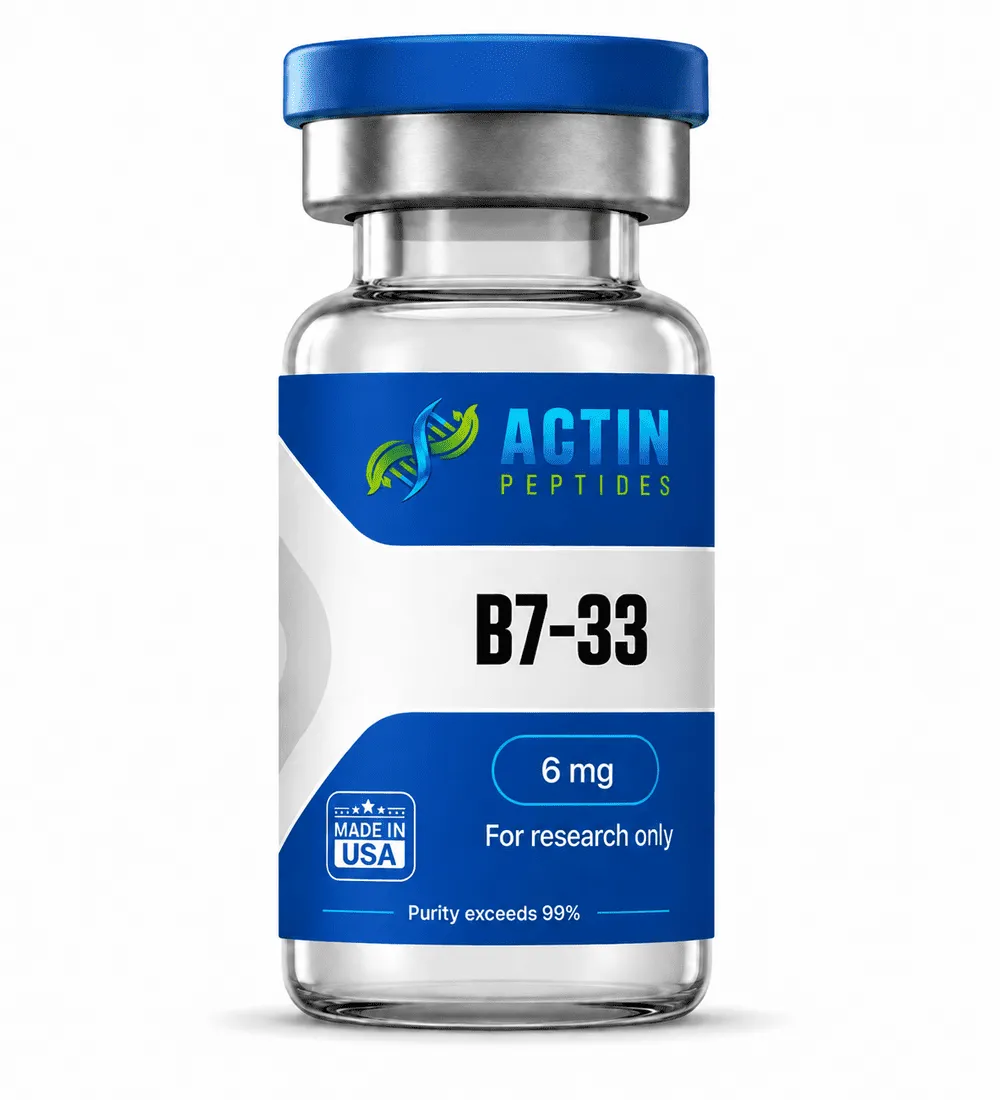
B7-33 is a synthetic peptide engineered from the naturally occurring hormone relaxin-2 (H2-relaxin). Scientists developed this peptide to replicate selected biological activities of relaxin while reducing activation of signaling pathways associated with unwanted cellular responses. As a result, B7-33 has become an important subject in peptide research involving tissue remodeling, extracellular matrix regulation, vascular biology, and cellular signaling.
Researchers have extensively investigated B7-33 for its interaction with Relaxin Family Peptide Receptor 1 (RXFP1), its influence on matrix metalloproteinases, and its potential role in regulating fibrosis-related pathways. Consequently, B7-33 research continues to expand across cardiovascular, musculoskeletal, and regenerative science fields.
For researchers seeking advanced relaxin analogs, B7-33 peptide represents a unique tool for investigating targeted RXFP1 signaling without fully reproducing all biological actions associated with native relaxin.
What Is B7-33?
B7-33 is a synthetic single-chain relaxin analog derived from the B-chain region of human H2-relaxin.
Unlike full-length relaxin, B7-33 was specifically engineered to maintain RXFP1 receptor activity while favoring extracellular signal-regulated kinase (ERK) signaling over cyclic adenosine monophosphate (cAMP) signaling.
Quick Answer
What is B7-33?
B7-33 is a synthetic relaxin-derived peptide studied for its interaction with RXFP1 receptors and its potential role in tissue remodeling, fibrosis research, vascular biology, and extracellular matrix regulation.
Overview of B7-33 Peptide
Researchers developed B7-33 after earlier relaxin analogs demonstrated poor solubility and limited biological activity.
Through structural modifications to the relaxin B-chain and C-terminal region, scientists created a stable and soluble peptide capable of selectively activating RXFP1 receptors.
Current B7-33 studies focus on:
- Fibrosis-related cellular signaling
- Tissue remodeling
- Extracellular matrix regulation
- Matrix metalloproteinase activity
- Endothelial function
- Vascular protection research
- Cellular regeneration pathways
- Growth factor signaling
Because of its selective signaling profile, B7-33 has attracted attention as a next-generation relaxin analog for mechanistic research.
How Does B7-33 Work?
B7-33 primarily works by binding to RXFP1 receptors and activating downstream ERK signaling pathways involved in tissue remodeling and extracellular matrix regulation.
Quick Answer
How does B7-33 work?
B7-33 binds to RXFP1 receptors and preferentially activates ERK signaling pathways. This activity may influence matrix metalloproteinases, extracellular matrix turnover, cellular communication, and tissue remodeling processes.
Mechanism of Action
RXFP1 Receptor Activation
Relaxin Family Peptide Receptor 1 (RXFP1) serves as the primary cellular target of B7-33.
Scientists have investigated RXFP1 because it regulates:
- Cellular signaling
- Extracellular matrix turnover
- Tissue remodeling
- Vascular function
- Growth factor activity
After binding to RXFP1, B7-33 initiates intracellular signaling cascades that differ from those triggered by full-length H2-relaxin.
ERK Signaling Pathway
One of the most unique aspects of the B7-33 mechanism is its preference for ERK signaling.
ERK (Extracellular Signal-Regulated Kinase) belongs to the MAPK signaling family and participates in:
- Cellular differentiation
- Cell survival
- Tissue remodeling
- Gene expression regulation
Research suggests that B7-33 activates phosphorylated ERK (pERK), which may contribute to extracellular matrix regulation while limiting excessive cAMP pathway stimulation.
Matrix Metalloproteinase Regulation
Studies indicate that B7-33 may increase Matrix Metalloproteinase-2 (MMP-2) activity.
MMP-2 is an enzyme involved in:
- Extracellular matrix remodeling
- Collagen turnover
- Tissue repair processes
- Structural protein degradation
Scientists continue investigating how this mechanism may influence fibrosis-related cellular environments.
Growth Factor and Endothelial Signaling
Research suggests that B7-33 may influence signaling pathways associated with:
- Vascular Endothelial Growth Factor (VEGF)
- Endothelial cell communication
- Angiogenesis research
- Tissue remodeling
These mechanisms remain active areas of investigation within cardiovascular and regenerative biology.
Chemical Makeup
| Property | Value |
|---|---|
| Peptide Name | B7-33 |
| Molecular Formula | C131H228N40O37S |
| Molecular Weight | 2987.75 g/mol |
| Alternate Names | (B7-33)H2, GTPL9321 |
| Peptide Class | Relaxin Analog |
| Primary Target | RXFP1 Receptor |
Research and Clinical Studies
B7-33 Peptide and Vascular Biology Research
Study Objective
Researchers investigated whether B7-33 could replicate selected vascular activities associated with H2-relaxin.
Methodology
Experimental models received either B7-33, H2-relaxin, or control compounds before vascular function assessments.
Findings
Studies indicated that B7-33 may enhance endothelial-dependent relaxation within specific vascular tissues.
Researchers also observed activity associated with endothelial-derived hyperpolarization pathways.
Scientific Significance
These findings support continued investigation into RXFP1-mediated vascular signaling and endothelial biology.
B7-33 Peptide and VEGF Signaling Research
Study Objective
Scientists investigated the influence of B7-33 on growth factor signaling pathways.
Methodology
Researchers exposed cytotrophoblast cell cultures to B7-33 and measured cellular responses associated with vascular signaling.
Findings
Studies indicated increased VEGF expression following B7-33 exposure.
VEGF plays a critical role in:
- Angiogenesis
- Endothelial cell communication
- Vascular development
- Tissue oxygen delivery
Scientific Significance
These findings suggest that B7-33 may provide researchers with a valuable model for studying VEGF-related signaling mechanisms.
B7-33 Peptide and Fibrosis Research
Study Objective
Scientists evaluated whether B7-33 could support antifibrotic signaling without strongly activating cAMP pathways.
Methodology
Researchers administered B7-33 in experimental models involving fibrosis-related tissue remodeling.
Findings
Research suggests that B7-33 may influence extracellular matrix turnover through ERK-mediated pathways and matrix metalloproteinase activity.
Investigators reported reductions in fibrosis-associated tissue changes in several experimental settings.
Scientific Significance
These findings position B7-33 as an important research compound for investigating tissue remodeling and extracellular matrix biology.
B7-33 Peptide and Cardiac Tissue Remodeling
Study Objective
Researchers explored the peptide’s effects on cardiac extracellular matrix dynamics.
Methodology
Experimental models received B7-33 following induced cardiac tissue injury.
Findings
Studies indicated modulation of fibrosis-associated pathways and extracellular matrix remodeling markers.
Scientific Significance
The data supports ongoing research into selective RXFP1 activation and tissue remodeling biology.
B7-33 Peptide as a Biomaterial Coating
Study Objective
Scientists investigated whether B7-33 could improve tissue responses to implanted medical devices.
Methodology
Researchers incorporated the peptide into implant coatings and evaluated surrounding tissue responses.
Findings
Studies reported reduced fibrotic tissue accumulation around implanted materials.
Scientific Significance
This research highlights potential applications of RXFP1 signaling in biomaterial and regenerative medicine studies.
Related Peptide Research
Researchers interested in tissue remodeling, extracellular matrix biology, and regenerative signaling frequently explore complementary compounds, including:
- GHK-Cu for extracellular matrix and collagen research
- Matrixyl for skin matrix studies
- SYN-COLL (Palmitoyl Tripeptide-5) for collagen signaling research
- BPC-157 for tissue repair investigations
- TB-500 for cellular migration and regeneration studies
- Humanin for mitochondrial function research
- FOXO4-DRI for cellular senescence studies
What Is B7-33 Researched For?
Scientists have studied B7-33 for:
- RXFP1 receptor signaling
- Tissue remodeling
- Extracellular matrix regulation
- Fibrosis-related pathways
- Angiogenesis research
- Growth factor signaling
- Endothelial biology
- Vascular function
- Regenerative science
What Makes B7-33 Unique?
B7-33 differs from full-length H2-relaxin because it preferentially activates ERK signaling pathways while maintaining RXFP1 receptor activity.
This selective signaling profile allows researchers to investigate tissue remodeling mechanisms with reduced reliance on cAMP-mediated signaling.
Conclusion
B7-33 represents a significant advancement in relaxin-based peptide research. Through selective RXFP1 receptor activation and ERK pathway signaling, the peptide has become an important tool for investigating tissue remodeling, extracellular matrix regulation, angiogenesis, endothelial biology, and fibrosis-related mechanisms.
Current B7-33 studies continue to expand scientific understanding of relaxin signaling while supporting research into regenerative biology and cellular communication pathways.
Researchers seeking to buy B7-33, explore B7-33 peptide for sale options, or conduct advanced B7-33 research can utilize this compound as part of broader investigations into tissue remodeling and RXFP1-mediated signaling networks.
FAQ
What is B7-33 peptide?
B7-33 is a synthetic relaxin-derived peptide designed to activate RXFP1 receptors and support research into tissue remodeling, extracellular matrix regulation, and fibrosis-related pathways.
How does B7-33 work?
B7-33 binds to RXFP1 receptors and primarily activates ERK signaling pathways, which may influence matrix metalloproteinases and tissue remodeling processes.
What is B7-33 researched for?
Researchers study B7-33 for fibrosis research, extracellular matrix regulation, vascular biology, angiogenesis, endothelial signaling, and regenerative science applications.
Is B7-33 the same as relaxin?
No. B7-33 is a synthetic analog derived from relaxin that selectively activates certain signaling pathways while differing structurally from full-length H2-relaxin.
Where can researchers buy B7-33?
Researchers seeking B7-33 peptide for sale should purchase only from reputable peptide suppliers that provide research-grade materials and analytical documentation.
Research Disclaimer
B7-33 peptide is available strictly for research and laboratory purposes only. It is not approved for human consumption, therapeutic use, or diagnostic applications. Please review our Terms and Conditions before placing an order.



 English
Reviews
There are no reviews yet.