
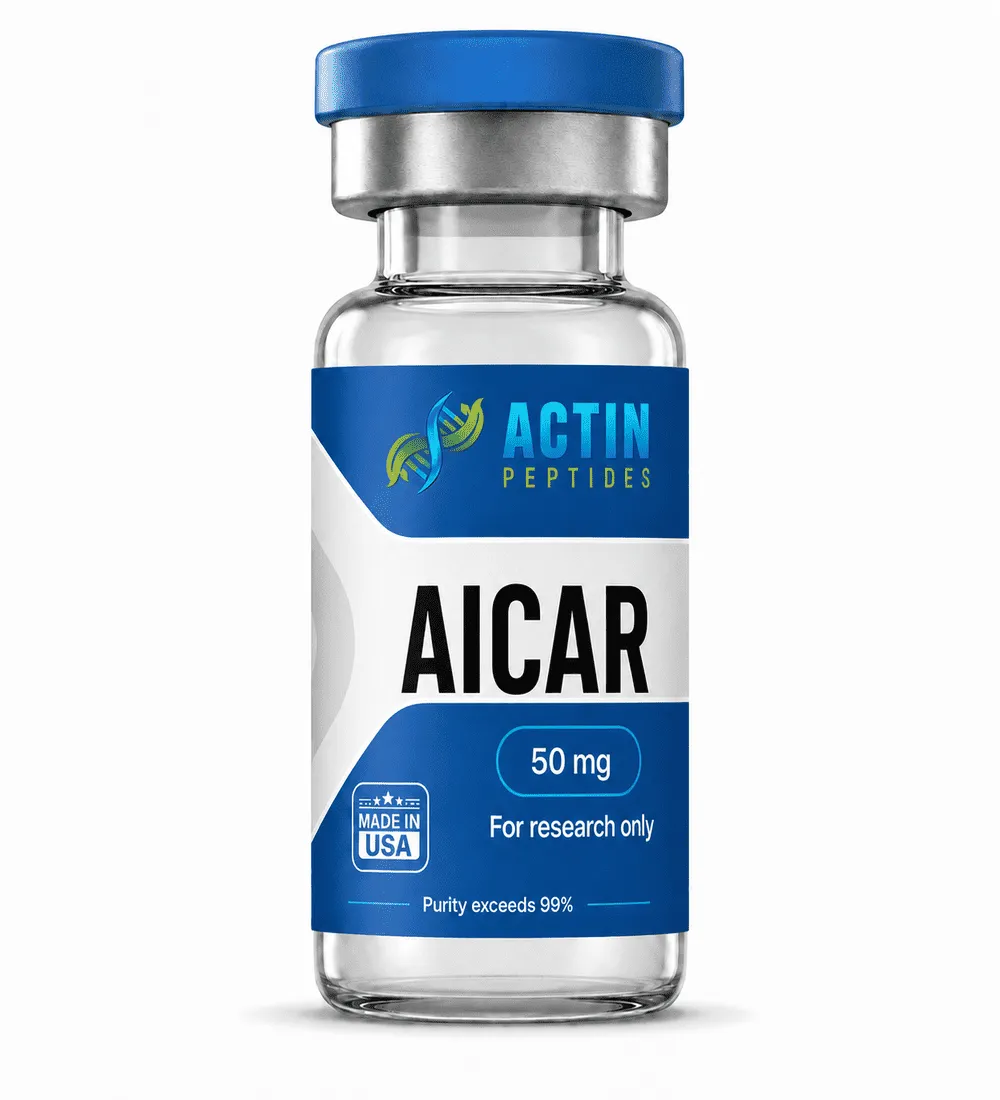
Description
AICAR Peptide Research Overview: AMPK Activation and Cellular Energy Metabolism
Introduction
AICAR peptide is a research compound that scientists have extensively investigated for its effects on cellular energy metabolism, mitochondrial function, and metabolic signaling. As an analog of adenosine monophosphate (AMP), AICAR plays an important role in peptide research because it activates AMP-activated protein kinase (AMPK), one of the body’s primary energy-sensing enzymes.
Research suggests that AICAR may influence glucose metabolism, fatty acid oxidation, mitochondrial biogenesis, cellular stress responses, and endurance-related adaptations. Consequently, researchers continue to study AICAR for its potential applications in metabolism research, tissue protection, exercise physiology, and cellular energy regulation.
For researchers exploring other metabolism-focused compounds, related products include MOTS-C, AOD-9604, and Fragment 176-191.
What Is AICAR?
AICAR is a synthetic analog of AMP that researchers use to activate AMP-activated protein kinase (AMPK) inside cells.
Studies indicate that AMPK serves as a central regulator of energy balance by increasing energy-producing pathways while reducing energy-consuming cellular activities. Because of this mechanism, scientists have studied AICAR for metabolism research, endurance adaptation, mitochondrial function, glucose regulation, and cellular stress responses.
What Is AICAR Researched For?
Researchers have studied AICAR for:
- Cellular energy metabolism
- AMPK activation
- Mitochondrial biogenesis
- Glucose transport
- Fatty acid oxidation
- Endurance adaptation
- Tissue protection during metabolic stress
- Cellular signaling pathways
- Inflammation research
- Autophagy and cellular maintenance
What Makes AICAR Unique?
Unlike many research compounds, AICAR directly activates AMPK, a master regulator of cellular energy homeostasis. This unique mechanism allows researchers to investigate multiple biological pathways simultaneously, including metabolism, mitochondrial function, autophagy, and endurance adaptation.
Overview of AICAR Peptide Research
AICAR has become one of the most widely studied AMPK activators in peptide research. Scientists have investigated its potential role in regulating cellular energy production and adaptation to metabolic stress.
When cellular energy levels decline, AMPK becomes activated to restore balance. AICAR appears to mimic this natural response by increasing intracellular concentrations of ZMP, an AMP-like molecule capable of activating AMPK signaling pathways.
As a result, researchers have explored AICAR in studies involving:
- Metabolic flexibility
- Cellular energy production
- Mitochondrial function
- Endurance performance
- Glucose utilization
- Fat metabolism
- Cellular adaptation to stress
Researchers often compare AICAR with metabolic research compounds such as MOTS-C because both compounds influence cellular energy pathways and mitochondrial activity.
How Does AICAR Work?
AMPK Activation
AICAR primarily works by activating AMP-activated protein kinase (AMPK).
AMPK functions as a cellular energy sensor. When activated, it promotes energy-producing pathways while simultaneously reducing energy-consuming processes.
Research suggests that AMPK activation may:
- Increase glucose uptake
- Enhance fatty acid oxidation
- Support mitochondrial biogenesis
- Promote autophagy
- Improve cellular energy efficiency
- Influence inflammation-related signaling pathways
Consequently, AICAR has become a valuable research tool for studying metabolic regulation.
Cellular Energy Regulation
Studies indicate that AICAR may increase cellular ATP availability by encouraging cells to use glucose and fatty acids more efficiently.
Furthermore, AMPK activation appears to suppress several anabolic pathways that consume significant amounts of energy, allowing cells to adapt to metabolic stress more effectively.
Mitochondrial Function and Biogenesis
Researchers have investigated AICAR for its effects on mitochondrial function.
Mitochondria produce most of the energy used by cells. Studies suggest that activation of the AMPK-PPARδ pathway may stimulate mitochondrial biogenesis, potentially increasing both mitochondrial number and efficiency.
This mechanism has attracted significant attention in endurance and exercise adaptation research.
Glucose Transport and Metabolic Signaling
Research suggests that AICAR may increase glucose transport into skeletal muscle by influencing glucose transporter proteins and AMPK signaling.
Scientists have also investigated interactions between:
- AMPK
- GLUT transporters
- ERK1/2 signaling pathways
- Fatty acid metabolism enzymes
- Cellular stress-response mechanisms
These interactions make AICAR a valuable compound for studying whole-body energy regulation.
Chemical Makeup
| Property | Details |
|---|---|
| Peptide Name | AICAR |
| Molecular Formula | C9H15N4O8P |
| Molecular Weight | 338.21 g/mol |
| Alternative Name | AICA Ribonucleotide |
| Compound Type | AMP Analog |
| Primary Biological Target | AMP-Activated Protein Kinase (AMPK) |
Research and Clinical Studies
AICAR and Tissue Protection Research
Study Objective
Scientists investigated whether AMPK activation may support cellular resilience during periods of metabolic stress and reduced oxygen availability.
Methodology
Researchers analyzed multiple cardiovascular and metabolic studies involving AICAR administration and AMPK activation.
Findings
Studies indicate that AICAR may influence:
- Cellular energy availability
- Glucose utilization
- Glycogen breakdown
- Metabolic adaptation during stress
Researchers also observed potential changes in myocardial glucose metabolism and energy production pathways.
Scientific Significance
These findings highlight the importance of AMPK as a central regulator of cellular survival and metabolic adaptation under challenging conditions.
AICAR and Liver Metabolism Research
Study Objective
Researchers examined how AMPK activation influences lipid metabolism and cellular energy regulation within liver tissues.
Methodology
Scientists evaluated metabolic markers associated with lipid synthesis and fatty acid metabolism.
Findings
Research suggests that AICAR may:
- Influence fatty acid metabolism
- Reduce lipid synthesis signaling
- Support fatty acid oxidation pathways
- Alter metabolic gene expression
Scientific Significance
These observations strengthen the understanding of AMPK as a master regulator of metabolic homeostasis.
For broader metabolism-focused peptide research, investigators often compare AICAR with AOD-9604, Adipotide FTPP, and Fragment 176-191.
AICAR and Insulin Sensitivity Research
Study Objective
Scientists investigated whether AMPK activation may influence glucose transport and insulin responsiveness.
Methodology
Researchers evaluated skeletal muscle tissue responses following exposure to AICAR.
Findings
Studies indicate that AICAR may:
- Increase glucose transport
- Influence GLUT protein expression
- Enhance glucose utilization
- Promote metabolic flexibility
Researchers also observed signaling changes involving extracellular signal-regulated kinases (ERK1/2).
Scientific Significance
These findings support ongoing investigations into the relationship between AMPK activation and cellular glucose metabolism.
AICAR and Endurance Adaptation Research
Study Objective
Researchers explored whether AICAR influences pathways associated with endurance and exercise adaptation.
Methodology
Scientists evaluated mitochondrial markers, metabolic gene expression, and endurance-related outcomes in preclinical models.
Findings
Research suggests that AICAR may:
- Activate the AMPK-PPARδ pathway
- Promote mitochondrial biogenesis
- Enhance oxidative metabolism
- Influence endurance-related adaptations
Additionally, studies indicate that AICAR may increase blood flow through nitric oxide-related mechanisms.
Scientific Significance
These findings have positioned AICAR as one of the most studied compounds in endurance and exercise physiology research.
Researchers interested in muscle performance pathways often review related compounds including IGF-1 LR3, MGF, ACE-031, and Follistatin 344.
AICAR and Cellular Apoptosis Research
Study Objective
Scientists investigated how AICAR influences cellular signaling pathways involved in apoptosis and energy regulation.
Methodology
Researchers examined intracellular AMPK activation, ZMP accumulation, and apoptosis-related signaling proteins.
Findings
Studies indicate that AICAR may:
- Activate AMPK signaling
- Increase intracellular ZMP levels
- Influence caspase activation pathways
- Affect cellular energy regulation mechanisms
Scientific Significance
These observations provide valuable insight into the relationship between metabolism, cellular signaling, and programmed cell responses.
Frequently Asked Questions
What is AICAR peptide?
AICAR is an AMP analog that activates AMP-activated protein kinase (AMPK). Researchers use it to study cellular energy metabolism, mitochondrial function, glucose regulation, and endurance-related adaptations.
How does AICAR work?
AICAR increases intracellular ZMP levels, which activate AMPK. This activation influences glucose uptake, fatty acid oxidation, mitochondrial biogenesis, and cellular energy regulation.
What is AICAR researched for?
Scientists have studied AICAR for metabolism research, mitochondrial function, endurance adaptation, glucose transport, cellular signaling, inflammation pathways, and energy homeostasis.
What makes AICAR unique?
AICAR directly activates AMPK, a master regulator of cellular energy balance. This mechanism allows researchers to investigate multiple interconnected metabolic pathways simultaneously.
Is AICAR being researched alongside other metabolic peptides?
Yes. Researchers frequently evaluate AICAR alongside compounds such as MOTS-C, Humanin, Epithalon, and FOXO4-DRI when studying cellular longevity, metabolism, and mitochondrial biology.
Conclusion
AICAR remains one of the most extensively studied AMPK activators in peptide research. Scientists have investigated its influence on glucose metabolism, mitochondrial function, cellular energy regulation, endurance adaptation, and metabolic signaling pathways.
Research suggests that its ability to activate AMPK makes it a valuable tool for studying how cells respond to metabolic stress, regulate energy production, and adapt to changing physiological demands. As interest in metabolic health, mitochondrial biology, and cellular signaling continues to grow, AICAR research remains an important area of scientific investigation.
Research Disclaimer
AICAR peptide is available strictly for research and laboratory purposes only. It is not approved for human consumption, therapeutic use, or diagnostic applications. Please review our Terms and Conditions before placing an order.
 English
Reviews
There are no reviews yet.